

Trench coats carry a rare kind of authority in fashion. They are practical enough for a rainy commute, polished enough for a client meeting, and romantic enough for a weekend in the city. Few garments manage that range. A well-made trench can be thrown over a suit, a knit dress, or jeans and a t-shirt, and in each case it looks deliberate rather than accidental. That versatility explains why the style has survived more than a century of shifting trends while so many other outerwear shapes have come and gone.
Choosing the right one, however, takes more thought than most shoppers realise. The details that define a quality trench, from the tightness of the weave to the placement of the storm flap, all affect how it performs and how it looks. This guide walks through the history, the construction, the fit principles, and the styling formulas that make a trench coat one of the most dependable investments in any wardrobe.
What Makes a Coat a Trench Coat
A trench coat is a long, belted overcoat traditionally made from water-resistant cotton gabardine, featuring distinctive design elements such as a double-breasted front, wide lapels, epaulettes, storm flaps, and a deep back vent. The belt, often with a metal buckle, is a defining feature, as is the length, which typically falls between mid-thigh and below the knee. What separates a genuine trench from a generic belted coat is the combination of these functional details rather than any single element.
The origins of those details are rooted in military utility. Thomas Burberry developed gabardine in the late nineteenth century, a tightly woven cotton fabric that repelled water while remaining breathable, and the British War Office commissioned a version for officers during the First World War. The epaulettes originally held rank insignia or equipment straps, the storm flap at the chest protected the wearer from wind and rain, and the D-rings on the belt were designed to hold grenades or map cases. Today those features serve aesthetics and brand identity more than function, but they remain the visual shorthand that makes a trench instantly recognisable.
The transition from battlefield to boulevard happened quickly once the war ended, accelerated by Hollywood. Humphrey Bogart in Casablanca and Audrey Hepburn in Breakfast at Tiffany’s cemented the coat’s association with mystery, romance, and quiet sophistication. That cultural weight is part of why the style still feels significant to wear. It carries a story, and the best versions honour that heritage rather than merely borrowing the silhouette.
The Cultural Legacy and Enduring Appeal of the Style
The trench coat occupies a strange and enviable position in fashion history. It is both utilitarian and glamorous, associated with detectives, spies, and film stars as much as with commuters caught in a downpour. That duality gives it a flexibility few garments possess. It can be read as practical, mysterious, elegant, or rebellious depending on how it is styled and who is wearing it.
The appeal has proven remarkably durable because the design is fundamentally well resolved. A belted waist flatters most body shapes. A long line elongates the frame. A neutral palette, typically in beige, khaki, black, or navy, works with almost everything underneath. Even the double-breasted front, which some find intimidating, creates structure and definition across the torso. These are functional solutions to real problems, and functional solutions tend to endure.
There is also something to be said for the way the coat fits into modern life. It performs in weather that cannot decide what it is doing, which describes a surprising proportion of the year in many climates. It layers comfortably over knitwear in cool spring and autumn conditions, and a lightweight version can be worn over summer evening outfits. This adaptability means a good trench earns its place in the wardrobe through sheer frequency of use, which is the real measure of value in clothing.
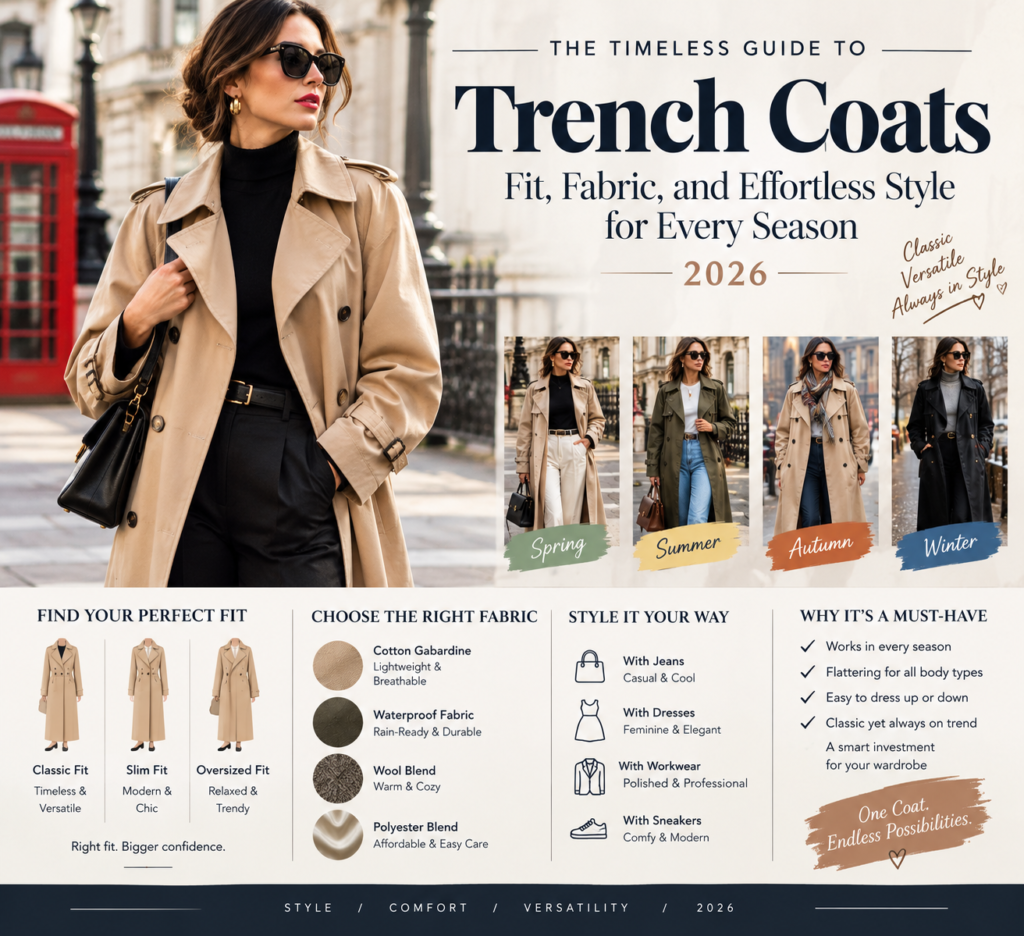
Materials That Define Quality and Performance
The classic trench material is cotton gabardine, a tightly woven twill with a high thread count that resists water penetration through density rather than chemical coating. A genuinely good gabardine feels dense and slightly stiff when new, with a smooth surface and a subtle diagonal texture. It softens with wear and, importantly, continues to repel light rain because the weave itself does the work. This is a meaningful advantage over coatings, which wear off over time and leave the fabric vulnerable.
Modern trenches appear in a wide range of materials. Cotton-poplin blends offer a lighter, crisper feel at a lower cost, though they are less water-resistant. Technical fabrics such as polyester-cotton blends with a water-repellent finish perform well in heavier rain but may lack the classic drape and breathability of natural gabardine. Wool trenches provide warmth for colder months but require dry cleaning and should not be relied on for wet weather. Leather and suede versions exist as statement pieces, offering protection from wind and a very different aesthetic at a considerably higher price and weight.
Lining matters as much as the outer fabric. A full lining in viscose, cupro, or satin makes the coat easier to put on and take off, prevents the outer fabric from clinging, and adds structure. An unlined trench is lighter and more breathable, which suits warmer climates, but it can feel less substantial and may show interior seams. Checking the seams, the stitching density, and the finish of the hem and cuffs reveals a great deal about overall construction quality. Dense, even stitching and clean seam finishes are the marks of a coat built to last.
Trench Coat Fabric and Feature Reference
| Element | Traditional Standard | Modern Variation | What It Means for the Wearer |
|---|---|---|---|
| Outer fabric | Cotton gabardine | Cotton blends, technical synthetics, wool, leather | Natural gabardine offers best breathability and classic drape |
| Water resistance | Achieved through tight weave | Chemical coating or membrane | Woven resistance lasts; coatings degrade with cleaning |
| Lining | Viscose or cupro | Satin, polyester, removable quilted | Full lining improves drape and ease of wear |
| Closure | Double-breasted, horn or metal buttons | Single-breasted, zip, snap | Double-breasted offers more coverage and structure |
| Belt | Cotton webbing with metal buckle | Self-fabric, leather, removable | Removable belts increase styling flexibility |
| Length | Mid-calf | Cropped, mid-thigh, ankle-length | Shorter lengths suit petite frames; longer lengths add drama |
| Storm flap | Front and back | Front only, decorative | Functional in wind and rain; adds visual detail |
| Vent | Deep single back vent | Double vent, no vent | Single vent improves movement and drape |
How to Find the Right Fit and Length
Fit is where most trench coat purchases succeed or fail, and the challenge is that the coat must work over layers. A trench worn only over a t-shirt can fit more closely, while one intended to go over a suit or heavy knit needs additional room through the shoulders and chest. The reliable test is to try the coat on over the thickest garment you expect to wear underneath. If the shoulders pull or the sleeves ride up, the coat is too small, regardless of what the label says.
Shoulder placement is the most important measurement. The shoulder seam should sit at or just beyond the natural shoulder point, never pulling inward or sliding down the arm. Sleeves should reach the wrist bone or slightly beyond, allowing a centimetre or two of shirt cuff to show if that is the look you want. The belt should cinch at the natural waist rather than sitting high under the ribs, which distorts the line of the coat, or low on the hips, which lengthens the torso and shortens the legs.
Length changes the entire character of the garment. A cropped trench ending at the hip feels modern and casual and works well with high-waisted trousers or dresses. A mid-thigh length is the most versatile, offering coverage without overwhelming the frame, and it suits most heights. A knee-length or mid-calf trench is the most dramatic and the most traditional, creating a long vertical line that flatters taller frames particularly well. Petite wearers often find that a mid-thigh or just-above-knee length preserves proportion better than a full-length coat, though a well-fitted long trench worn with heels can work beautifully. The hem should ideally land at a narrowing point of the leg rather than at the widest part of the calf.
Styling a Trench Coat for Work and Formal Settings
The trench coat is one of the few pieces of outerwear that genuinely belongs in a professional wardrobe. Worn open over a tailored suit, it reads as considered and authoritative. Belted over a midi dress and heels, it becomes an elegant alternative to a blazer. The neutral palette that defines most trenches is precisely what makes this possible, since beige, navy, black, and stone sit comfortably alongside almost any colour scheme without competing.
For office settings, the details matter. A crisp, structured trench in a darker neutral, such as navy or charcoal, feels more formal than a soft, slouchy version in pale beige. Wearing the belt fastened creates a defined silhouette that reads as polished, while leaving it open and loose feels more relaxed. Sleeve length should be precise, and the coat should be clean and well pressed. A trench that looks rumpled undermines the effect, so fabric choice matters here as well. Gabardine holds a press well, while softer blends crease more readily.
For evening and formal occasions, the trench can function as a dramatic finish to an outfit rather than a purely functional layer. Worn over a slip dress and heels, belted at the waist, it creates a striking contrast between structured outerwear and fluid underneath. A black trench over an all-black outfit reads as sleek and modern, while a classic beige over a jewel-toned dress creates a deliberate focal point. The key in formal contexts is to treat the coat as part of the outfit rather than something to be removed and forgotten at the door.
Styling a Trench Coat for Casual and Weekend Wear
The casual side of the trench is where it earns its reputation for versatility. Thrown over jeans, a white t-shirt, and sneakers, it instantly elevates an outfit that would otherwise be entirely ordinary. This is the trench’s quiet magic. It does the work of several accessories at once, adding structure, length, and polish without any visible effort. The same coat worn over leggings and a hoodie on a school run looks intentional rather than thrown together.
Layering underneath changes the coat’s character considerably. A chunky knit and scarf beneath an open trench creates a cosy, autumnal look. A denim jacket worn under an oversized trench adds texture and a layered silhouette that works particularly well in transitional weather. A cropped trench over high-waisted wide-leg trousers plays with proportion, keeping the top half compact while the bottom half flows. Footwear sets the tone as well. Chunky boots lend a utilitarian edge, loafers add a preppy touch, and trainers keep things relaxed and modern.
Colour choices beyond the classic beige open up different moods. An olive or khaki trench feels more casual and outdoorsy. A black trench is sharper and more urban. A pastel or cream version feels lighter and suits spring. A bold colour, such as burgundy or forest green, turns the coat into a statement piece that anchors an otherwise neutral outfit. There is no wrong answer here, only the question of what the coat needs to do in your wardrobe. If it is your only trench, a neutral is the safest and most useful choice. If it is a second or third, colour becomes a genuine pleasure.
Solving Common Trench Coat Problems
Even a well-chosen trench can present difficulties, and most of them have practical solutions. The most common complaint is that the coat feels too stiff when new, particularly in heavier gabardine. This is normal and temporary. The fabric softens with wear and with the movement of the body. Wearing it regularly accelerates the process, and a gentle steam can help relax the fibres without damaging the weave. Avoid machine washing a structured trench, since this can distort the shape and strip the water resistance.
Water resistance is another frequent concern. A gabardine trench repels light rain effectively, but sustained heavy rain will eventually penetrate the fabric. Reproofing sprays can restore and enhance water repellency, and they are worth applying once or twice a season to a coat in regular use. The spray should be applied to a clean, dry coat in a well-ventilated area and allowed to cure fully before wearing. For heavier protection, a technical shell worn underneath the trench handles the worst of the weather while the coat handles the style.
Sizing issues are also common, particularly for taller or shorter wearers who find standard lengths awkward. Sleeve length can be adjusted by a tailor, as can overall length, though shortening a trench alters its proportions and should be done thoughtfully. Petite wearers may find that having a long trench hemmed to mid-thigh transforms an overwhelming coat into a flattering one. For those between sizes, sizing up and having the waist taken in is usually more successful than sizing down and hoping the shoulders stretch. Replacing the belt with a leather one in a contrasting tone is also a simple way to personalise a coat and fix a flimsy original.
Care, Storage, and Longevity
A trench coat is an investment, and how it is cared for determines whether it lasts three seasons or fifteen. Most cotton gabardine trenches should be dry cleaned rather than machine washed, since water and agitation can shrink the fabric, distort the shape, and compromise the water-repellent weave. Dry cleaning should be done sparingly, perhaps once or twice a year, because the solvents can also strip the fabric over time. Between cleanings, spot treatment with a damp cloth handles small marks. Grease stains should be treated with a specialised product rather than rubbed, which spreads the mark and damages the fibres.
Storage matters as much as cleaning. A trench should be hung on a sturdy, wide-shouldered hanger that supports the shape of the coat rather than a thin wire hanger that distorts the shoulders. A breathable cotton garment bag protects the coat from dust and light without trapping moisture, which is important because gabardine needs to breathe. Storing a damp coat in a sealed bag is a recipe for mildew. The coat should be completely dry before it goes into storage, and it should be kept away from direct sunlight, which fades natural fibres over time.
Buttons, buckles, and belts are the details most likely to need attention over the life of the coat. Loose buttons should be reattached promptly, and it is worth keeping a small supply of matching buttons if the originals are distinctive. Belt buckles can tarnish, and a gentle polish restores them. If the belt itself wears out before the coat does, which is common with fabric belts, a replacement leather belt in a complementary tone is an easy upgrade. These small interventions keep the coat looking sharp and extend its useful life considerably.
Frequently Asked Questions About Trench Coats
Are trench coats still in style?
Yes, and the style has proven remarkably resistant to trend cycles. The trench coat has remained a wardrobe staple for over a century because its design solves real problems, offering weather protection, a flattering belted waist, and a long vertical line that suits most body shapes. It appears in designer collections and high street ranges every year in some form, and its neutral palette means it rarely dates. Rather than following seasonal trends, the coat has become a permanent fixture that adapts to whatever is worn underneath it.
What is the best colour for a first trench coat?
A classic beige or honey tone is the most versatile starting point and the colour most associated with the traditional trench coat. It pairs well with almost everything, from black and navy to pastels and prints, and it reads as timeless rather than trend-driven. For those who find beige difficult to wear against their skin tone, navy, charcoal, or stone offer similar neutrality with a slightly different mood. Black is a popular alternative and feels sharper and more urban, though it loses some of the coat’s traditional character.
How should a trench coat fit over a suit?
A trench worn over a suit needs additional room through the shoulders, chest, and upper arms so the jacket underneath does not bunch or restrict movement. The shoulder seam should still sit at the natural shoulder point rather than pulling inward. Sleeves should be long enough to cover the suit jacket’s cuffs or allow a centimetre of cuff to show. The belt should fasten comfortably at the natural waist without compressing the suit jacket beneath. Trying the coat on over the actual suit, rather than a t-shirt, is the only reliable way to assess this fit.
Can a trench coat be worn in heavy rain?
A traditional cotton gabardine trench repels light to moderate rain effectively because of the tightness of its weave, but sustained heavy rain will eventually soak through. For heavy downpours, a technical waterproof shell is more reliable. That said, a trench can be treated with a reproofing spray to improve its water resistance, and it performs better in wind than many lighter jackets because of its weight and coverage. The storm flap and deep back vent, originally designed for weather protection, still add practical benefit.
How do I stop my trench coat from looking creased?
Creasing depends largely on the fabric. Cotton gabardine holds its shape well and resists creasing better than softer blends or poplin versions. Hanging the coat on a wide-shouldered hanger immediately after wearing allows the fabric to recover its shape naturally. A gentle steam, rather than a direct iron, relaxes creases without flattening the weave or damaging water-repellent finishes. Storing the coat with enough space around it in the wardrobe, rather than cramming it between other garments, also prevents the compression creases that form when fabric is folded or squashed for long periods.
Conclusion
The trench coat has earned its place as one of the most reliable pieces of outerwear a person can own. It performs in unpredictable weather, flatters a wide range of body shapes, and moves seamlessly between professional and casual settings without any adjustment beyond how you style it. The qualities that make a good one are not mysterious. Dense cotton gabardine, clean construction, a well-placed shoulder seam, a belt that sits at the natural waist, and a length that suits your proportions are the factors that separate a coat you wear for a decade from one that lingers unworn.
The broader insight is that the best outerwear does not ask you to change your life to accommodate it. A trench coat fits around what you already do, whether that is commuting, travelling, parenting, or simply walking to the shops in unpredictable weather. It adds polish without effort, protection without bulk, and a sense of occasion to ordinary days. Choose one that fits properly, care for it well, and it will remain one of the most quietly useful things you own, season after season.