
Handbags for women occupy a unique place in fashion. They are practical tools, style statements, and often deeply personal possessions that carry far more than keys and a phone. A bag can complete an outfit, signal professionalism in a meeting, or hold the chaos of daily life together with quiet efficiency. Yet the sheer range available, from a ten-pound canvas tote to a four-figure designer piece, can make choosing feel overwhelming rather than exciting.
The good news is that the principles behind a genuinely good bag are consistent regardless of budget. Construction quality, material durability, strap comfort, and proportional balance matter far more than a logo. Understanding how these elements interact allows anyone to shop with confidence, avoid expensive mistakes, and build a small collection that actually works. This guide covers everything from silhouette selection and leather grades to hardware, care, and the ethical considerations shaping modern purchasing decisions.
What Defines Handbags for Women and How the Category Works
Handbags for women are portable, handled containers designed to carry personal essentials, typically featuring a main compartment, one or more straps, and a closure mechanism such as a zip, flap, magnetic snap, or clasp. The category covers an enormous spectrum, from miniature evening clutches to oversized work totes, and the naming conventions vary so widely between brands that labels are often unreliable guides.
The distinctions between subcategories usually come down to four practical variables rather than names. How the bag is carried determines whether it suits hands-free travel or formal occasions. How it closes affects security and accessibility. How it holds its shape determines whether it looks polished or relaxed. How much it contains dictates whether it works for a commute or an evening out. Focusing on those four factors rather than on whether a bag is technically called a hobo or a shoulder bag produces far better decisions.
The cultural history of these accessories also shapes how they are read. Structured top-handle styles descend from document carriers and luggage, which is why they project formality and authority. Soft slouchy shapes grew from casual, practical use. The crossbody emerged as a hands-free solution for travel and city living. Recognising that lineage helps predict how a bag will be perceived in a given setting, which is genuinely useful when building a wardrobe rather than just buying individual pieces.
The Main Types of Handbags for Women and What Each Does Best
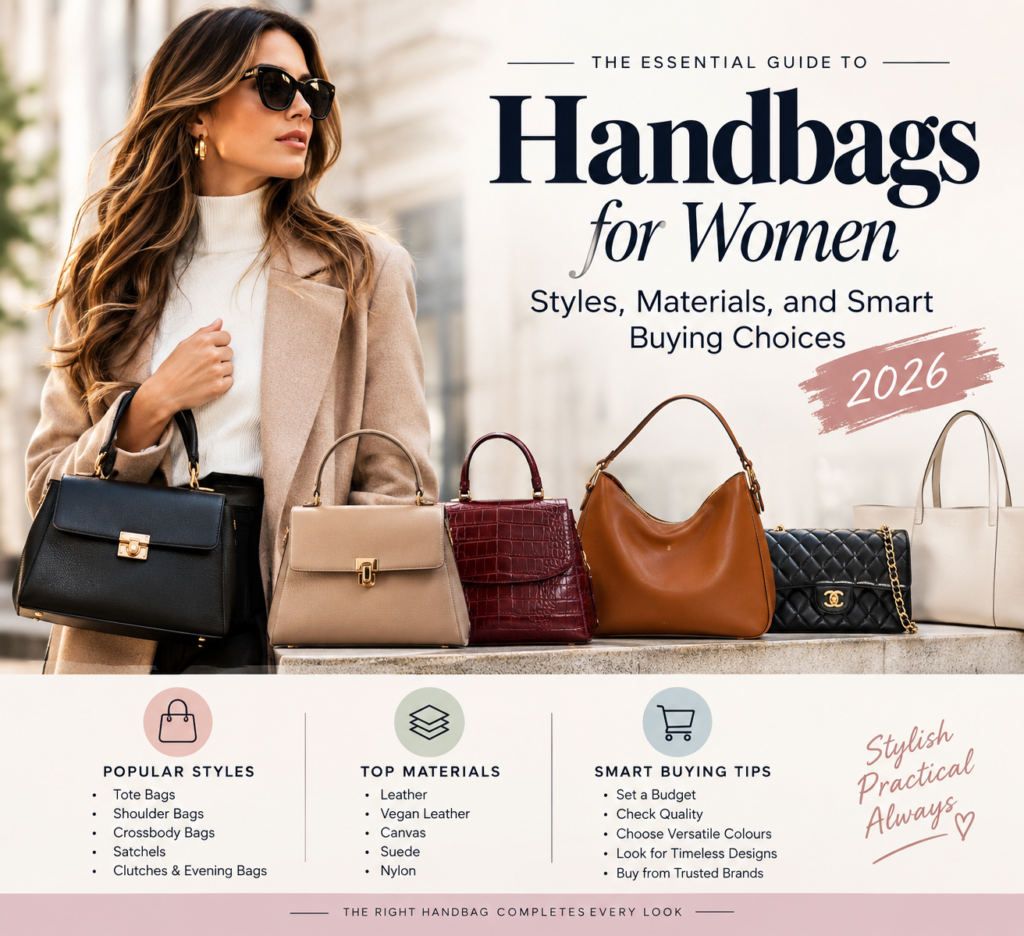
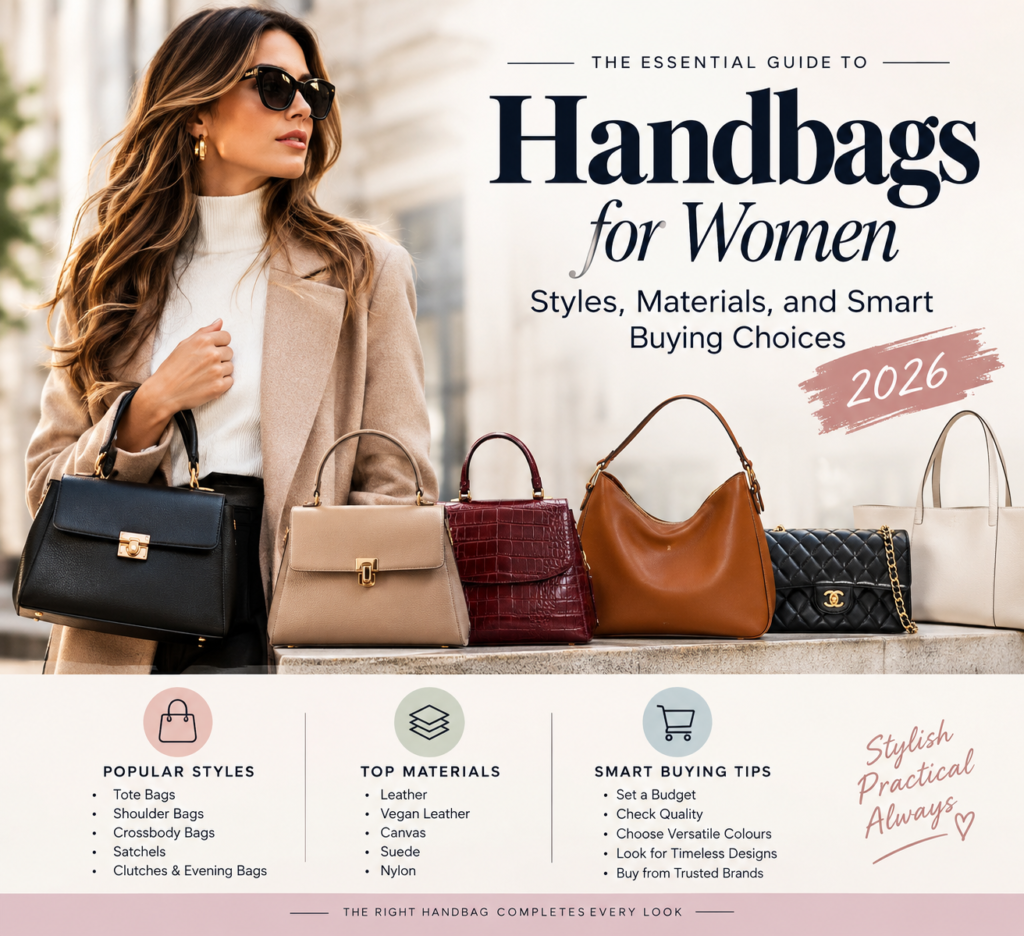
Totes are the workhorses of the category. Defined by an open or zipped top and a wide, deep interior, they swallow a laptop, a water bottle, a notebook, and a packed lunch without strain. That capacity makes them the default for commuters, students, and parents. The trade-offs are weight and security. A large tote loaded with essentials strains one shoulder, and an open top offers little protection in crowded spaces. A zipped tote with a wide, padded strap solves both problems and remains the single most practical everyday choice for most people.
Shoulder bags sit under the arm and offer a middle ground between capacity and portability. Hobos are soft and slouchy with a single strap, while structured shoulder bags hold their shape and read as more formal. Crossbody bags place the strap diagonally across the body, keeping hands free and the bag close to the hip, which is why they dominate travel and weekend use. Clutches are held in the hand and serve almost purely as occasion wear, offering minimal capacity and no strap. Satchels borrow from schoolbags with a flap closure and structured body, suiting anyone who wants a neat, organised look with vintage character.
Bucket bags, drawstring pouches, saddle bags, and baguettes fill out the remaining common shapes. The bucket bag has a cylindrical body and a drawstring closure, offering surprising capacity in a compact footprint. The saddle bag mimics the curve of a riding saddle and works well worn across the body. The baguette, a small rectangular shoulder bag, trades capacity for proportion and looks best when the strap sits high under the arm. Each shape has a natural context in which it performs best, and matching shape to context is the fastest route to a bag that feels right rather than merely attractive on a shelf.
How Materials Determine Whether a Bag Lasts
Material choice is the single biggest predictor of how a bag will look after three years of daily use, and it matters more than brand name for long-term satisfaction. Full-grain leather is the highest grade commonly available, retaining the entire grain of the hide. It develops a patina over time, resists wear, and becomes more characterful with age rather than less. Top-grain leather has the outer layer sanded and corrected, producing a more uniform surface that is less durable. Genuine leather is a broad marketing term that typically signals a lower grade, often split leather with a surface coating, and it tends to peel or crack where full-grain would simply soften.
Beyond leather, the options each carry distinct trade-offs. Vegan leather, usually polyurethane or a plant-based alternative, offers an animal-free option and can look convincing, though lower-quality versions crack and flake within a year or two. Nylon and canvas are lightweight, water-resistant, and easy to clean, which makes them excellent for travel and everyday utility, though they lack the structure of leather. Suede is soft and tactile but vulnerable to water and staining, requiring protective spray and careful storage. Exotic leathers such as crocodile or ostrich offer distinctive texture at high cost and raise significant ethical questions that many buyers now weigh carefully.
Construction details matter as much as the material itself. Stitching should be even, tight, and consistent, with no loose threads or skipped sections. Edges should be finished with edge paint or folded and stitched rather than left raw. Linings should be sewn in rather than glued, and interior seams should be clean because that is where quality control is most often cut. A bag that looks beautiful outside but has a glued-in lining and uneven stitching will not survive heavy use, no matter how good the leather feels in the hand.
Understanding Hardware, Closures, and Functional Design
Hardware is the jewellery of a bag, and its quality is one of the clearest signals of overall craftsmanship. Solid brass and stainless steel are durable and hold their finish, while plated metals can chip or tarnish over time, revealing a dull base layer beneath. Zips are particularly telling. Metal-toothed zips from established makers such as YKK or Riri glide smoothly and resist jamming, whereas cheap plastic zips fail at the worst possible moment. A heavy, well-machined zipper pull is a small detail that consistently correlates with a better-built bag.
Closures shape how a bag functions day to day. Zip closures offer the best security, which matters in cities and on public transport. Flap closures with magnetic snaps are quick to open but less secure. Turn-lock and push-lock clasps look elegant and hold well but can be fiddly when your hands are full. Drawstrings are casual and flexible but allow contents to shift and offer minimal protection from rain. The best choice depends on how you use the bag rather than on which closure looks most refined in a photograph.
Functional design extends to the strap and interior. A strap that is too narrow digs into the shoulder when the bag is loaded, while a wide, padded strap distributes weight comfortably. Adjustable straps are more versatile than fixed ones because they accommodate different body proportions and layers of clothing. Interior organisation matters more than most shoppers expect. A bag with a zipped inner pocket for valuables, a slip pocket for a phone, and a key leash is dramatically easier to live with than one large open cavity, because you spend less time rummaging and less time worrying about your keys.
Handbag Materials and Characteristics at a Glance
| Material | Durability | Appearance and Aging | Best Use Case | Care Requirements |
|---|---|---|---|---|
| Full-grain leather | Excellent, years of daily use | Develops rich patina, improves with age | Investment everyday bags | Condition periodically, keep dry |
| Top-grain leather | Good, moderate wear | Uniform, less characterful, may dull | Mid-range everyday bags | Wipe clean, occasional conditioning |
| Genuine or split leather | Fair, prone to peeling | Coated surface cracks over time | Budget bags, occasional use | Minimal, avoid abrasion |
| Vegan leather (PU) | Fair to good, varies widely | Can flake at stress points | Fashion-led or seasonal bags | Wipe with damp cloth, avoid heat |
| Nylon and canvas | Very good, hard wearing | Fades slightly, holds shape well | Travel, commuting, utility | Machine washable in some cases |
| Suede | Moderate, delicate | Softens and darkens with handling | Occasion and autumn wear | Protect with spray, brush regularly |
| Exotic leathers | Excellent with care | Distinctive texture, high prestige | Investment and collector pieces | Specialist care recommended |
Choosing the Right Size and Proportion for Your Frame
Size is where many bag purchases go wrong, because shoppers tend to buy for the outfit in their head rather than the body in the mirror. Proportion is the governing principle. A very large tote on a petite frame can overwhelm the silhouette, while a tiny crossbody on a taller frame can look lost. The general guideline is that the bag should sit somewhere between the waist and the hip when worn on the shoulder, and its width should not exceed roughly the width of your torso.
Height also influences strap choice. A crossbody strap that sits too low will bounce against the hip and feel awkward, while one that sits too high looks cramped. Adjustable straps allow fine-tuning, and checking the strap drop measurement before buying avoids disappointment. For structured bags, the depth of the bag matters as much as its width, because a deep bag pushes the body outward and can look bulky from the side even when it appears slim from the front.
The context of use should drive the final decision. A work bag needs to accommodate a laptop, which usually means at least a thirteen-inch internal sleeve and a reinforced base to prevent sagging. An evening bag needs to hold a phone, a cardholder, and a lipstick, and anything larger becomes a burden to carry. A travel bag needs a secure closure, a strap long enough to wear across the body, and a material that tolerates weather and handling. Buying for the specific scenario rather than for a generic idea of what a bag should be produces far better outcomes.
How to Evaluate Quality Before You Buy
Assessing quality in person is a skill that develops quickly once you know what to look for. Start with the leather or material surface. Run a thumb across it gently. Good leather has a soft, slightly irregular grain that catches the light unevenly, while a heavily coated surface feels plasticky and reflects light uniformly. Smell matters too. Genuine leather has an earthy, distinctive scent, while synthetic materials often smell of chemicals or plastic.
Then examine the stitching. Look along the seams for even spacing, tight tension, and clean termination points where the stitching stops. Reinforced stitching at strap attachments and handle roots is a good sign, because those are the points that fail first under load. Check the interior. A lined interior with sewn-in seams and a branded label suggests attention to detail, while a loose, glued-in lining suggests corners were cut. Test the hardware by working the zip and the clasps. They should move smoothly and feel substantial rather than flimsy.
For online purchases, the same assessment can be approximated through detailed product photography and reviews. Close-up images of stitching, hardware, and interior reveal more than full product shots. Reviews that mention durability after months of use are more informative than first-impression reviews. Checking the stated dimensions against a bag you already own and like is a reliable way to predict whether the size will work, and it prevents the most common reason for returns.
Solving Common Problems with Handbags for Women
One of the most frequent complaints is shoulder and neck pain from carrying a heavy bag on one side. The solution is distribution rather than avoidance. A wide, padded strap spreads the load, and alternating shoulders prevents one side from bearing all the strain. For heavier loads, a crossbody worn close to the body or a backpack-style bag transfers weight more evenly across the back and shoulders. Reducing the contents is the most effective fix of all, which is why periodic decluttering of a bag matters as much as the bag itself.
Strap slipping is another persistent annoyance. Smooth leather straps slide off rounded shoulders easily, particularly in winter coats. A strap with a textured underside, a chain detail, or a wider profile grips better. Adding a shoulder pad or a strap grip is a cheap and effective remedy. For crossbody straps that are too long, a strap shortener or a simple knot can adjust the length without alteration, while a tailor can shorten a non-adjustable strap properly if the bag is worth the investment.
Colour transfer and staining are common with light-coloured bags and dark denim. Protective sprays create a barrier that helps, particularly on suede and untreated leather, and rotating bags rather than wearing the same one daily reduces exposure. For stains that have already set, professional cleaning is safer than home remedies on leather, though canvas and nylon can often be spot cleaned with mild soap and water. Water damage on leather should be blotted, never rubbed, and allowed to dry away from direct heat, because heat causes cracking. Finally, sagging in soft totes can be countered with a bag organiser insert, which also adds structure and makes switching between bags far easier.
Care, Storage, and Keeping a Bag Looking New
A bag that is properly cared for can look presentable for a decade or more, which makes care a genuine investment rather than a chore. Leather should be conditioned periodically with a product suited to its finish, which keeps the material supple and prevents drying and cracking. This matters most in dry, centrally heated homes and in cold climates. Conditioning every few months is usually sufficient for regularly used bags, and more often for bags exposed to weather.
Storage shapes longevity as much as cleaning. Bags should be stored upright rather than folded or stacked, because compression creates permanent creases in leather and distorts structured shapes. Stuffing a bag with tissue or bubble wrap helps it hold its form, and a dust bag protects it from light, dust, and scratches. Structured bags are best kept on a shelf with space around them rather than crammed into a wardrobe. Humidity should be avoided because it encourages mould, particularly in leather, and direct sunlight fades colour over time.
Hardware benefits from occasional attention as well. Plated metals tarnish, and a soft cloth removes the dulling film before it becomes stubborn. Chains and clasps should be checked periodically for loose links or screws, because a failing clasp can drop a bag without warning. For suede, a brush restores the nap and removes surface dust, and a protective spray applied before first use reduces staining. Rotating bags between wears gives the material, particularly leather, time to recover from the stress of carrying weight and exposure to body oils. These small habits add up to a significant difference in how long a bag remains something you are happy to carry.
Frequently Asked Questions About Handbags for Women
How do I choose the right size handbag for everyday use?
The right everyday size is the smallest bag that genuinely holds everything you carry daily. Measure your essentials, including your phone, wallet, keys, and any regular items like a notebook or water bottle, and check the bag’s internal dimensions against them rather than relying on the external measurements. A bag that is too large encourages you to carry unnecessary weight, while one that is too small forces you to leave essentials behind or overstuff the bag, which stresses the seams and hardware. For commuting, a zipped tote with an internal laptop sleeve and a wide strap is usually the most practical option.
Is full-grain leather worth the higher price?
For a bag you intend to use regularly for years, full-grain leather is usually worth the investment. It is the most durable grade available, resists wear better than corrected or split leather, and develops a patina that many people find more attractive than the original finish. It also holds value better and is easier to repair. For occasional or trend-led bags, a lower grade or a synthetic alternative may be perfectly adequate, since the material will not be subjected to enough use to justify the premium.
What is the difference between a tote and a shoulder bag?
A tote is defined by its shape and capacity rather than by how it is carried. It typically has a wide, deep, open or zipped body and two top handles, though many also include a detachable shoulder strap. A shoulder bag is defined by its strap length, sitting under the arm, and can be any shape. In practice, the categories overlap heavily. The more useful distinction for shopping is how you intend to carry the bag and how much you need it to hold, rather than which label the retailer applies.
How can I protect a light-coloured bag from stains?
Prevention is far more effective than cleaning once a stain has set. Applying a protective spray designed for the specific material before first use creates a barrier that repels water and oils. Rotating bags rather than wearing the same light-coloured one daily reduces exposure, and avoiding contact with dark denim, which transfers dye readily, prevents the most common staining problem. For suede, a brush and a dedicated protector are essential. If a stain does occur, professional cleaning on leather is safer than home remedies, while canvas and nylon can often be spot cleaned with mild soap and water.
What should I look for when buying handbags for women online?
Focus on the details that photographs and descriptions reveal. Look for close-up images of stitching, hardware, and the interior lining, since these are where quality differences show most clearly. Check the stated dimensions against a bag you already own and like. Read reviews that mention durability over months of use rather than first impressions, and pay attention to comments about strap comfort and weight. Verify the returns policy before buying, since fit and proportion are difficult to judge without handling a bag in person, and a generous return window removes much of the risk.
Conclusion
Choosing handbags for women is ultimately an exercise in matching design to daily reality. The bag that looks most striking on a shelf is not always the one that serves you best on a rainy Tuesday commute, and the most expensive option is rarely the most practical. What matters is that the material suits your climate and habits, the strap is comfortable under real load, the size fits your essentials, and the construction will hold up to the way you actually treat your belongings. Get those fundamentals right, and a bag becomes something you reach for with pleasure rather than tolerate out of habit.
The deeper takeaway is that a considered collection of two or three well-chosen bags will outperform a crowded wardrobe of impulse purchases every time. One durable everyday tote, one hands-free crossbody, and one occasion piece covers the vast majority of situations life presents. Buy for longevity rather than novelty, care for what you own, and the bag you choose today will still be carrying your essentials, and quietly elevating your outfit, many years from now.