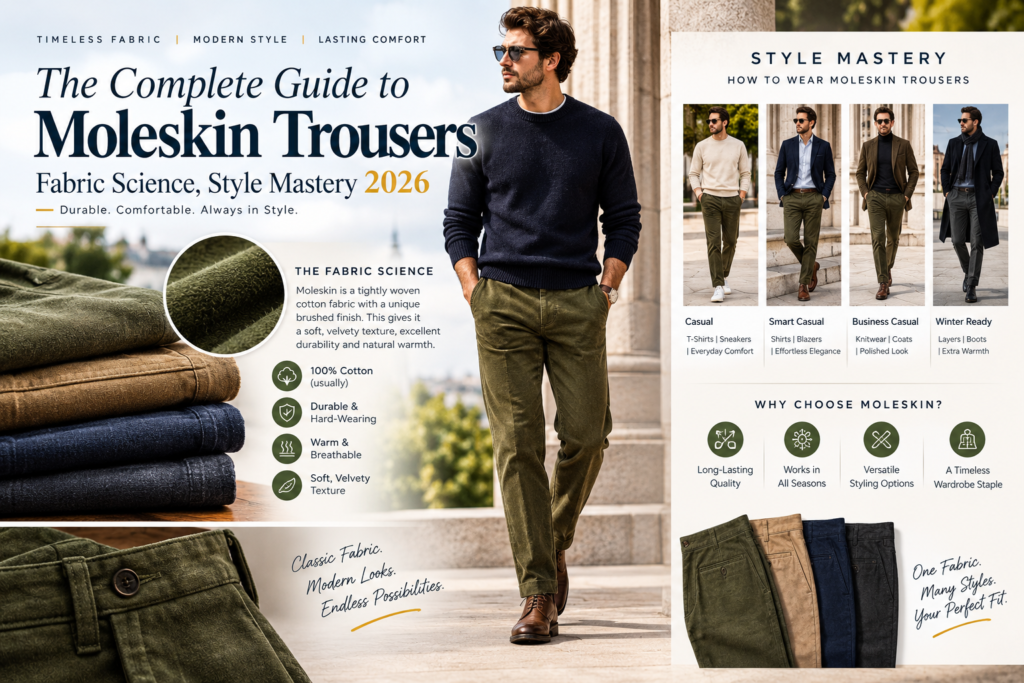

There exists a peculiar category of menswear that occupies the fertile ground between rugged utility and refined elegance, and moleskin trousers sit right at the center of it. They possess the soft hand of suede, the durability of denim, and a quiet sophistication that few other fabrics can match. If you have ever found yourself frustrated by chinos that feel too thin for winter, or denim that reads too casual for a smart lunch, moleskin represents the solution. This guide is written for the man who wants to understand not just what moleskin trousers are, but why they perform the way they do.
What Exactly Is Moleskin Fabric and Why Does It Matter for Trousers
The name itself is misleading, and that confusion has followed moleskin for centuries. It has nothing to do with the small burrowing mammal, nor does it involve any animal products whatsoever. Moleskin is a heavy cotton fabric that undergoes a specific mechanical finishing process to create its signature texture. The base cloth is woven using carded cotton yarn in a dense, weft-faced satin weave, which gives it a tight, substantial structure .
The implications of this construction for trousers are significant. The dense weave creates a fabric that resists wind penetration, a quality that was historically prized by outdoor workers . The brushed nap adds a layer of insulation without the bulk of heavier woolens. Perhaps most importantly, the tight weave combined with the soft surface creates a fabric that drapes cleanly while retaining a tactile, almost luxurious hand-feel. Unlike cotton sateen, which uses cheaper short-strand cotton and wears quickly, true moleskin is built for longevity .
The Historical Journey from French Coal Mines to Modern Wardrobes
Understanding the history of moleskin trousers illuminates why they possess such a distinctive character. The fabric did not emerge from a fashion atelier; it emerged from the demands of hard labor. In nineteenth-century Europe, moleskin was adopted by workers across a range of trades. British workers favored it for its insulating and windproof qualities, finding it ideal for the damp, cold conditions of industrial and agricultural work . In France, the fabric became closely associated with coal miners, who valued its durability and protective density . The tight weave offered a degree of resistance against abrasion and sparks, making it suitable for factory environments where workers faced constant physical hazards .
This working-class pedigree gives moleskin trousers a certain integrity. They were not designed to be precious or delicate; they were designed to endure. Over the decades, as workwear migrated into the broader fashion vocabulary, moleskin made a parallel transition. It retained its utilitarian credibility while acquiring a more refined aesthetic. Today, a pair of moleskin trousers can trace a direct lineage to the garments that protected French miners and British farmers, yet they are equally at home in a country pub or a city restaurant. That duality is precisely what makes them so versatile. They carry the weight of their history without being weighed down by it.
The Unique Properties That Separate Moleskin from Chinos and Denim
The most common question a man asks when considering moleskin trousers is how they differ from the chinos already hanging in his closet. The distinction begins with weight and density. A typical chino might be woven from cotton twill at around 250 to 300 grams per square meter. Quality moleskin trousers often weigh between 365 and 440 grams per square meter, a substantial difference that you feel immediately when you pick them up . That extra density translates directly into warmth. The fabric traps air within its dense structure, creating an insulating barrier that keeps cold at bay without requiring the bulk of flannel or the itch of wool.
The surface texture is another defining characteristic. Chinos have a smooth, flat finish. Denim has a visible diagonal weave and a rougher hand. Moleskin presents a soft, brushed surface that is visually matte and tactilely inviting . This nap also affects how the fabric interacts with light. Rather than reflecting light sharply, moleskin absorbs it, giving the trousers a deep, rich color presentation that resists the fading that plagues many cotton garments . The fabric also accepts dye exceptionally well, which is why you will find moleskin available in saturated navy, deep forest green, warm tobacco, and classic stone tones that retain their vibrancy through repeated wear and washing.
A Reference Table for Moleskin Fabric Weight and Typical Uses
| Weight Range | Typical Application | Characteristics |
|---|---|---|
| 280–320 gsm | Lightweight overshirts, summer-weight trousers | Softer drape, less insulation |
| 365–400 gsm | Standard tailored trousers, smart casual wear | Balanced warmth and structure |
| 440–500 gsm | Heavy-duty workwear, extreme cold layering | Maximum wind resistance, substantial feel |
Frame of Reference: How Moleskin Trousers Should Fit and Feel
The fit of moleskin trousers follows a logic that differs subtly from other fabrics. Because moleskin has a degree of natural give, particularly when blended with a small percentage of elastane, it conforms to your body over time without losing its shape . However, the fabric’s weight means that a poorly sized pair will not drape correctly; it will either pull across the hips or billow awkwardly below the knee. The guiding principle is a clean line from waist to hem. A straight-leg or gently tapered cut works best for most body types, as it allows the fabric’s inherent structure to create a flattering silhouette without clinging .
The waistband deserves particular attention. A quality pair of moleskin trousers will typically feature a fully lined waistband and horn buttons rather than plastic, details that speak to the garment’s intended lifespan . When trying on a pair, pay attention to how the fabric sits at the waist. It should rest comfortably without digging in, and there should be no gaping at the back. The dense weave means that moleskin does not stretch out dramatically with wear, so the fit you experience in the fitting room is close to the fit you will have months later. This predictability is one of the fabric’s underappreciated virtues.

Color Selection and the Moleskin Palette
The traditional moleskin palette is drawn from the landscapes where the fabric earned its reputation. Navy, beige, brown, stone, and green form the core of the classic range . These are not arbitrary choices. They reflect the earth tones of rural Britain and continental Europe, and they possess a natural harmony that makes them extraordinarily easy to combine. A navy pair of moleskin trousers pairs effortlessly with a blue Oxford shirt and a grey tweed jacket. A stone or beige pair works with almost any knitwear, from oatmeal cables to charcoal crewnecks. Brown moleskin sits naturally alongside waxed jackets and leather boots.
Modern manufacturers have expanded the palette to include black and deep burgundy, opening up more urban and evening-oriented possibilities . A black moleskin trouser with front pleats and a sharp silhouette can transition from a day at the office to an evening dinner with minimal adjustment. The key is to consider how the color interacts with the fabric’s matte surface. Because moleskin absorbs light, darker colors appear particularly rich and dimensional, while lighter tones take on a subtle warmth. This is not a fabric that produces harsh or flat color; it renders every shade with a depth that photographs and in-person observation both capture beautifully.
Styling Moleskin Trousers for Smart Casual Occasions
The smart casual register is where moleskin trousers perform most impressively. Their texture provides visual interest that smooth cotton cannot match, which means they elevate simple combinations without requiring complex layering. A navy or stone pair paired with a white or blue Oxford shirt, a fine-gauge lambswool crewneck, and an unstructured tweed jacket creates an outfit that reads as considered and effortless . The texture of the tweed echoes the texture of the moleskin, creating a tactile harmony that is pleasing without being studied. Brown suede loafers or brogues complete the look, grounding it in the same country-adjacent aesthetic that has defined British menswear for generations.
The critical insight here is that moleskin trousers allow you to dress with intention without appearing to try too hard. They communicate a level of sartorial awareness that a pair of chinos cannot quite replicate, yet they never feel overdressed. For a weekend lunch, a country wedding, or a workplace where the dress code has relaxed, they occupy the sweet spot between formality and ease. The fabric’s weight also means they hang cleanly and resist wrinkling, which matters when you are sitting through a long meal or a day of meetings. You look put-together because the fabric is doing the work for you.
Casual Everyday Wear and the Art of Relaxed Texture
For weekends, errands, and the unstructured hours of life, moleskin trousers offer a warmth and character that denim struggles to match in cold weather. The formula is straightforward: take whatever you would normally wear with jeans and pair it with moleskin instead. A simple cotton T-shirt or henley, layered under a flannel overshirt or a quilted gilet, creates an outfit that is comfortable without being sloppy . Earth tones work hardest here. Brown or beige moleskin with an olive overshirt and a pair of Chelsea boots is a combination that feels both rugged and refined, capable of handling a muddy dog walk and an impromptu coffee stop with equal composure.
The key to casual styling is to embrace the fabric’s tactile quality rather than fight it. Moleskin is not a sleek, technical fabric; it is a soft, substantial cloth with a visible nap. Pairing it with other textured garments, such as chunky knitwear, waxed cotton, or suede, creates a coherent visual language. Rolling the cuff once softens the trouser further and brings it closer to the denim register . The goal is not to look like you are wearing workwear cosplay, but to draw on the genuine heritage of the fabric while keeping the overall impression modern and relaxed.
Winter Layering Strategies for Maximum Warmth and Style
When temperatures drop, moleskin trousers come into their own. The brushed nap traps warmth close to the body, and the dense weave blocks the wind that cuts through lighter fabrics . This makes them an ideal foundation for layered winter outfits. A green or navy pair of moleskin trousers paired with a heavy cable-knit jumper, a wool scarf, and a long overcoat or waxed jacket creates a silhouette that is both protective and elegant . The weight of the moleskin balances the volume of the knitwear above, preventing the outfit from feeling top-heavy.
The strategic advantage of moleskin in winter is that it allows you to dress warmly without resorting to technical fabrics or insulated trousers that sacrifice style for function. They look like smart trousers, but they perform like cold-weather gear. This makes them particularly valuable for men who live in climates with genuine winters and who refuse to abandon their personal style when the temperature drops. A sturdy welted boot or a heavy Chelsea boot completes the winter look, providing both traction and a visual anchor that matches the substantial character of the moleskin.
Common Problems and Practical Solutions for Moleskin Trousers
Even the finest moleskin trousers present certain challenges, and understanding how to address them is part of owning them well. The most common issue is shrinkage. Cotton moleskin, like most natural fabrics, can shrink when exposed to heat, particularly in the first few washes . The solution is straightforward: wash at low temperatures, ideally 30 degrees Celsius or cooler, and avoid tumble drying. Some higher-quality garments are pre-shrunk during manufacturing, which virtually eliminates this concern, but it is always safer to assume that a new pair of moleskin trousers will benefit from careful laundering . If you are uncertain about the care instructions, washing inside out on a gentle cycle and line drying is the most reliable approach.
Another common concern is the appearance of shine or pressure marks, particularly on darker colors. The nap of the fabric can become flattened in areas of repeated friction, such as the seat or knees, creating a visible sheen. This is not permanent damage, but it requires attention. Ironing on the reverse side with a low heat setting, or using a garment steamer, can restore the nap and refresh the fabric’s appearance . Storing moleskin trousers on a hanger rather than folded also helps preserve the nap and prevents creasing that can become set over time. The fabric is remarkably resilient, but it responds best to gentle, consistent care.
Care Rituals That Extend the Life of Your Moleskin Trousers
The longevity of moleskin trousers is one of their most appealing qualities, but that longevity is not automatic. It depends on a care routine that respects the fabric’s nature. Washing should be done sparingly, as frequent laundering can dull the nap and accelerate wear. Spot cleaning is often sufficient for minor marks, and airing the trousers between wears allows them to freshen naturally. When washing is necessary, turn the garment inside out, use a mild detergent, and select the gentlest cycle available . Avoid fabric softeners, which can coat the cotton fibers and diminish the fabric’s breathability and softness.
Drying is equally important. Moleskin trousers should be line dried or tumble dried on the lowest possible heat setting. High heat is the enemy of cotton, causing shrinkage and damaging the nap. If ironing is required, do so on the reverse side while the fabric is still slightly damp, using a medium heat setting. This restores the smooth appearance of the trouser while protecting the brushed surface. Stored properly on a hanger in a dry, well-ventilated space, a quality pair of moleskin trousers can maintain its appearance and fit for a decade or more, making the initial investment remarkably economical over time.
Quality Indicators: How to Evaluate Moleskin Trousers Before You Buy
Distinguishing a well-made pair of moleskin trousers from a mediocre one requires attention to a few key details. The first is the fabric itself. Run your hand across the surface. A quality moleskin will feel dense and substantial, with a nap that is soft but not fuzzy. It should not feel thin or flimsy. The weight is a reliable indicator; if the fabric feels light and insubstantial, it will not provide the warmth and durability that define the best moleskin garments. Look for a tight weave that does not allow light to pass through easily when held up to a window.
Construction details matter just as much. Check the waistband. A fully lined waistband is a sign of quality, as it provides structure and prevents the fabric from stretching out of shape . Look at the buttons. Horn or corozo buttons indicate a manufacturer that cares about materials; plastic buttons suggest cost-cutting. Examine the stitching at stress points, such as the fly, the pocket openings, and the crotch.
The Quiet Luxury of Moleskin in Contemporary Menswear
In an era when menswear increasingly favors understated quality over conspicuous branding, moleskin trousers align perfectly with the quiet luxury aesthetic. They do not announce themselves with logos or flashy details. Their value is communicated through texture, weight, and the way they drape. A man wearing well-cut moleskin trousers in a deep navy or rich brown is signaling a level of discernment that does not require external validation. He has chosen a fabric that performs beautifully and looks refined, and that choice speaks for itself.
Designers like Maison Margiela and Studio Nicholson have embraced moleskin for precisely this reason . It offers a canvas for subtle experimentation, whether through unusual silhouettes, pleated fronts, or the contrast of white stitching against black fabric. But even in its most classic form, a pair of moleskin trousers carries a quiet authority. They are the sartorial equivalent of a firm handshake: confident, understated, and impossible to fake. This is why men who care about how they dress return to moleskin season after season. It delivers on every promise it makes.
Frequently Asked Questions About Moleskin Trousers
What is the difference between moleskin and corduroy?
Moleskin and corduroy are both members of the fustian family of fabrics and share a similar dense cotton construction, but their surface finishes differ significantly. Corduroy features distinct parallel ridges, known as wales, that create its characteristic texture. Moleskin, by contrast, has a smooth, uniform nap that feels like suede or chamois. It is shorn and brushed rather than cut into ridges . This makes moleskin trousers less visually busy and easier to pair with patterned garments, while retaining the same warmth and durability that make corduroy popular in cold weather.
Can moleskin trousers be worn in warmer weather?
Moleskin trousers are primarily a cold-weather garment due to their weight and insulating properties, but lighter-weight versions can be worn in transitional seasons. A 365 grams per square meter fabric is comfortable in autumn and early spring, while heavier 440 grams per square meter weights are best reserved for winter . In genuinely warm conditions, the fabric’s density can cause discomfort, as it does not breathe as freely as lighter cottons or linens. For mild weather, a moleskin overshirt might be a better choice than trousers, allowing you to enjoy the fabric’s texture without the insulation .
How should I wash my moleskin trousers to prevent shrinkage?
Washing moleskin trousers at 30 degrees Celsius or cooler on a gentle cycle is the most reliable way to prevent shrinkage. Turn them inside out before washing and use a mild detergent without bleach or fabric softener. Avoid tumble drying; line drying is safest . Some manufacturers pre-shrink their moleskin fabric during production, which minimizes the risk, but careful laundering remains the best practice. If you must use a dryer, choose the lowest heat setting and remove the trousers while they are still slightly damp to prevent overdrying.
What shoes work best with moleskin trousers?
Moleskin trousers have a country and heritage bias, so leather and suede footwear in earthy tones nearly always works well. Chelsea boots, particularly in brown, oxblood, or suede, are the default choice and pair effectively with both smart casual and relaxed outfits . Brogues, loafers, and sturdy welted boots also complement the fabric’s character. Stark white trainers and formal dress oxfords tend to clash with moleskin’s texture and heritage, creating a stylistic mismatch that undermines the overall impression. The goal is footwear that shares the trouser’s grounded, substantial quality.
Are moleskin trousers suitable for formal occasions?
Moleskin trousers occupy a smart casual register rather than a formal one. They are appropriate for occasions with relaxed dress codes, such as country weddings, smart restaurants, and workplaces where suits are optional. They are not a substitute for wool dress trousers in genuinely formal settings. However, a well-cut pair in a dark color like navy or black, paired with a blazer and polished shoes, can read as sophisticated and intentional in semi-formal contexts where a traditional suit would feel overly stiff .
Final Thoughts on Moleskin Trousers and the Smartest Wardrobe Investment
Moleskin trousers represent a rare convergence of practical utility and refined aesthetics. They are warm without being heavy, durable without being coarse, and versatile without being bland. The fabric’s history as workwear gives it a credibility that fashion cannot manufacture, while its contemporary applications prove that it belongs in the modern wardrobe just as much as it belonged in the mines and fields of the nineteenth century. For the man who values substance over hype, moleskin offers a quiet, enduring answer to the perennial question of what to wear when the weather turns cold and the occasion calls for something better than denim.
The final insight is this: moleskin trousers are not a trend. They are a tool. Like any good tool, they reward the person who understands how they work and uses them with intention. Choose a weight appropriate to your climate, a color that complements your existing wardrobe, and a fit that respects the fabric’s structure. Care for them gently. In return, they will serve you through countless winters, looking better with each season and asking for nothing more than a little attention. That is the quiet bargain that moleskin offers, and it is one that discerning men have been accepting for generations.