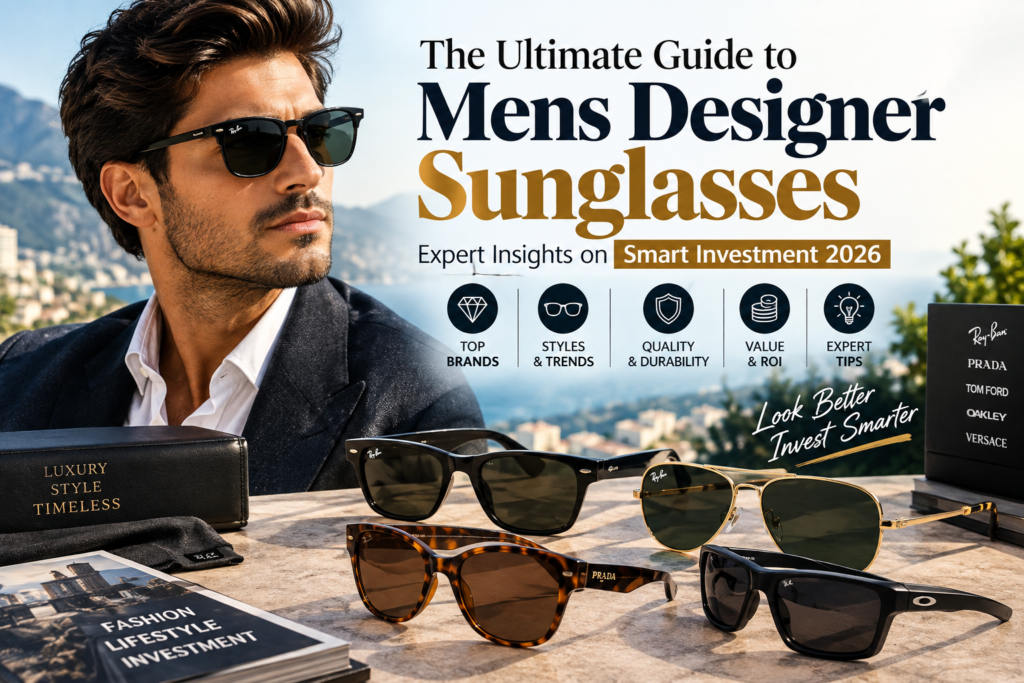

Mens designer sunglasses occupy a unique space in the world of fashion accessories. They are simultaneously functional necessities and expressive statements, protective gear and status symbols, everyday tools and collectible objects. A single pair can transform an ordinary outfit into something memorable, or disappear seamlessly into a well-constructed look. But the world of luxury eyewear has become increasingly complex, with dozens of heritage houses, independent Japanese ateliers, and boundary-pushing fashion labels all vying for attention. Understanding what separates exceptional eyewear from merely expensive eyewear requires a deeper look at materials, manufacturing, design philosophy, and the subtle cues that signal quality.
The market for premium eyewear has evolved significantly. No longer is it enough for a frame to simply carry a recognizable logo. Discerning buyers now seek transparency about production methods, genuine UV protection, and frames that tell a story about their origins. From the acetate workshops of Sabae, Japan, to the mineral glass lens laboratories of Italy, the geography of eyewear craftsmanship matters more than ever. This guide explores every dimension of mens designer sunglasses, from the technical specifications that protect your vision to the aesthetic considerations that determine whether a pair feels like a natural extension of your personal style.
Why Mens Designer Sunglasses Deserve a Closer Look
The distinction between mass-market sunglasses and genuine luxury eyewear reveals itself the moment you examine the details. According to the American Academy of Ophthalmology, quality sunglasses should block 100 percent of UV rays to protect against cataracts and long-term eye damage . While this level of protection is achievable at various price points, designer frames offer something beyond baseline safety: optical clarity, material integrity, and design coherence that mass-produced alternatives struggle to match.
Consider the difference between a frame made from injection-molded plastic and one carved from block acetate. The former emerges from a machine in seconds, while the latter undergoes a process measured in days, involving cutting, tumbling, polishing, and hand-finishing. This extended timeline isn’t mere indulgence. It produces a material depth and tactile quality that cannot be replicated through faster methods. Designer houses like Jacques Marie Mage have built their reputations on this painstaking approach, with founder Jérôme Mage describing his frames as “collectible objects meant to be discovered not only now but also in 100 years” .
Beyond materials, the engineering of hinges, nose pads, and temple arms determines how a frame feels after hours of wear. A sprung hinge that allows the temple to flex outward without stress prevents the loosening that plagues cheaper constructions. Titanium components, reserved for premium eyewear, offer remarkable strength-to-weight ratios that keep a frame feeling almost weightless. These are the invisible qualities that justify the investment, the elements you notice not on the first wear but on the hundredth, when the frame still sits perfectly and the lenses remain optically clear.
The Anatomy of Quality: Materials That Define Luxury Eyewear
The foundation of any exceptional pair of mens designer sunglasses lies in its materials. Acetate, the most common premium frame material, is a plant-based plastic derived from cotton fibers and wood pulp. Unlike petroleum-based plastics, acetate can be produced in layered sheets that reveal depth and pattern when cut, allowing for the tortoiseshell and marbled effects that define classic eyewear aesthetics . Italian acetate from producers like Mazzucchelli has become a benchmark for quality, prized for its consistency and the richness of its color saturation.
Metal frames introduce a different set of considerations. Titanium, in particular, represents the pinnacle of frame material technology. It is remarkably lightweight, hypoallergenic, and resistant to corrosion, making it ideal for daily wear . The challenge with titanium lies in its manufacturing difficulty. It requires specialized equipment and expertise to shape without compromising its structural integrity, which explains why titanium frames command higher prices. Japanese manufacturers have developed particular proficiency with beta-titanium alloys, creating frames that feel almost intangible on the face while maintaining exceptional durability.
Lens materials and coatings constitute another critical dimension. Optical-grade lenses, whether made from glass or high-quality polycarbonate, provide distortion-free vision that cheap lenses cannot replicate . Polarization, which eliminates glare from reflective surfaces, is most effective when integrated into the lens structure rather than applied as a superficial coating. Anti-reflective and scratch-resistant treatments further enhance both visual comfort and longevity. The American Academy of Ophthalmology notes that polarization and UV protection are separate considerations, and premium lenses typically offer both . When evaluating mens designer sunglasses, these technical specifications should carry as much weight as aesthetic preferences.
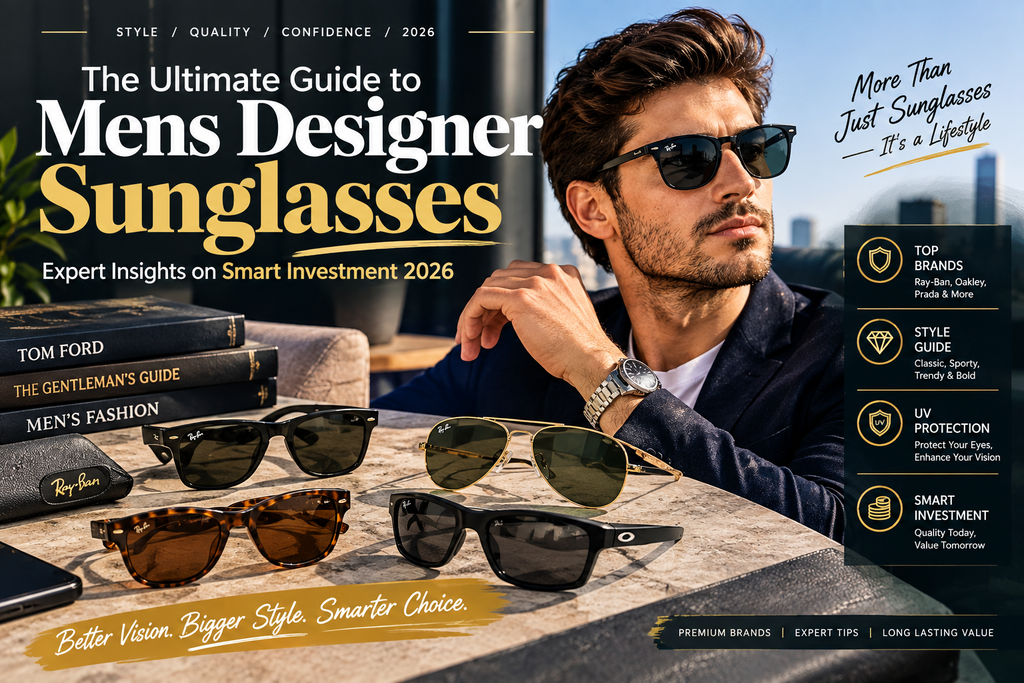
The Brands That Define Modern Luxury Eyewear
The landscape of premium eyewear encompasses heritage houses, independent ateliers, and fashion-forward labels, each with distinct approaches to design and manufacturing. Ray-Ban, founded in 1937, remains the most universally recognized name in sunglasses, with the Wayfarer and Aviator silhouettes achieving iconic status through decades of cultural visibility . The brand’s accessibility and timeless designs make it an ideal starting point for anyone building an eyewear collection.
Jacques Marie Mage has emerged as perhaps the most influential independent eyewear brand of the past decade. Founded in 2014, the Los Angeles-based label produces frames in limited quantities, often serialized and released in runs of a few hundred pairs . The brand’s commitment to Japanese manufacturing and 18-month production cycles has attracted a devoted following among style-conscious individuals, including actors like Jacob Elordi and Austin Butler. “The intricate packaging really adds to the overall experience,” notes Grace Wilson, Accessories Buyer at MR PORTER, highlighting how presentation contributes to the perception of value .
Cutler and Gross, established in 1969 by opticians Graham Cutler and Tony Gross, represents the heritage wing of independent eyewear. The British brand, now manufacturing in Italy and Japan, has maintained its reputation for individually crafted frames and has collaborated with cultural figures ranging from Madonna to Michael Fassbender . Meanwhile, Moscot, a five-generation family business founded in 1915 on New York’s Lower East Side, offers a distinctly American perspective on eyewear craftsmanship, with custom tint services that allow customers to select from dozens of lens colors .
At the luxury fashion end, houses like Prada, Saint Laurent, and Bottega Veneta interpret eyewear through the lens of their broader design philosophies. Prada’s rectangular frames with flat brow lines embody the brand’s intellectual minimalism, while Bottega Veneta’s logo-free designs reflect creative director Matthieu Blazy’s commitment to quiet luxury . These frames function as extensions of a house’s identity, allowing wearers to participate in a design narrative that extends far beyond eyewear.
Matching Frame Shapes to Face Shapes and Personal Style
The relationship between frame shape and facial features is the most practical consideration in selecting mens designer sunglasses. While personal preference should ultimately guide the decision, certain combinations tend to produce balanced, flattering results. Square and rectangular faces benefit from round or aviator frames that soften angular jawlines and add curvature to the overall silhouette . Conversely, round faces are complemented by angular square or rectangular frames that introduce definition and structure.
The rectangle remains the workhorse of men’s eyewear, versatile enough to complement oval and round faces while disappearing into a look rather than dominating it . A narrow rectangular lens reads sharp and modern, while a chunkier frame projects confidence. For those uncertain about where to begin, a rectangle in tortoiseshell offers a safe starting point that works across contexts and seasons.
Aviators occupy a distinct position, offering a classic sensibility that pairs naturally with tailoring and structured garments. However, aviators demand a certain facial architecture to look balanced, ideally a defined jaw or strong shoulders that can support the frame’s width. Saint Laurent’s metal aviators in silver with brown lenses exemplify how the shape can read sharp and refined rather than retro when executed with precision .
Squares and flat-top designs introduce graphic lines that work particularly well for men with longer or narrower faces, adding width and visual interest . The flat-top variant, characterized by a straight upper line rather than a curved brow, reads younger and more directional. Gucci’s Web collection includes flat-top acetate frames that embody this approach, combining the house’s maximalist heritage with contemporary proportions. Tortoiseshell, the single most useful colorway in men’s eyewear, offers warmth that black cannot provide while remaining understated enough for daily wear .
The Rise of Tinted Lenses and Customization
Tinted lenses have undergone a significant renaissance in men’s fashion, moving from purely functional accessories to expressive statements. David Beckham has been particularly visible in this trend, wearing peach-tinted shades from his own brand at high-profile events, while Michael B. Jordan favors red-tinted lenses . This shift reflects a broader cultural moment where color in eyewear signals confidence and individuality rather than mere eccentricity.
The appeal of tinted lenses extends beyond aesthetics. As David Iarossi, Safilo Head Designer, explains, tinted shades are “ideal for now: the light isn’t as intense as in August, and they can be worn seamlessly both indoors and outdoors. The 1960s inspiration evokes the Italian ‘dolce vita'” . This versatility makes tinted lenses particularly useful for transitional seasons and evening events, where standard dark lenses might feel too severe.
Customization services have made this trend increasingly accessible. Moscot’s Custom Made Tints program invites customers to select from 20 different lens colors, each dip-dyed by hand to create a unique pair . The brand’s fourth-generation craftsman, Harvey Moscot, began his career as a lens-dipper in the family lab, lending authentic heritage to the service. Ray-Ban’s Remix platform takes a different approach, offering over 3,000 frame and lens combinations through an online configurator . German brand Johann Wolff goes further, mixing custom tints at no additional cost for those seeking truly one-of-a-kind eyewear.
For those exploring mens designer sunglasses with tinted lenses, the functional properties of different colors are worth understanding. Brown lenses provide contrast and minimize eye strain, making them excellent for driving and variable light conditions. Yellow enhances object definition and works well for low-light situations, while amber sharpens distant objects . These practical considerations can guide selection beyond pure aesthetic preference.
Understanding What You Pay For: Value in Designer Eyewear
The question of whether mens designer sunglasses justify their price tags deserves an honest examination. The American Academy of Ophthalmology notes that even inexpensive sunglasses can provide adequate UV protection, so the baseline safety argument alone does not account for the price differential . What luxury eyewear offers is a combination of factors that collectively justify the investment for many buyers.
Lens quality represents a significant portion of the value proposition. Premium lenses are typically made from optical-grade materials that minimize distortion, with coatings integrated during manufacturing rather than applied afterward . This integration means scratch-resistant and anti-reflective treatments last longer and perform more consistently. Polarized lenses in cheaper eyewear may be created by laminating a film between lens layers, which can delaminate or distort over time. High-end manufacturers build polarization into the lens itself, ensuring optical integrity throughout the product’s lifespan.
Frame materials and construction constitute another dimension of value. Titanium frames, as noted, offer an exceptional strength-to-weight ratio that makes them nearly unnoticeable during wear. Acetate frames from premium producers retain their color and shape far better than injection-molded alternatives, which can become brittle and fade over months rather than years . The hinges, perhaps the most mechanically stressed component of any frame, differ dramatically between price points. Sprung hinges with precise tolerances maintain their tension through thousands of open-close cycles, while cheaper hinges loosen within weeks of regular use.
Design heritage and authenticity round out the value equation. Iconic shapes developed by houses like Ray-Ban or Persol carry cultural associations that mass-market copies cannot replicate. The guarantee of authenticity, particularly when purchasing from authorized retailers, protects both the investment and the wearer’s eye health. Counterfeit sunglasses often lack genuine UV protection entirely, meaning the wearer receives no protection against harmful rays despite the dark lenses creating an illusion of safety .
| Feature | Designer Sunglasses | Mass-Market Alternatives |
|---|---|---|
| UV Protection | Guaranteed 100 percent UV400 | Often partial or unverified |
| Lens Quality | Optical-grade, often polarized | Basic, prone to distortion |
| Frame Material | Premium acetate, titanium, surgical metals | Brittle plastics, base metals |
| Hinge Construction | Sprung, precision-engineered | Simple pin hinges, prone to loosening |
| Lifespan | Many years with proper care | Months before degradation |
| Warranty and Service | Genuine warranty, repair services | Rarely available |
| Design Origin | Original designs with heritage | Copies of established shapes |
The Manufacturing Geography of Premium Eyewear
Understanding where mens designer sunglasses are made provides valuable insight into their quality and character. Japan has emerged as the undisputed leader in premium eyewear manufacturing, with the city of Sabae on Honshu island earning comparison to Champagne for its concentration of master craftspeople . Frames produced in Sabae benefit from generations of accumulated expertise in working with acetate and titanium, materials that demand specialized knowledge to shape without compromising integrity.
Italian manufacturing, particularly in the Veneto region, represents another pillar of eyewear excellence. Italian acetate from producers like Mazzucchelli has become a global standard, and many luxury houses partner with Italian factories for both frame production and final assembly. The combination of Japanese frame components with Italian acetate is common among premium brands, each geography contributing its particular strength.
Jacques Marie Mage’s manufacturing protocol exemplifies the Japanese approach. The brand describes an 18-month production cycle, a timeline that allows for careful material selection, precision cutting, and extensive hand-finishing . This extended process contrasts sharply with the rapid production timelines of mass-market eyewear, where a frame might move from design to shelf in a fraction of the time. The result, according to Mage, is “spectacles that are more than just products but carry the soul of our craft masters.”
The geography of production also influences design sensibility. German brands like Johann Wolff draw on Miami design influences despite their European origins, while American brands like Moscot maintain a distinctly New York aesthetic despite manufacturing in Japan . This globalized production landscape means that national identity in eyewear is increasingly about design philosophy rather than physical origin, though the “Made in Japan” designation continues to carry particular weight among knowledgeable buyers.
Sustainable Practices and Ethical Considerations in Eyewear
Sustainability has become an increasingly important consideration in the luxury eyewear market, though the conversation remains more nuanced than in some other fashion categories. Acetate, as a plant-based material, offers an inherently more sustainable alternative to petroleum-based plastics, though the production process still involves chemical treatments and significant energy inputs. The durability of premium frames represents perhaps their strongest sustainability argument: a pair that lasts a decade or more avoids the repeated consumption of disposable alternatives.
Several independent brands have begun to foreground sustainability in their operations. District Vision, founded by former Acne and Saint Laurent employees, offers sunglasses with suede pouches made from 30 percent recycled plant-based fibers . The brand’s focus on running and active pursuits aligns with a broader movement toward functional, durable products that serve multiple purposes. Cubitts, a London-based brand founded in 2013, emphasizes fair pricing and transparency, with founder Tom Broughton stating that the brand is “about being decent and honest with our customers” .
For buyers concerned about sustainability, the most impactful choices often involve longevity and care rather than specific material certifications. Selecting frames that can be repaired rather than replaced, working with opticians who offer adjustment and maintenance services, and investing in quality cases that protect the investment all extend product lifespans significantly. Many premium brands offer repair services for frames that have been damaged, further reducing the need for replacement. When considering mens designer sunglasses through a sustainability lens, durability and repairability emerge as the most meaningful criteria.
Problem-Solution Scenarios: Common Eyewear Challenges
Even the most carefully selected eyewear can present challenges in daily wear. One common problem involves frames that slip down the nose, particularly for wearers with lower nose bridges or asymmetrical facial features. Premium frames address this through adjustable nose pads, typically made from titanium in high-end models for their durability and hypoallergenic properties. Brands like Oakley have developed specialized nose pad systems, such as the Unobtanium pads used in their performance frames, which actually increase grip when exposed to moisture .
Weight distribution presents another challenge. Frames that feel comfortable during a brief try-on may become burdensome after hours of wear if the weight is concentrated at the nose or temples rather than distributed evenly. Titanium frames solve this problem through their remarkable lightness, often weighing less than half of comparable acetate frames. For those who prefer acetate aesthetics, brands like Jacques Marie Mage compensate through careful balancing of frame mass, positioning thicker sections where they will not create pressure points.
Lens glare in specific driving or outdoor situations can be mitigated through polarization, but not all polarized lenses perform equally. Cheaper polarization films can create distortion or fail to eliminate glare from certain angles. Premium polarized lenses, particularly those from Maui Jim and similar performance-oriented brands, offer superior glare reduction across a wider range of conditions. The American Academy of Ophthalmology cautions that polarization should always be combined with verified UV protection, as the two features serve different protective functions .
Prescription compatibility represents a final consideration. Not all designer frames can accommodate prescription lenses, particularly those with highly curved or wrapped designs. Those requiring vision correction should prioritize frames explicitly designed for prescription conversion, often indicated by the manufacturer’s specifications. Ray-Ban and several other major brands offer frames that work seamlessly with prescription lenses, ensuring that style does not require sacrificing visual acuity .
The Cultural Significance of Mens Designer Sunglasses
Sunglasses have long functioned as tools of self-presentation, offering both literal protection and a controlled boundary between the wearer and the world. For men in particular, a well-chosen frame can communicate sophistication, confidence, and a certain unbothered quality that is difficult to achieve through other accessories. The cultural weight of specific silhouettes reinforces this communicative power: the Wayfarer’s association with mid-century cool, the Aviator’s connection to pilots and mavericks, the Clubmaster’s intellectual bent .
The contemporary moment has expanded the vocabulary of men’s eyewear. Chunky acetate frames in translucent colors, geometric shapes with unexpected proportions, and tinted lenses that prioritize expression over convention all represent departures from the restrained minimalism that characterized men’s accessories for much of the 2010s. Jacob Elordi’s frequent pairing of Jacques Marie Mage frames with Bottega Veneta tailoring exemplifies how eyewear can serve as the focal point of an otherwise understated look .
This cultural evolution has made mens designer sunglasses a more expressive category than ever before. The frames a man chooses reveal something about his aesthetic priorities, his relationship to tradition versus innovation, and his willingness to embrace color or remain within monochrome parameters. The best choices are those that feel genuinely aligned with the wearer’s identity rather than trends or external expectations. As with any element of personal style, coherence matters more than adherence to any particular rule.
How to Evaluate Authenticity and Make Smart Purchases
The prevalence of counterfeit eyewear makes authentication a critical concern for anyone investing in mens designer sunglasses. Counterfeits range from crude imitations sold at street markets to sophisticated replicas that closely mimic genuine products. The stakes extend beyond financial loss: counterfeit sunglasses often provide no meaningful UV protection, leaving wearers vulnerable to eye damage while believing they are protected .
Authentic designer sunglasses purchased from authorized retailers come with verifiable hallmarks of quality. Serial numbers, often engraved or printed on the inside of the temple arm, can sometimes be verified with the manufacturer. The quality of engraving or printing itself offers clues: genuine frames feature crisp, precise lettering, while counterfeits often display blurry or irregular markings. Packaging also matters, with authentic products arriving in branded cases with cleaning cloths and documentation that matches the manufacturer’s standards.
Purchasing from established opticians and authorized boutiques provides additional protection. Lawrence & Mayo, a retailer with locations in India and the UK, notes that every pair sold through their boutiques is backed by warranty and fitted by certified optometrists . This combination of authenticity verification and professional fitting ensures both the product’s legitimacy and its suitability for the individual wearer. Online purchases from unauthorized sellers, even at significant discounts, carry substantial risk that often outweighs any short-term savings.
For those building an eyewear collection, a thoughtful approach involves starting with one versatile frame in a neutral colorway before expanding into more expressive options. A rectangle in tortoiseshell or black serves as the foundational piece, capable of pairing with nearly any outfit or occasion . From there, additions can explore different moods: a metal aviator for a sharper, more formal edge, a tinted lens for expressive moments, or a bold square frame for days when the eyewear should take center stage.
Caring for Your Investment: Maintenance and Longevity
The lifespan of mens designer sunglasses depends significantly on how they are treated between wears. Simple habits make a substantial difference. Storing frames in a protective case when not in use prevents scratches to lenses and accidental damage to hinges or frame fronts. Cleaning with the provided microfiber cloth rather than shirt tails or tissues avoids the microscopic abrasions that accumulate over time and degrade optical clarity.
Lens care deserves particular attention. Cleaning sprays formulated for optical lenses remove oils and debris without leaving residue or damaging coatings. For frames with adjustable nose pads, periodic tightening prevents the pads from slipping and maintains proper alignment. Those who wear their sunglasses in saltwater environments should rinse frames with fresh water after exposure, as salt can corrode metal components over time.
Professional servicing extends the life of premium eyewear significantly. Many opticians offer adjustment services that restore proper fit and alignment, often at no cost for frames purchased through their practice. Some brands provide repair services for damaged frames, including hinge replacement and lens replacement. These services, while sometimes carrying a fee, represent a fraction of the cost of replacing a premium frame and help ensure that well-made sunglasses remain wearable for years rather than months.
FAQ
How can I verify that mens designer sunglasses offer genuine UV protection?
Look for labeling that explicitly states 100 percent UV protection or UV400, which indicates the lenses block all UVA and UVB rays. According to the American Academy of Ophthalmology, lens darkness and color do not indicate UV protection, so a dark lens without proper labeling may offer no protection at all . When purchasing from authorized retailers, the UV rating should be clearly displayed. If uncertain, an optician can test the lenses with specialized equipment to verify their protective capabilities.
Are polarized lenses worth choosing in mens designer sunglasses?
Polarized lenses offer significant benefits for specific situations, particularly driving and outdoor activities where glare from roads, water, or reflective surfaces causes visual discomfort. However, polarization and UV protection are separate features, so polarized lenses must also carry verified UV400 or 100 percent UV protection to safeguard eye health . Some wearers find that polarization interferes with reading LCD screens or creates unusual visual effects, so trying polarized lenses before committing to a purchase is advisable for those who frequently interact with digital displays.
What is the difference between acetate and titanium frames?
Acetate is a plant-based plastic that can be produced in layered sheets, allowing for rich color patterns and a warm, substantial feel. Titanium is a metal prized for its exceptional strength-to-weight ratio, hypoallergenic properties, and resistance to corrosion . Acetate frames tend to offer more design flexibility and are available in a wider range of colors and patterns, while titanium frames are generally lighter and more durable. Many premium frames combine both materials, using titanium for hinges and nose pads while maintaining an acetate front.
How long should a quality pair of mens designer sunglasses last?
With proper care, premium sunglasses can last a decade or longer. The factors that determine longevity include the quality of materials, the construction of hinges and other mechanical components, and how the frames are treated during daily wear . Frames with sprung hinges and titanium components tend to maintain their fit and function longer than those with simpler constructions. Storing frames in a protective case, cleaning them with appropriate cloths, and occasional professional servicing all contribute to extended lifespan.
Can mens designer sunglasses be fitted with prescription lenses?
Many designer frames can accommodate prescription lenses, though some designs are more suitable for this than others. Highly curved or wrapped frames may present challenges for prescription conversion, while more traditional shapes typically work well with prescription lenses. The manufacturer’s specifications indicate whether a frame supports prescription conversion, and this information is typically available from authorized retailers . Those requiring prescription sunglasses should prioritize frames explicitly designed for this purpose to ensure both comfort and optical clarity.
What should I look for in terms of lens quality?
Optical-grade lenses should provide clear, distortion-free vision across the entire lens surface. Premium lenses often feature anti-reflective and scratch-resistant coatings integrated during manufacturing rather than applied afterward, which improves both performance and durability . Polarization, if desired, should be built into the lens structure rather than applied as a film that can delaminate over time. Lens material also matters: while glass offers exceptional optical clarity, high-quality polycarbonate provides similar performance with lighter weight and greater impact resistance.
How do I choose the right frame shape for my face?
The general principle is to choose frames that contrast with your facial features. Square faces benefit from round or aviator frames that soften angular jawlines, while round faces are complemented by square or rectangular frames that add definition . Oval faces can wear nearly any shape successfully. Beyond facial geometry, consider the overall impression: angular frames project sharpness and modernity, while rounded frames offer softness and approachability. Trying frames in person, ideally with professional guidance, remains the most reliable method for determining what suits your features.
Are there ethical or sustainable considerations in buying designer sunglasses?
Durability and repairability represent the most significant sustainability contributions of quality eyewear. A pair that lasts ten years replaces numerous disposable alternatives and reduces overall consumption. Some brands have incorporated recycled or plant-based materials into their products, such as District Vision’s suede pouches made from recycled plant-based fibers . Consumers concerned about sustainability should prioritize frames that can be serviced and repaired rather than replaced, and should dispose of old eyewear responsibly through recycling programs where available.
Conclusion
Choosing mens designer sunglasses is ultimately an exercise in understanding what you value. The category encompasses extraordinary diversity, from the heritage silhouettes of Ray-Ban to the artisanal productions of Jacques Marie Mage, from performance-oriented designs to purely expressive statements. What unites the finest examples is a commitment to quality that manifests in every detail: the depth of acetate that reveals itself in changing light, the precision of a hinge that maintains its tension for years, the optical clarity that transforms the simple act of seeing.
The investment in premium eyewear rewards itself not through any single dramatic moment but through the accumulation of small daily pleasures. The way a well-fitted frame settles onto the face without adjustment. The confidence that comes from knowing your eyes are genuinely protected. The subtle satisfaction of wearing something made with care by people who understand their craft. These are not qualities that can be measured or quantified, but they are real, and they endure.
For those beginning their exploration of mens designer sunglasses, the advice is straightforward: start with quality, prioritize fit, and trust your instincts about what feels right. The perfect pair will not announce itself through logos or trends but through the simple experience of putting it on and feeling that this, somehow, is exactly what you were looking for.