


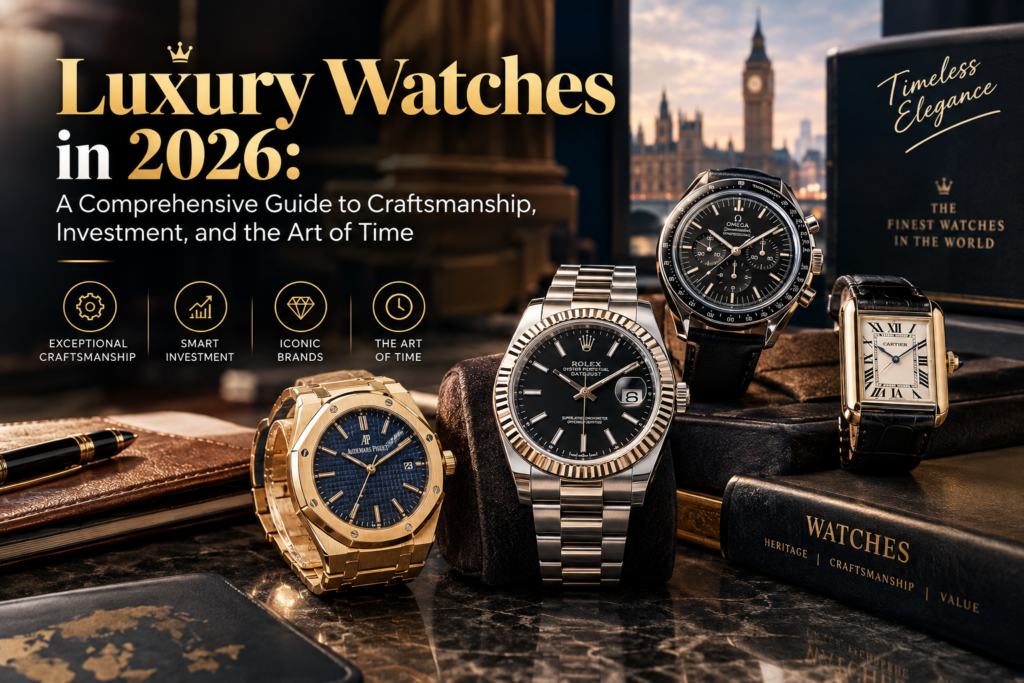
Luxury watches are more than instruments for telling time; they are mechanical marvels that represent centuries of accumulated knowledge, artistic expression, and the relentless pursuit of precision. In a world increasingly dominated by digital convenience and disposable technology, these objects stand as deliberate counterpoints—testaments to the enduring value of human craftsmanship and the beauty of mechanisms that function without batteries or software updates. The category encompasses a remarkable spectrum, from the legendary Rolex Submariner to the esoteric creations of independent watchmakers like F.P. Journe, each occupying its own space within a market that rewards connoisseurship and punishes pretension.
The global luxury watch market has demonstrated remarkable resilience and growth, with Swiss watch exports reaching substantial figures despite fluctuating economic conditions . According to industry data, the Asia-Pacific region remains the largest market, accounting for over forty percent of global revenue, driven by rising wealth and a growing community of collectors . This sustained demand reflects something deeper than mere consumerism; it speaks to a universal human appreciation for objects that embody excellence, heritage, and the promise of permanence in an impermanent world.
What Defines a Luxury Watch: Beyond Brand Names and Price Tags
A luxury watch is a timepiece that demonstrates exceptional craftsmanship, mechanical sophistication, and enduring value, typically characterized by fine movement finishing, precision adjustment, low production volumes, and often, the presence of complications. The distinction between a luxury watch and an expensive watch matters enormously in the collector community, because price alone guarantees nothing. A fashion brand can charge thousands for a quartz watch assembled from mass-produced components, but that does not make it horologically significant.
The historical criteria for luxury watchmaking provide a useful framework for evaluation. Miniaturization has long been a mark of prestige, as creating extremely thin movements without sacrificing performance requires tolerances that challenge even the most skilled watchmakers . The classic high complications—perpetual calendars, split-seconds chronographs, and minute repeaters—have historically separated the masters from the merely competent, as each requires not only precise manufacturing but also a deep understanding of how microscopic parts behave under real-world conditions . These criteria remain relevant today, though the definition has evolved to encompass innovations in materials, escapements, and chronometric performance.
Modern luxury watchmaking has expanded the traditional boundaries in fascinating ways. Omega and Tudor, for instance, have staked their reputations on METAS Master Chronometer certification, which tests watches to standards far exceeding conventional chronometer requirements, including resistance to magnetic fields up to 15,000 gauss . Grand Seiko’s Spring Drive technology represents a unique fusion of mechanical and electronic regulation, achieving accuracy that mechanical escapements cannot match . Rolex continues to innovate with escapement designs like Chronergy and Dynapulse, demonstrating that even the most traditional manufacturers remain committed to advancing the state of the art . These developments remind us that luxury watchmaking is not a static tradition but a living discipline that evolves while respecting its heritage.
The Anatomy of Haute Horlogerie: Movements, Finishing, and Complications
Understanding what makes a luxury watch exceptional requires examining the movement—the mechanical heart that drives every function and defines the watchmaker’s art. A fine mechanical movement typically comprises hundreds of individual components, each manufactured to tolerances measured in microns and assembled with painstaking care. The finishing of these components, both visible and hidden, serves as a signature of craftsmanship. Anglage (beveling of edges), Côtes de Genève (Geneva stripes), perlage (circular graining), and mirror polishing on steel components are marks of a movement that has received proper attention from skilled hands.
The distinction between visible and hidden finishing deserves particular emphasis. In haute horlogerie, even components that will never be seen by the owner—the undersides of bridges, the flanks of gears, the interior surfaces of plates—receive the same meticulous treatment as those visible through a sapphire caseback. This seemingly irrational attention to detail serves as a form of signature, proof that the watchmaker approached the work with integrity rather than cutting corners where no one would notice. Collectors and connoisseurs have learned to recognize these signs of genuine craftsmanship, and they factor heavily into a watch’s desirability and value.
Complications—functions beyond basic timekeeping—represent the most visible demonstration of horological expertise. The three classic high complications are the perpetual calendar, which accounts for leap years without adjustment; the rattrapante or split-seconds chronograph, which allows timing of two events simultaneously; and the minute repeater, which chimes the time on demand with remarkable acoustic precision . The ability to produce all three, whether in a single watch or across a collection, has historically served as the ultimate benchmark of a manufacture’s capabilities. The tourbillon, though technically a regulating device rather than a complication, occupies a similar position of prestige, having evolved from an ultra-rare precision mechanism to something more accessible, though its romantic appeal endures .
The Investment Case for Luxury Watches: Evidence, Risks, and Realities
The perception of luxury watches as investment assets has intensified in recent years, driven by headline-grabbing auction results and the remarkable performance of certain references in the secondary market. Christie’s Hong Kong Important Watches sale in May 2026 achieved a total of HK$279 million, up forty percent year-on-year, with top lots including an extremely rare Patek Philippe Sky Moon Tourbillon that realized over US$1.8 million . Sotheby’s followed with an even more spectacular result, achieving HK$414.2 million—the highest total ever for a watch sale at the house and the most valuable watch auction ever held in Asia . These figures understandably capture the imagination, suggesting that fine timepieces offer not just pleasure but also financial returns.
For the prospective buyer considering a luxury watch purchase, the most sensible approach treats investment potential as a secondary consideration at best. Buy what you love, what you will wear and enjoy, and what aligns with your aesthetic and functional needs. If the watch happens to appreciate, that is a pleasant bonus rather than the primary objective. The emotional dividends—the daily pleasure of wearing a beautifully made object, the connection to horological tradition, the satisfaction of owning something built to last generations—provide returns that no financial calculation can capture. Buyers who approach watches purely as investments often make poor decisions, chasing hype rather than quality, and may find themselves disappointed when the market shifts.
Navigating the Market: From Authorized Dealers to Auction Houses
The distribution landscape for luxury watches has evolved significantly, offering buyers multiple pathways to acquisition, each with distinct advantages and considerations. Authorized dealers remain the primary channel for new watches, providing the assurance of authenticity, manufacturer warranty coverage, and the opportunity to develop relationships that can prove valuable for accessing limited-edition pieces. The challenge, particularly for in-demand references from brands like Rolex and Patek Philippe, lies in availability. Waiting lists stretching years are common, and some dealers prioritize customers with established purchase histories, creating a cycle that frustrates newcomers.
The pre-owned and vintage market offers a different proposition, providing access to discontinued references, historically significant pieces, and opportunities to acquire watches that would otherwise be unavailable. Auction houses like Christie’s, Sotheby’s, and Phillips conduct regular sales that attract global bidding, with results that can provide useful price benchmarks . Independent dealers and online platforms have also proliferated, though the importance of authentication and due diligence increases substantially in these channels. The proliferation of high-quality counterfeit watches, sometimes produced using advanced machining techniques that blur the line between genuine and fake, makes verification essential .
The social and digital dimensions of watch collecting have transformed how enthusiasts discover, discuss, and acquire timepieces. Platforms like Instagram and YouTube have democratized access to information, allowing collectors to learn from experienced voices and see watches on the wrist in real-world conditions. Celebrity and influencer associations can generate immediate demand—when a notable figure wears a particular reference, searches and secondary market inquiries spike within hours . This phenomenon has led brands to embrace digital content and influencer partnerships, showcasing craftsmanship and technical features to audiences that might never visit a boutique. For buyers, these platforms offer valuable research opportunities, though the line between genuine enthusiasm and commercial promotion requires careful navigation.
The Culture of Collecting: Communities, Events, and Shared Passion
The online watch community has become equally vital, with forums, social media groups, and video platforms creating spaces where collectors share knowledge, debate preferences, and occasionally, buy and sell. The culture of “incoming” posts—celebrating new acquisitions—and “wrist shots” documenting watches in daily life has created a shared visual language that transcends geography. This community dimension adds a social layer to what might otherwise be a solitary pursuit, transforming watch ownership from a private pleasure into a shared experience. The friendships and connections formed through this shared passion often prove as valuable as the watches themselves.
For newcomers to collecting, the community offers essential guidance and perspective. Experienced collectors can provide insights on fair pricing, reputable dealers, and the relative merits of different references. They can warn against common pitfalls—overpaying for hype-driven models, overlooking condition issues, or falling for cleverly marketed but horologically insignificant pieces. This mentorship tradition, passed from one generation of collectors to the next, helps maintain the integrity and knowledge base of the hobby. It also ensures that the culture remains welcoming and accessible, despite the intimidating price points of some watches.
Service, Maintenance, and the Long-Term Ownership Experience
Owning a luxury watch involves a commitment to maintenance that extends far beyond the initial purchase, a reality that prospective buyers should understand before committing. Mechanical watches contain hundreds of moving parts that require periodic servicing to function properly. A full service involves complete disassembly of the movement, ultrasonic cleaning of every component, inspection for wear, replacement of worn parts, reassembly with precise lubrication, and regulation on a timegrapher to ensure accuracy . For a complicated movement from a prestigious brand, this service can cost anywhere from $1,200 to $4,000 at an authorized service center .
The service history of a pre-owned watch significantly impacts its value and desirability. A documented service from a brand-authorized center, performed recently and with invoices to prove it, adds tangible value to a watch. Conversely, a watch with no service history, or one serviced by an unknown independent, may carry hidden costs and risks. Collectors have learned to ask specific questions: who performed the service, when, and what was replaced. The difference between a watch serviced two years ago with full documentation and one serviced three months ago without paperwork can be substantial in pricing terms . This reality underscores the importance of treating service history as a critical variable in any watch transaction, not merely a checkbox to be ticked.
The restoration and preservation question adds further complexity, particularly for vintage pieces. Originality matters enormously in the vintage market, and over-restoration can destroy value faster than neglect. A case that has been polished excessively loses its sharp edges and original geometry; a dial that has been refinished loses its original patina and character. Collectors and auction houses have developed sophisticated frameworks for evaluating condition, distinguishing between honest wear that tells a story and damage that diminishes the object. For owners of vintage watches, the guiding principle should be minimal intervention—preserving what can be preserved, restoring only what is necessary for function, and always prioritizing originality over cosmetic perfection.
The Counterfeit Challenge and Authentication Imperative
The proliferation of counterfeit luxury watches represents one of the most significant challenges facing the industry and its consumers. Modern counterfeiters employ Computer Numerical Control machining and 3D printing techniques that produce replicas capable of fooling all but the most trained eyes . Enforcement actions underscore the scale of the problem: United States Customs seized over $186 million worth of counterfeit luxury watches and jewelry in Louisville in July 2025, followed by another seizure of over 50 fake watches with a real value exceeding $6 million at Cincinnati/Northern Kentucky Airport . These figures represent only a fraction of the illicit trade that undermines consumer confidence and legitimate sales.
For buyers, the authentication imperative cannot be overstated. The safest path involves purchasing from authorized dealers or established auction houses that guarantee authenticity. When buying pre-owned, working with reputable dealers who offer warranties and return policies provides important protections. Independent authentication services can provide expert opinions for a fee, examining everything from movement finishing to case engravings to dial printing details that distinguish genuine from counterfeit. The old advice—if a deal seems too good to be true, it probably is—applies with particular force in the watch market, where greed and ignorance create fertile ground for fraud.
Brands have responded to the counterfeit challenge with increasingly sophisticated anti-counterfeiting measures. Digital certificates, micro-engraving, holographic elements, and blockchain-based authentication systems represent ongoing efforts to stay ahead of counterfeiters. These measures provide important tools for verification, but they also place responsibility on buyers to educate themselves and exercise caution. The watch community’s collective knowledge—shared through forums, social media, and personal networks—serves as an additional layer of defense, helping members identify suspicious offerings and avoid costly mistakes.
Market Trends Shaping the Future of Luxury Watches
The luxury watch market in 2026 reflects broader cultural and economic currents that will shape its evolution in the years ahead. The Asia-Pacific region’s dominance continues, accounting for over 41 percent of global revenue . China, despite economic headwinds, remains a critical market, while other Asian countries show strong growth in both volume and value terms . The United States market has demonstrated remarkable strength, with Swiss watch exports to the country increasing significantly in early 2026 . These geographic shifts reflect the changing distribution of global wealth and the universal appeal of fine watchmaking across cultures.
Product innovation continues to drive interest and differentiation. Advances in materials—from ceramic composites to proprietary alloys—offer improved durability, lighter weight, and novel aesthetics. The integration of smart features into luxury timepieces, while controversial among purists, represents an acknowledgment that younger buyers expect connectivity alongside craftsmanship. Hybrid models that blend traditional aesthetics with modern functionality are gaining traction, projected to grow at a compound annual rate exceeding six percent through 2031 . This segment appeals to consumers who value both heritage and innovation, suggesting that the future of luxury watches may involve a coexistence of traditional and hybrid approaches rather than a winner-take-all competition.
The sustainability question looms increasingly large over the industry. Consumers, particularly younger ones, are asking harder questions about sourcing, manufacturing practices, and environmental impact. Brands have begun responding with initiatives around ethical gold, recycled materials, and transparency in supply chains. The “Swissness” legislation, which strictly defines what can legitimately bear the Swiss label, represents a regulatory framework that protects both consumers and legitimate manufacturers . As scrutiny intensifies, the brands that demonstrate genuine commitment to sustainability will likely find themselves at an advantage in the marketplace.
| Category | Key Characteristics | Representative Brands | Investment Potential |
|---|---|---|---|
| Ultra-High-End | Rare complications, exceptional finishing, limited production | Patek Philippe, Vacheron Constantin, F.P. Journe | High for specific references |
| Professional Sports | Robust construction, in-house movements, heritage | Rolex, Omega, Tudor | Moderate, reference-dependent |
| Entry Luxury | Accessible price points, solid movements, brand cachet | Longines, Oris, Nomos Glashütte | Low to moderate |
| Independent Artisanal | Unique designs, small-scale production, watchmaker-led | Gruebel Forsey, Philippe Dufour | High for recognized names |
| Fashion/Lifestyle | Brand-driven, often quartz or modified movements | Various fashion houses | Minimal |
Frequently Asked Questions About Luxury Watches
What makes a luxury watch different from an expensive watch?
The distinction lies in horological substance rather than price alone. A luxury watch demonstrates fine movement finishing, precision adjustment, low production volumes, and often, complications that showcase watchmaking expertise. An expensive watch from a fashion brand may command a high price based on brand cachet and marketing, but lacks the mechanical sophistication and craftsmanship that define true luxury in the horological sense.
Are luxury watches a good investment?
The honest answer is that most luxury watches are not investments in the financial sense. While certain rare references have appreciated significantly, these represent a small minority of the market. The watches that perform well typically combine rarity, historical significance, and exceptional condition. For most buyers, the primary returns come from daily enjoyment and the satisfaction of owning a finely crafted object, with any financial appreciation serving as a bonus rather than a rationale.
How often do luxury watches need servicing?
Mechanical luxury watches generally require servicing every five to seven years, though this can vary based on usage, movement complexity, and environmental conditions. Signs that servicing is due include declining accuracy, irregular power reserve, or unusual sounds from the movement. Waiting too long between services can cause wear that increases repair costs significantly. A properly maintained watch can function well for generations.
What should I look for when buying a pre-owned luxury watch?
Service history and documentation top the list of considerations. Ask for service invoices that show who performed the work, when, and what was replaced. Brand-authorized service adds more value than independent work. Examine the condition carefully—original cases that have not been over-polished command higher values than restored examples. Purchase from reputable dealers or auction houses that guarantee authenticity and offer return policies.
How has the smartwatch rise affected the luxury watch market?
Smartwatches have created a clear division in the market rather than cannibalizing luxury sales. Quartz and mechanical watches still dominate the luxury segment, holding over 63 percent of market share, as collectors and enthusiasts value traditional craftsmanship and enduring design . In fact, the ubiquity of smartwatches may have reinforced the appeal of mechanical watches as objects of distinction and heritage, creating a “flight to quality” among discerning buyers.
Conclusion
Luxury watches occupy a unique position in the material culture of our time, serving simultaneously as precision instruments, objects of beauty, stores of value, and symbols of personal achievement. The market’s continued strength—evidenced by record auction results, growing global demand, and vibrant collector communities—reflects a widespread appreciation for craftsmanship that transcends mere consumption. In an era of rapid technological change and disposable everything, these mechanical objects offer something increasingly precious: the assurance of permanence, the evidence of human skill, and the pleasure of owning something made with genuine care.
For those considering entry into this world, whether as first-time buyers or seasoned collectors, the essential insight is that knowledge is the ultimate protection. Understanding what distinguishes genuine craftsmanship from marketing hype, recognizing the signs of quality in movement finishing and case construction, and approaching purchases with realistic expectations about investment potential will serve far better than any single recommendation. The watch that best suits you is not the one that ranks highest on some arbitrary list, but the one that speaks to your particular sensibilities, fits your lifestyle, and will bring pleasure every time you glance at your wrist. In a market filled with noise and hype, that simple truth remains the most reliable guide.