

The shirt you are wearing right now tells a story. It might have been designed on a Tuesday, manufactured in a Guangdong factory by Friday, and shipped to a warehouse in the American Midwest before the week was out. That is the promise of fast fashion: trends translated into affordable garments at a velocity that would have been unimaginable to the mid-twentieth-century apparel trade. But behind the convenience and the low price tag lies a sprawling, complex, and increasingly contested system. The fast fashion market was valued at roughly $98.2 billion in 2025 and is projected to reach $174.1 billion by 2032, growing at a compound annual rate of 8.5 percent .
Those numbers represent millions of decisions made by consumers, billions of dollars of profit for retailers, and a mounting pile of environmental and human costs that regulators, activists, and even the industry itself can no longer ignore. Understanding fast fashion means looking past the storefront and into the supply chain, the landfill, and the lives of the seventy-five million people who work in the global textile and garment industry .
What Fast Fashion Actually Means in Operational Terms
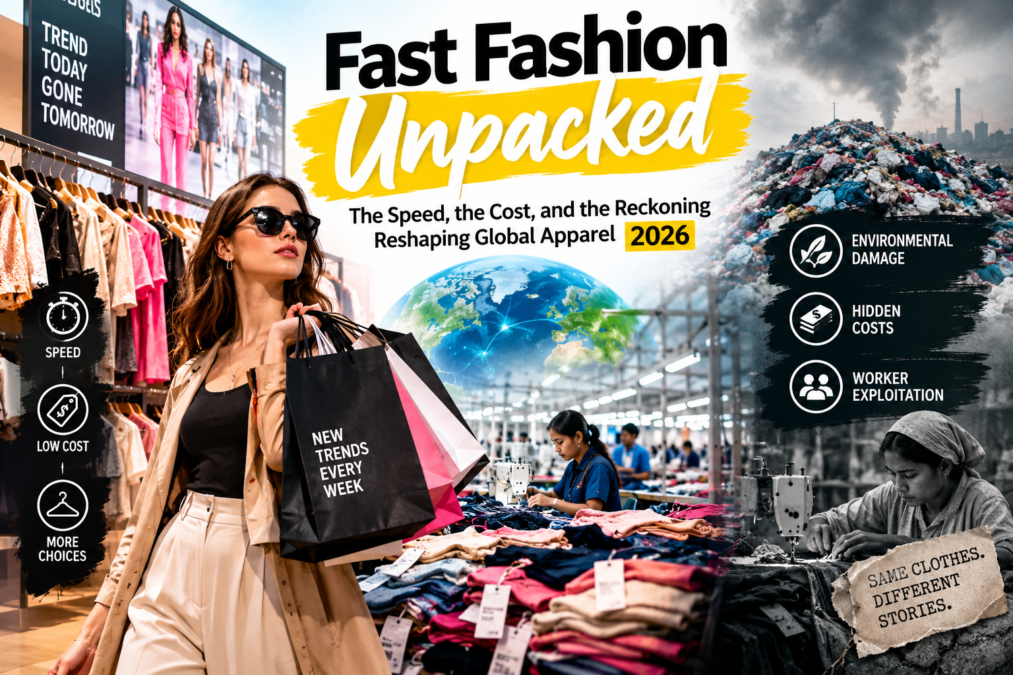
At its core, fast fashion is a business model defined by speed and volume. It rejects the traditional fashion calendar of four to six annual seasons in favor of dozens of micro-seasons, sometimes releasing new designs daily or weekly. Emma Håkansson, founding director of Collective Fashion Justice, puts it bluntly: “We used to make clothing that was tailored specifically to a person, and they wore that clothing for years. Now we have 52, if not more, ‘micro seasons’ in the fashion world” . The result is a perpetual carousel of novelty that trains consumers to expect constant newness at ever-lower prices.
The operational engine behind this model varies by company, and the differences matter. Zara, the flagship brand of Inditex, built its reputation on a vertically integrated supply chain concentrated in Spain and Morocco. It produces smaller initial batches, observes what sells, and replenishes quickly, creating a sense of scarcity that minimizes markdowns and protects margins . H&M, by contrast, leans on a massive network of independent suppliers, primarily in Asia, and a more traditional volume-driven approach that leads to heavier discounting and markdown pressure . These are not trivial distinctions.
represent two different philosophies of speed: one based on responsive agility, the other on sheer throughput. Both, however, share the same fundamental logic of converting trend awareness into sales as quickly and cheaply as possible.
The Ultra-Fast Disruption and the Economics of Freshness
If Zara defined the first generation of fast fashion, Shein and Temu have rewritten the rules entirely. Researchers at Stanford and Cornell have labeled their model “ultra-fresh” fashion. The key insight from their analysis is counterintuitive: these companies are not necessarily faster at manufacturing and shipping than Zara. What they do with unprecedented efficiency is design. They mine social media, celebrity sightings, and trade-show data for signals, then generate thousands of designs in rapid succession. As Hau Lee of Stanford Graduate School of Business explains, “They just bomb the market, and hopefully some land” . The goal is not to predict the winner but to flood the zone with options and let consumer behavior reveal the hits.
This model creates what economists call demand creation through freshness. The constant stream of new products stimulates latent desires, making consumers feel that each visit to the app might yield something they did not know they wanted. The academic model behind this strategy shows that frequent launches, high variety, and low prices can steadily increase firm profits and benefit consumers in aggregate, but they also carry significant environmental consequences if left unchecked .
The freshness factor is not an accident of the system; it is the system’s core value proposition. And it is precisely this feature that regulators in France have targeted with new legislation aimed at “ultra-express fashion,” recognizing that the sheer volume of short-lived garments is incompatible with climate commitments .
The Environmental Ledger: Water, Carbon, and the Microfiber Problem
The environmental footprint of the apparel sector is staggering, and fast fashion is the primary accelerant. Global fiber production more than doubled between 2000 and 2024, reaching 132 million tonnes. Approximately 60 percent of that fiber is polyester, a fossil-fuel-derived material . The fashion industry accounts for up to 10 percent of global greenhouse gas emissions and consumes an estimated 215 trillion liters of water annually . To put that water figure in perspective, it is enough to fill tens of millions of Olympic swimming pools. And the waste is equally profound: the equivalent of a garbage truck full of textiles is burned or landfilled every second, and around 85 percent of all textiles are discarded each year .
The microplastics dimension deserves particular attention because it is less visible than a landfill but more insidious. Washing synthetic garments releases approximately 500,000 tonnes of microfibers into the ocean annually . These fibers do not biodegrade. They enter the food chain, accumulate in marine organisms, and eventually return to human bodies through the water supply and seafood. A single polyester fleece can shed hundreds of thousands of fibers in a single wash cycle. The solution is not simply “buy natural fibers,” because cotton production carries its own heavy water and pesticide burdens.
The real problem is volume: too many garments, made too cheaply, worn too briefly, and discarded too quickly. Circular economy advocates argue that doubling the average lifespan of garments from roughly 80 wears to 160 would be a meaningful step, but that requires a cultural shift away from novelty for its own sake .
Labor Realities Behind the Price Tag
The situation at the most aggressive end of the fast fashion spectrum has drawn particular scrutiny. Investigations into Shein’s supply chain have documented workweeks of up to 75 hours and wages of roughly four cents per garment produced, with instances of child labor also reported . These are not isolated abuses but symptoms of a system where lead times are compressed to days and cost pressure is relentless. The problem is compounded by the atomization of the workforce. When production is outsourced through layers of subcontractors, accountability becomes diffuse, and the brands at the top of the chain can plausibly claim ignorance of conditions several tiers down.
Former employees of an Italian luxury lingerie brand, speaking at the Sfashion Weekend in Milan, captured the dynamic succinctly: “The system seeks to atomize relationships to weaken us, but only in unity lies the power to amplify our struggles” .
| Company | Model Type | Key Characteristic | Primary Sourcing Region | Sustainability Positioning |
|---|---|---|---|---|
| Zara (Inditex) | Vertically integrated fast fashion | Small batches, rapid replenishment, scarcity-driven | Spain, Morocco, proximate suppliers | Traceability leadership, recycler partnerships |
| H&M | Volume-driven fast fashion | Broad supplier network, basics-heavy, heavy markdowns | Asia (diverse network) | Conscious Collection, garment take-back, circularity investment |
| Shein | Ultra-fast fashion | AI-driven design volume, daily launches, micro-batch testing | China (Guangdong cluster) | Limited public transparency, cited in labor investigations |
| Temu | Ultra-fast marketplace | Platform model, extreme price competition, broad categories | China and diversified | Minimal sustainability reporting |
The Regulatory Reckoning: From Self-Regulation to Statutory Mandates
For decades, the apparel industry operated as a largely self-regulating domain. Voluntary codes of conduct, sustainability reports, and green marketing claims filled the space where legislation might have been. That era is ending. In Europe, the Ecodesign for Sustainable Products Regulation took effect in July 2026, prohibiting large companies from destroying unsold apparel and footwear. The European Commission estimates that between 4 and 9 percent of unsold textiles in Europe are destroyed before being worn, generating approximately 5.6 million tonnes of carbon dioxide emissions annually . France went further, enacting Law No. 2026-602, which creates a statutory framework specifically for “ultra-express fashion” and will prohibit advertising for covered products and brands beginning in January 2027 .
In the United States, the approach is more fragmented but no less consequential. California is implementing a textile extended producer responsibility program that requires apparel producers to fund collection, repair, reuse, and recycling infrastructure. New York legislators have considered bills requiring large fashion sellers to conduct greenhouse gas inventories and set reduction targets covering Scope 1, 2, and 3 emissions . The patchwork nature of U.S. regulation creates compliance challenges for global brands, but the direction of travel is unmistakable. The fast fashion model’s externalities—environmental and social—are being internalized through law. The companies that adapt earliest and most substantively will be the ones that survive the transition with their reputations and margins intact.
The Consumer Paradox: Intentions, Actions, and the Accessibility Problem
Consumers occupy an uncomfortable position in the fast fashion story. Surveys consistently show that shoppers care about sustainability, yet sales of cheap, disposable clothing continue to rise. The gap between stated values and actual purchasing behavior is not simple hypocrisy. It is a structural problem. Ethically made clothing costs more because paying living wages, using safer chemicals, and sourcing traceable materials all cost more. For households with limited budgets, the choice between a $15 shirt and a $75 shirt is not an abstract ethical dilemma; it is a monthly budget calculation.
Håkansson notes that “fast fashion isn’t sustained by people with limited income, it’s driven by high-volume consumption among those with disposable income,” but the accessibility of sustainable alternatives remains a real barrier for many .
The most practical solution for budget-conscious shoppers, according to fashion experts, is not to buy more “sustainable” new clothes but to buy fewer clothes overall. The most sustainable garment is the one already in your closet. When new purchases are necessary, secondhand and vintage shopping extends garment life and reduces demand for virgin materials. But even resale can be corrupted by a fast-fashion mindset:
treating platforms like Depop or ThredUp as an endless carousel of cheap novelty simply shifts the consumption pattern rather than disrupting it. Curated, intentional secondhand shopping works best when the question is “Do I actually need this?” rather than “Is this a good deal?” . The problem-solution dynamic here is less about finding a perfect ethical brand and more about recalibrating the relationship between identity, novelty, and consumption itself.
The Material Future: Innovation, Circularity, and the Limits of Technology
The industry’s favored narrative for resolving its environmental crisis centers on innovation: recycled fibers, bio-based materials, digital product passports, and closed-loop recycling. There is real progress. H&M Group has invested approximately $600 million in circularity initiatives, including ventures like Syre, and reported a 41 percent reduction in Scope 1 and 2 emissions in 2025 . Inditex has signed multi-year agreements with recyclers such as Ambercycle . The Netherlands has emerged as a hub for textile recycling technology, with facilities processing post-consumer cotton waste into cellulosic fiber feedstock .
Conclusion
The fast fashion industry is at an inflection point. The business model that delivered decades of growth and democratized style for millions is now facing a convergence of pressures that will reshape it irrevocably. Regulation is moving from voluntary to mandatory. Consumers are becoming more skeptical of green claims. The environmental and human costs of endless novelty are too well-documented to be dismissed as externalities. The companies that thrive in the coming decade will not be the ones that produce the most clothes the fastest, but the ones that figure out how to deliver style and value within ecological and ethical limits.
For individuals, the takeaway is simpler and more personal: the most powerful vote you cast for the future of fashion is not in a polling booth or a boardroom but in the quiet moment when you decide whether you actually need another shirt. The fast fashion era taught us that clothing could be cheap and immediate. The next era must teach us that it can also be considered, durable, and fair—and that those qualities are worth paying for, in money and in attention.
FAQ
What is the definition of fast fashion in simple terms?
Fast fashion is a business model in which clothing retailers rapidly produce and sell affordable garments that mimic current trends, often releasing new designs weekly or even daily to encourage frequent purchases. It prioritizes speed, low cost, and high volume over durability, ethical labor practices, and environmental sustainability. The model relies on compressed supply chains, low-wage manufacturing in developing countries, and marketing that frames clothing as disposable and constantly renewable.
How does fast fashion harm the environment?
Fast fashion drives environmental harm through several interconnected mechanisms. It accelerates resource extraction for synthetic fibers, primarily polyester derived from fossil fuels. It consumes enormous quantities of water for cotton cultivation and textile processing. It generates massive textile waste, with the equivalent of a garbage truck of clothes landfilled or burned every second. It releases microplastics into waterways with every wash of synthetic garments. And it contributes up to 10 percent of global greenhouse gas emissions, more than international aviation and shipping combined .
Why are fast fashion garments so inexpensive?
The low price of fast fashion garments reflects a supply chain designed to minimize costs at every stage. Labor is sourced from countries with weak labor protections and low minimum wages, and workers are often paid piece rates that amount to cents per garment. Materials are predominantly cheap synthetics rather than natural fibers. Production is outsourced to factories that compete on price, creating downward pressure on wages and safety standards. Retailers also benefit from economies of scale, tax structures, and in some cases, loopholes like the de minimis exemption that allowed small shipments to bypass customs duties .
What are ultra-fast fashion companies and how do they differ from traditional fast fashion?
Ultra-fast fashion companies like Shein and Temu represent an intensification of the fast fashion model rather than a departure from it. Their distinguishing feature is not manufacturing speed but design volume. They use data mining and algorithmic trend detection to generate thousands of new designs rapidly, test them in small batches, and scale production only for items that sell. This “bomb the market” approach creates a sense of constant freshness that stimulates demand more aggressively than traditional fast fashion’s seasonal collections. The environmental and labor implications are correspondingly more severe .
What can individuals do to reduce their fast fashion footprint?
The most impactful individual action is to buy fewer new garments and wear the ones you own for longer. When purchases are necessary, prioritize secondhand and vintage items, which extend garment life and reduce demand for new production. Avoid treating resale platforms as another form of fast fashion by shopping intentionally rather than impulsively. Support brands that publish verifiable supply chain information and labor standards, and be skeptical of vague sustainability claims. Finally, recognize that individual choices matter but are not sufficient: systemic change requires regulatory pressure, industry accountability, and a cultural shift away from equating novelty with value .