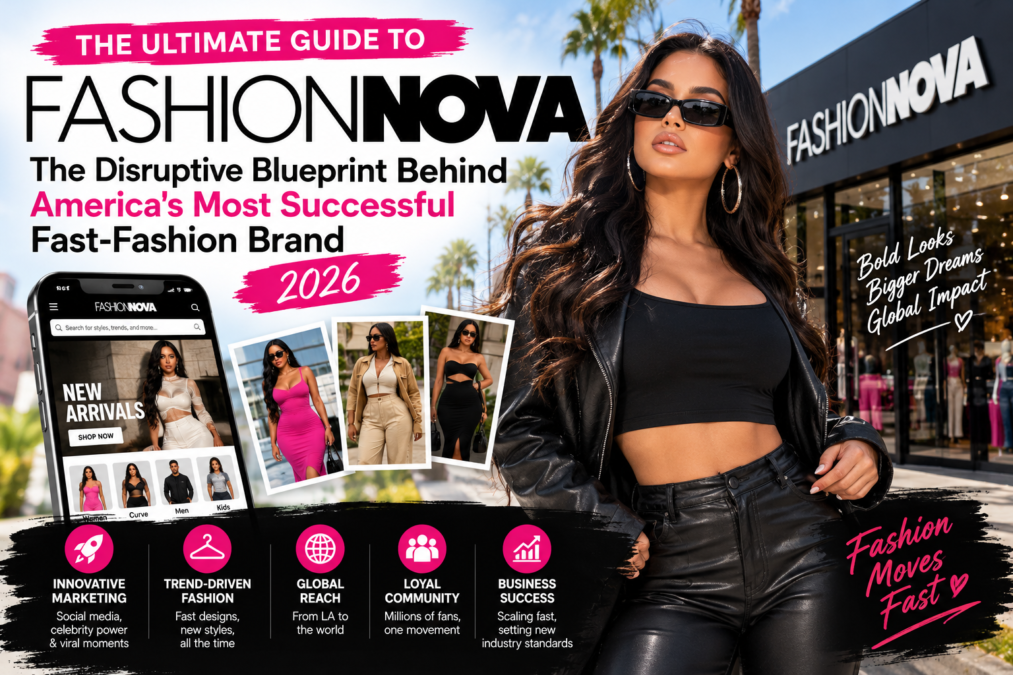
Fashion Nova is not merely a clothing retailer. It is a cultural operating system that turned Instagram into a storefront, influencers into unpaid trend scouts, and real-time social signals into manufacturing orders. Founded in 2006 as a single Los Angeles storefront by Richard Saghian, the brand has evolved into a $2 billion annual revenue juggernaut that, at its peak, was the most Googled fashion brand in the world—outranking legacy houses like Louis Vuitton, Versace, and Gucci . The story of Fashion Nova is a case study in how to reverse-engineer consumer desire, compress supply chains to near-instantaneous speeds, and build a community that functions as both marketing department and product development lab.
What separates this brand from the broader fast-fashion landscape is its fundamental orientation toward velocity and feedback. Traditional retailers design collections months in advance, predict trends through focus groups, and push inventory through seasonal calendars. The Fashion Nova model inverts every one of those assumptions. It watches what its customers and ambassadors are already posting, identifies patterns of engagement within hours, and manufactures matching styles before the trend has even finished its news cycle . This is not prediction. It is orchestration. The brand does not guess what will sell; it waits for social proof to emerge organically, then mass-produces what has already been validated by the crowd.
Understanding the mechanics of this operation requires looking beyond the surface-level glamour of celebrity collaborations and viral dresses. The real architecture rests on three interconnected pillars: a hyper-responsive supply chain capable of producing a prototype in twenty-four hours, a tiered influencer gifting program that generates thousands of pieces of authentic content at virtually zero media cost, and a hashtag taxonomy system that converts user-generated posts into actionable merchandising intelligence . Each pillar reinforces the others, creating a self-tuning machine that learns from every post, every like, and every click.
The Origin Story and the Architect Behind the Machine
The narrative of Fashion Nova begins with Richard Saghian, the son of Iranian immigrants who dropped out of college and opened a retail store in Los Angeles in 2006 . For the first several years, the business operated as a conventional brick-and-mortar operation, opening multiple locations and learning the rhythms of Los Angeles retail. The pivot that changed everything came in 2013, when Saghian launched the e-commerce platform and made a deliberate, strategic bet on social media as the primary distribution channel rather than a supplementary marketing tactic . This decision preceded the broader industry’s recognition that Instagram could function as a direct sales engine, positioning Fashion Nova as a first mover in what would eventually be called social commerce.
Saghian’s personal profile has remained deliberately low compared to the brand’s public visibility, though his business decisions reveal a pattern of aggressive, data-informed risk-taking. Forbes estimates the company generates approximately $2 billion in annual sales, and Saghian has deployed portions of that fortune into conspicuous real estate acquisitions, including a $141 million Bel Air megamansion . In 2018, the year Fashion Nova was named the most Googled fashion brand globally, the company’s growth rate hit 600 percent, a trajectory that validated the social-first strategy and attracted intense scrutiny from both competitors and critics . The brand’s rise was not gradual; it was a step-function leap that caught the established order off guard.
The Twenty-Four-Hour Trend Cycle and the Mechanics of Ultra-Fast Fashion
The practical implications of this speed are best understood through a concrete example. In late 2018, Kim Kardashian stepped out in a black Thierry Mugler dress that generated immediate viral attention. Within hours, a Fashion Nova version of the silhouette appeared on the website for roughly sixty dollars . The brand did not wait for a design cycle or a production window. It identified a moment of cultural heat and inserted itself into that moment with a product that was already manufactured, photographed, and ready to ship. This is the essence of what industry analysts call “trend-to-market” rather than “design-to-market.” The design function is subordinate to the signal function.
The Influencer Gifting Engine and the Economics of Free Content
Perhaps no aspect of the Fashion Nova playbook has been more widely imitated—or more misunderstood—than its influencer strategy. The headline statistic is almost absurd in its implications: in 2020, 1,182 creators published more than 5,700 sponsored Instagram posts for the brand, and zero dollars changed hands in direct compensation . The transaction was simple and non-negotiable. Creators received free clothing. In exchange, they posted photographs wearing the items, tagged the brand, and used designated hashtags. Most agencies would classify this arrangement as exploitative. Fashion Nova framed it as market dynamics.
and the results validated the approach: the brand generated an estimated $15.3 million in Earned Media Value from a single cohort of 122 active creators, a figure calculated by mapping organic engagements and impressions to their paid advertising equivalent .
The scale of this operation is what distinguishes it from conventional influencer marketing. Rather than negotiating individual contracts with a curated roster of macro-influencers, Fashion Nova messages thousands of micro-creators simultaneously through a gifting portal. There is no rate card, no negotiation, no bespoke brief. The creators who accept the terms self-select into the system, and those who decline simply do not participate . This volume-based approach floods the platform with content, creating an always-on stream of authentic-looking posts that function as a continuous advertisement without the overhead of media buys. The cost to the brand is limited to product, which is manufactured at a marginal cost far below retail, and the shipping logistics of distribution.
Hashtag Taxonomy as a Data Engine and Discovery System
The organizational architecture that makes the Fashion Nova influencer program scalable is a hashtag taxonomy that functions as both a content sorting mechanism and a real-time trend detection system. The brand operates distinct hashtags for its major product verticals: #NovaCurve for plus-size offerings, #NovaSwim for swimwear, and #NovaMen for menswear . Each hashtag serves as a discovery engine. When a creator posts with #NovaCurve, the brand’s systems capture that content, assess its performance relative to other posts in the same category, and feed the results into a dashboard that merchandising and marketing teams monitor continuously. The hashtags are not decorative; they are the connective tissue between the brand’s community and its supply chain.
The data captured through this taxonomy informs decisions at a granular level. If a particular swim style generates engagement that outpaces comparable items by twenty percent within the first seventy-two hours of a launch, the marketing team can immediately increase advertising spend behind that variant while alerting merchandising to increase inventory orders . The website’s analytics platform captures query strings that match influencer-driven searches, allowing the brand to trace conversions directly back to specific creator posts.
When a creator’s follower count crosses a threshold—say, from thirty thousand to fifty thousand—automated alerts prompt the influencer operations team to deepen that partnership with expanded gifting or, in some cases, cash stipends . The system is dynamic, continuously recalibrating the brand’s investment in individual creators based on their demonstrated ability to drive measurable outcomes.
The deeper strategic function of the hashtag taxonomy is that it turns the brand’s customer base into a distributed research and development department. Fashion Nova does not need to conduct focus groups to learn what its customers want because its customers are already telling it through their posts, their tags, and their engagement patterns. The brand watches what its community is wearing and amplifying, then manufactures more of what is already working . This is not a predictive model; it is a responsive one.
The distinction matters because predictive models are inherently probabilistic and subject to error, while responsive models are grounded in observed behavior. The community creates the trend, the taxonomy captures the signal, and the supply chain executes the production. The entire cycle can complete within days, a tempo that legacy retailers cannot replicate without dismantling and rebuilding their organizational structures.
The Curve Collection and the Politics of Inclusivity
The Fashion Nova Curve line represents one of the brand’s most commercially significant and culturally complicated undertakings. At a time when plus-size representation in mainstream fashion was largely confined to a handful of token offerings, Fashion Nova made a deliberate decision to build a dedicated category with its own marketing, its own models, and its own hashtag ecosystem. The commercial results were substantial: the Curve collection now accounts for nearly thirty-nine percent of the brand’s ready-to-wear womenswear revenue, compared to approximately twelve percent at Forever 21, a competitor that has since filed for bankruptcy .
This is not a marginal segment; it is a core driver of the business, and its success demonstrates that the demand for stylish, affordable clothing in extended sizes was always present, simply underserved by an industry that had convinced itself the market was too niche to prioritize.
The brand’s positioning around body positivity, however, has attracted legitimate critique that complicates the narrative of inclusivity. Influencer Tabria Majors publicly challenged Fashion Nova on the consistency of its commitment, asking why the brand used size 2 models to showcase its plus-size range and noting that Curve models were not consistently promoted across the brand’s main Instagram account or homepage . The question cut to the heart of a tension that runs through much of contemporary corporate inclusivity discourse:
whether representation is a genuine institutional priority or a marketing strategy that gestures toward inclusion without restructuring the underlying aesthetic hierarchies. Fashion Nova has not offered a comprehensive response to this critique, and the visibility of its Curve line remains uneven compared to its straight-size offerings.
The business case for the Curve line is nonetheless difficult to dispute. By offering extended sizes at the same price points and with the same trend responsiveness as its core line, Fashion Nova captured a demographic that had been conditioned to accept either poor fit, limited selection, or inflated prices from specialized plus-size retailers. The brand’s ability to manufacture Curve styles within the same twenty-four-hour cycle as its straight-size items meant that plus-size customers were no longer waiting months for trends to trickle down.
They could access the same viral silhouettes that were dominating their social feeds, at the same moment, for the same price. That parity—in speed, in price, in style—was a meaningful departure from industry norms, even if the brand’s broader aesthetic politics remained contested.
Legal Headaches, Regulatory Scrutiny, and the Reputation Tax
The Fashion Nova ascent has not been frictionless, and the brand’s legal and regulatory record offers a counterpoint to the narrative of untrammeled disruption. In 2022, the Federal Trade Commission announced that Fashion Nova had agreed to pay $4.2 million to settle allegations that it suppressed negative customer reviews on its website, blocking shoppers from posting critical feedback that might have influenced purchasing decisions . The FTC subsequently sent nearly $2.4 million in refunds to affected consumers, a remediation effort that underscored the seriousness of the original violation .
The case established a precedent that online retailers cannot curate their review sections to present a uniformly positive picture while suppressing legitimate criticism. For a brand whose entire model depends on social proof and community trust, the revelation that negative signals were being actively hidden struck at the credibility of the feedback loop that underpins its operations.
The reputational cost of these controversies is difficult to quantify but not negligible. Fashion Nova targets a younger, digitally native demographic that is increasingly attentive to corporate ethics, sustainability, and labor practices. The same social media ecosystem that the brand harnessed to build its empire also amplifies criticism, and the visibility of the FTC settlement and design-copying allegations means that any consumer who searches for information about the brand will encounter them. The brand’s response has been to largely ignore the criticism and continue executing its core strategy, a posture that has worked commercially but leaves unresolved questions about long-term brand equity as its target audience ages into consumers who may prioritize values alignment over trend responsiveness.
Fashion Nova in the Broader Ultra-Fast-Fashion Landscape
The competitive context in which Fashion Nova operates has shifted dramatically since its breakout years. The rise of Shein and Temu has introduced a new tier of ultra-fast fashion characterized by even lower price points, even wider assortments, and supply chains anchored in China that operate at scales Fashion Nova cannot match . Shein, in particular, has replicated many of the Fashion Nova playbook elements—real-time trend detection, influencer seeding, gamified browsing—while adding its own innovations in on-demand manufacturing and algorithmic personalization.
The competitive pressure has forced Fashion Nova to adapt, incorporating some of the codes of the ultra-fast segment while retaining its distinctive Los Angeles-based supply chain and its community-driven brand identity. The result is a hybrid model that sits between the traditional fast fashion of Zara and H&M and the hyper-accelerated model of Shein.
The brand’s differentiator in this crowded field remains its community and its cultural positioning. Fashion Nova is not simply a place to buy inexpensive clothing; it is a brand that has been name-checked in songs by Cardi B, Drake, and Saweetie, worn by Kylie Jenner and Megan Thee Stallion, and embedded in the visual language of hip-hop and celebrity culture . That cultural capital is not easily replicated by a competitor that lacks the same organic connections to the artists and personalities who shape trends.
When Cardi B rapped about Fashion Nova in a chart-topping single, the brand received a form of endorsement that no advertising budget could purchase, and the authenticity of that association—rooted in the rapper’s genuine history with the brand and her collaboration collections—reinforced the perception that Fashion Nova is of the culture rather than merely adjacent to it.
The sustainability question, however, looms larger with each passing year. European regulators are advancing legislation that would impose extended producer responsibility requirements on fashion brands, mandating contributions to textile waste management and imposing penalties for excessive production volumes. While the United States has not enacted comparable federal legislation, the regulatory trajectory in major markets is clear, and brands that have built their models on volume and velocity will face increasing compliance costs and reputational risks.
Fashion Nova has not articulated a public sustainability strategy that addresses these challenges, and its reliance on a high-volume, low-margin model makes the transition to a more sustainable footing structurally difficult. The brand’s future growth may depend less on its ability to capture trends and more on its capacity to navigate the regulatory and cultural shifts that are reshaping the entire fashion industry.
| Dimension | Fashion Nova Model | Traditional Fast Fashion (e.g., H&M) | Ultra-Fast Fashion (e.g., Shein) |
|---|---|---|---|
| Time from trend to shelf | 24 hours to prototype | Weeks to months | Days to weeks |
| New styles per week | ~600 | 100–200 | Thousands |
| Primary marketing channel | Influencer gifting, UGC, hashtags | Paid media, store displays | Algorithmic feeds, gamification |
| Influencer compensation model | Free product (no cash) | Mixed (cash + product) | Affiliate commissions, gifting |
| Core price point | 95% under $60 | $10–$50 | $5–$30 |
| Supply chain geography | ~1,000 local LA suppliers | Global, primarily Asia | Primarily China |
| Curve/plus representation | ~39% of womenswear revenue | ~12–15% | Growing segment |
The Data Feedback Loop and the Future of Social Commerce
The scalability of this model depends on the density of the signal and the speed of the response. Fashion Nova works because its supplier network is close enough and flexible enough to act on signals within hours rather than weeks. A brand that sources from overseas factories with minimum order quantities and long lead times cannot replicate this responsiveness, even if it adopts the same hashtag taxonomy and influencer gifting tactics.
Looking forward, the brand faces the challenge of maintaining its edge as the techniques it pioneered become standard practice. Every fast-fashion competitor now runs influencer gifting programs. Every retailer monitors social trends. The Fashion Nova advantage has always been its willingness to move faster and accept more operational risk than its peers, and that advantage is eroded as the rest of the industry catches up. The next frontier may lie in deeper personalization, more sophisticated use of first-party data, or expansion into new product categories and geographies. The brand has already demonstrated that it can sell men’s and kids’ clothing and that it can translate its aesthetic into international markets.
FAQ
What is the Fashion Nova business model and how does it generate revenue?
The Fashion Nova business model is built on ultra-fast fashion: identifying trending styles through social media monitoring, manufacturing them at high speed through a network of approximately one thousand local Los Angeles suppliers, and selling them directly to consumers through its e-commerce platform at prices that undercut traditional retailers . Revenue is generated through direct product sales, with approximately ninety-five percent of items priced under sixty dollars and new styles added at a rate of roughly six hundred per week.
How does Fashion Nova get influencers to promote its clothing?
Fashion Nova operates a volume-based gifting program rather than a traditional paid influencer marketing campaign. The brand contacts thousands of micro-influencers simultaneously through a gifting portal, offering free clothing in exchange for posts that tag the brand and use designated hashtags . There is no negotiation and no cash compensation for the vast majority of participants. In 2020, over 1,100 creators published more than 5,700 posts under this arrangement without receiving direct payment . The creators who accept the terms self-select into the program, and the brand tracks their content performance to identify high-performers who may later receive expanded support or cash stipends. This approach generates a continuous stream of authentic-looking content at a fraction of the cost of traditional advertising.
Why was Fashion Nova fined by the FTC?
The Federal Trade Commission fined Fashion Nova $4.2 million in 2022 to settle allegations that the company suppressed negative customer reviews on its website . The FTC determined that Fashion Nova blocked shoppers from posting critical feedback, creating a misleading impression that its products were uniformly well-received. The agency subsequently sent nearly $2.4 million in refunds to affected consumers . The case established an important precedent that online retailers cannot selectively curate review sections to present a uniformly positive picture while hiding legitimate criticism. For a brand whose model depends on social proof, the settlement highlighted the tension between managing reputation and maintaining transparency with customers.
What is the Fashion Nova return policy and how does it work?
Fashion Nova processes all approved returns as e-gift cards rather than refunds to the original payment method . The credit equals the amount actually paid for each returned item after discounts and promotions, and gift cards do not expire. Customers can use a UPS pre-paid return label for faster processing, with credit typically issued within twenty-four hours of warehouse arrival, or use their own carrier for standard processing that may take up to ten days during peak periods. For Buy Now
How does Fashion Nova handle sizing and fit across its product categories?
Sizing consistency at Fashion Nova varies depending on the fabric, cut, and product category. Bodycon dresses, stretch denim, and items with significant spandex content tend to run true to size or slightly larger, while structured pieces and certain knitwear can deviate from expectations . Experienced shoppers recommend reading product descriptions carefully, consulting customer reviews for specific fit notes, and checking the material composition before ordering.
The story of Fashion Nova is ultimately a story about the redistribution of power in fashion. The brand did not rise because it designed better clothes than its competitors. It rose because it built a system that listens to its customers more closely and responds more quickly than the institutions that had dominated the industry for decades. The influencers who post in Fashion Nova pieces are not passive advertisers; they are active participants in a feedback loop that shapes what the brand makes next. The hashtags are not marketing slogans; they are data structures. The twenty-four-hour production cycle is not a gimmick; it is an operational commitment that forces every part of the organization to prioritize responsiveness over prediction.
The final insight is this: Fashion Nova succeeded by treating social media not as a channel to broadcast messages through but as a nervous system that connects the brand directly to the desires, behaviors, and creativity of its community. The brands that understand this distinction—and that build their operations around it rather than bolting it on as an afterthought—will be the ones that define the next decade of retail.