


Converse high tops have a strange power over the wardrobe. They are not the newest sneaker on the market, nor the most technologically advanced, yet they keep showing up on feet everywhere from skate parks to fashion weeks. That staying power comes from something more durable than hype: a silhouette that has barely changed since the early twentieth century because it simply works. Whether you are hunting for your first pair, replacing a beloved worn-out set, or trying to work out why the Chuck 70 feels different from the classic All Star, understanding what sits behind the canvas and rubber makes the buying decision far easier.
The world of Converse high tops is broader than most shoppers realise. There are the standard All Stars, the premium Chuck 70s, platform variants, weatherproofed All Terrain builds, and a steady stream of collaborations and seasonal colourways. Each one carries the same DNA but delivers a slightly different experience in terms of comfort, durability, and fit. This guide walks through the history, the construction differences, the sizing quirks, and the practical care advice so you can pick the pair that actually suits your life rather than the one that just looks good in a product photo.
The Origins and Cultural Rise of the Converse High Top
Converse started life as a rubber shoe company in 1908, producing vulcanised footwear long before anyone thought of it as a fashion brand . The All Star basketball shoe arrived in 1918, and in 1923 the design was refined with input from basketball player Charles H. “Chuck” Taylor, whose name became permanently attached to the shoe . For decades, the Converse high top was a performance product first and foremost, worn on hardwood courts by professional players who needed grip, ankle coverage, and durability.
The cultural shift came later. From the 1960s onwards, the shoe was adopted by youth subcultures, skaters, musicians, and artists who valued its low cost, simple aesthetic, and customisation potential . That adoption is why a basketball shoe from the 1920s became a symbol of rock and roll, punk, and eventually mainstream casual style. Hal Peterson, in his book on the phenomenon, notes that although the design is simple and classic, true believers always find ways to individualise their footwear, a trend that began when black was the only colour available for nearly fifty years .
The manufacturing story adds another layer. Converse shoes stopped being made in the USA in 2001 and production moved to countries including China, India, Taiwan, Vietnam, Indonesia, Malaysia, and Pakistan . That shift changed some of the material feel and quality perceptions, a topic that still surfaces in customer discussions about older pairs versus newer ones. Nike acquired Converse in the early 2000s, and the brand has since balanced heritage preservation with modern comfort technology, most notably through the Chuck 70 line .
Chuck Taylor All Star Versus Chuck 70: What Actually Changes
The single most common source of confusion for buyers is the difference between the standard Chuck Taylor All Star and the Chuck 70. On a shelf, they look like siblings. On foot, the difference is noticeable, particularly if you spend a long day walking.
The standard All Star is the lightweight, original icon. It uses a relatively thin canvas upper, a simple rubber sole, and minimal internal padding. The Chuck 70, by contrast, is a premium, vintage-inspired version built off the 1970s design, with thicker and more durable canvas, a cushioned insole, and a sturdier overall build . A long-term wearer summarised the distinction bluntly: the Chuck 70s are “much better comfort wise than the Allstars” thanks to the comfort soles and the thicker canvas and rubber, and the difference is something you can actually feel when you put them on .
The visual details also diverge. The Chuck 70 features a higher sidewall, a set-back toe cap, a glossy rubber finish, and vintage-inspired details like a varnished off-white midsole . Some wearers note that the Chuck 70 lacks the tongue loop found on classic All Stars, a small design choice that matters to some people and not at all to others . The price gap is real, but many regular wearers consider it worthwhile: one reviewer who owns both classic and 70 models stated plainly that the 70s are “the best ones by far” and worth the extra cost .
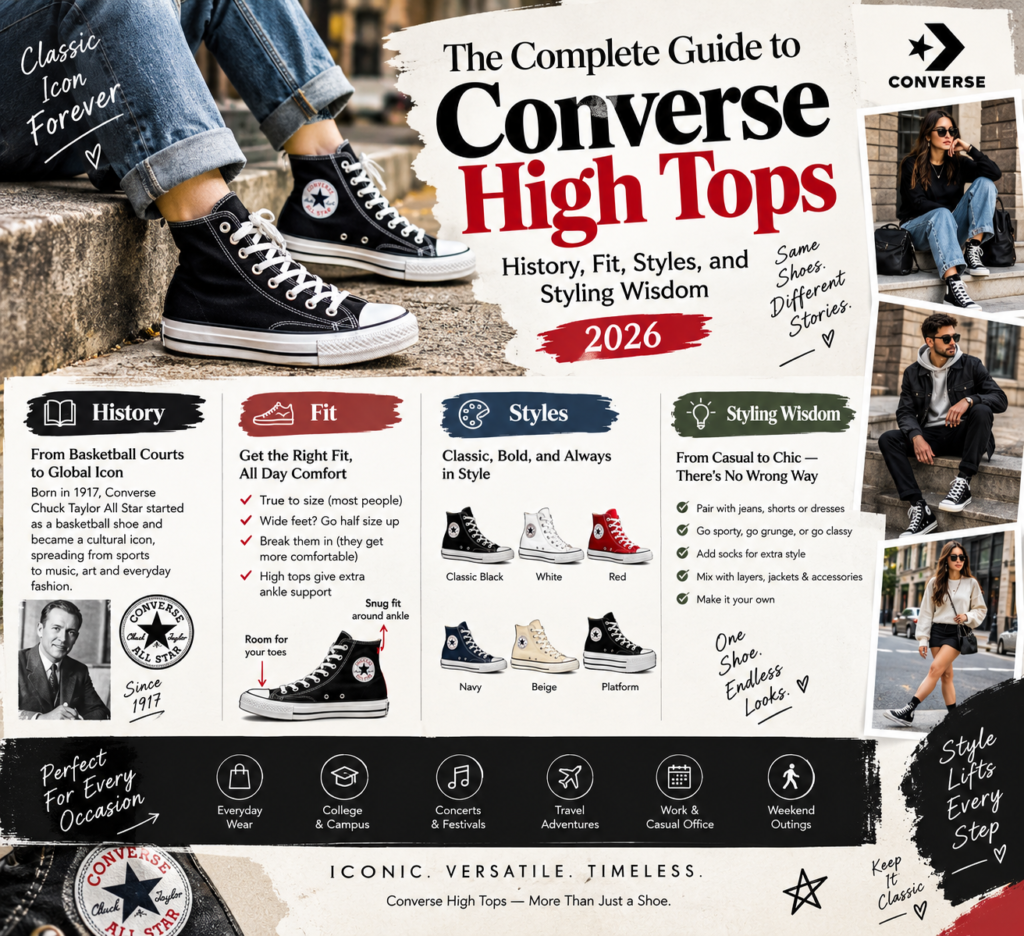
Understanding Fit and Sizing Across Converse High Top Models
Sizing is where Converse high tops trip up more buyers than any other factor. The brand itself flags that the classic Chuck Taylor All Star Canvas runs large and advises ordering a half size down . That guidance holds across a huge number of reviews and personal accounts. One experienced wearer who had been buying the same size for decades confirmed that the Chuck 70 fit the same as their All Star size, which is useful context if you are switching between models and hoping the sizing carries over .
The complications multiply when you move into specialist builds. The Cozy Suede women’s high top, for example, runs large and the brand recommends ordering a half size down, while the XXHi knee-high style runs true to size . The XXHi also introduces a different fitting challenge entirely: the calf circumference. Reviews from buyers with wider calves note that the knee-high silhouette can be snug or difficult to zip, and the common workaround is to loosen the front laces first, zip up the back, then adjust the laces to comfort . That is a real-world example of how a Converse high top can look perfect but require a fitting strategy that has nothing to do with foot length.
The practical approach is to treat each model on its own terms rather than assuming one size fits all across the Converse range. If you are between sizes, the general pattern is to size down for classic canvas and Chuck 70 models. If you have wide feet, the All Star is available in wide width for some canvas colourways, and the Chuck 70 has been reported to fit wide feet comfortably without feeling narrow . Trying in person remains the safest option, but the documented sizing patterns give you a reasonable starting point for online orders.
Material Differences That Affect Comfort, Durability, and Season
The material of a Converse high top shapes everything about how it performs: how it breathes, how it handles weather, how it ages, and how it feels on hour eight of a long day. Canvas is the default, and it is the reason the shoe is light, breathable, and relatively affordable. It also means water resistance is essentially zero unless the canvas has been treated, and stains sink in quickly if you do not address them.
Leather and suede variants change the equation considerably. The Chuck Taylor All Star Leather uses a full-grain leather upper, which gives a more structured feel and better weather resistance than canvas, while retaining the classic high-top silhouette . Suede, as seen in the Cozy Suede line, offers a softer, warmer texture and is paired with a faux fur lining for cold-weather wear, but it requires more careful cleaning than canvas and is less forgiving of rain . The All Star All Terrain takes a different approach entirely, using waterproof leather and 16oz non-wicking canvas with a quilted tongue and traction outsole for wet and cold conditions .
Seasonality matters when choosing between these options. A standard canvas Converse high top is a three-season shoe in most climates; it is comfortable in spring and autumn, warm enough for mild winter days if you wear thick socks, and breathable in summer. A Cozy Suede with faux fur lining is a genuinely winter-focused shoe, while a leather or All Terrain build handles wet weather far better than canvas. The mistake is buying a canvas pair for a wet climate and expecting it to perform like a leather boot, or buying a lined suede pair for summer and wondering why your feet are overheating.
Platform, Lugged, and Statement Silhouettes
Converse high tops are not limited to the flat, classic profile. Platform and lugged variants have become a significant part of the range, offering height, attitude, and a different styling energy. The Chuck Taylor All Star Lugged Heel Platform High Top takes the iconic design and adds a chunky lugged heel platform that lifts the silhouette and changes the proportions of whatever you pair it with .
The All Star Move Platform Leather is a lighter, more wearable take on the platform idea, using a synthetic leather upper and an innovative lightweight base that adds height without the weight penalty of some chunkier soles . For anyone who wants the Converse look but finds the flat sole too minimal, these platform builds offer a middle ground between the classic high top and a full statement shoe. The trade-off is that platform soles change how you walk and how the shoe fits around the ankle, so trying before buying is more important than with a standard pair.
The XXHi takes the high-top concept to its logical extreme, extending to knee-high coverage with a back zip for entry and adjustable laces for fit . It is a bold, fashion-forward silhouette that works as a statement piece, but it is also the most demanding in terms of fit, particularly around the calf . These statement builds are worth considering if you already know the classic high top works for you and want to expand into something with more visual impact.
Choosing Between Classic Canvas, Leather, and Specialist Builds
The decision between canvas, leather, and specialist builds comes down to where and how you will actually wear the shoes. Canvas is the right choice for dry-weather everyday wear, casual styling, and anyone who wants the authentic, lightweight Converse feel that has made the shoe a staple for over a century. It pairs with almost everything, from jeans to dresses to tailored trousers, and it is the most affordable entry point into the range.
Leather and All Terrain builds make more sense for people who live in wetter climates, want a more polished look, or need the shoe to handle rougher conditions without falling apart. A leather high top reads slightly dressier than canvas, which opens up styling possibilities with smarter casual outfits, while the All Terrain build is explicitly designed for weather resistance and outdoor use . Suede and lined variants are for cold-weather wearers who want warmth without switching to boots .
The specialist builds, platforms, and XXHi styles are less about practicality and more about expression. They work best as part of a rotation rather than as a single do-everything shoe. A platform lugged high top is excellent for a night out or a day when you want height, but it is not the pair you reach for when you are walking miles through a city. The classic canvas or Chuck 70 remains the most versatile all-rounder, which is why so many people who experiment with other builds still keep a standard pair in rotation.
Converse High Top Model Comparison Reference
The table below summarises the key differences between the most common Converse high top builds, drawing on official product information and long-term wearer feedback.
| Model | Upper Material | Fit Guidance | Key Strength | Best For |
|---|---|---|---|---|
| Chuck Taylor All Star Canvas | 12oz canvas | Runs large; size down half | Lightweight, iconic, affordable | Everyday casual wear, dry weather |
| Chuck 70 | Thicker canvas | Similar to All Star sizing | Premium comfort, sturdier build, vintage details | All-day wear, buyers wanting better cushioning |
| Chuck Taylor All Star Leather | Full-grain leather | Standard Converse sizing | Weather resistance, polished look | Smarter casual outfits, wet climates |
| All Star All Terrain | Waterproof leather + non-wicking canvas | Standard sizing | Waterproofing, traction, warmth | Cold and wet conditions |
| Chuck Taylor All Star Cozy Suede | Suede with faux fur lining | Runs large; size down half | Warmth and softness | Winter wear, cold weather |
| Lugged Heel Platform | Canvas | Standard sizing | Height, chunky aesthetic | Statement styling, nights out |
| XXHi | Durable canvas | True to size, calf-dependent | Knee-high coverage, dramatic silhouette | Fashion-forward statement looks |
Cleaning, Care, and Making Your Converse High Tops Last
The most common mistake people make with Converse high tops is throwing them in the washing machine. The advice from care guides and product recommendations is consistent: machine washing is not recommended because it weakens the adhesives, damages the canvas, and affects the overall shape of the shoe . A shoe that has been through a wash cycle rarely comes out the same, and the risk is not worth the convenience.
The hand-cleaning method is straightforward and effective. Remove loose dirt with a soft brush before gently wiping the canvas with a cloth, warm water, and a small amount of mild soap. For stubborn stains, a soft brush can be used carefully, then the shoes should air dry naturally at room temperature . Spot cleaning is particularly important for white high tops and any pair with printed or embellished details, where harsh scrubbing can damage the finish . A magic eraser works well on rubber scuffs, and a shoe protector spray can help repel water and stains before they set in .
For suede and leather variants, the care routine changes. Suede should be brushed gently and kept away from excessive moisture, while leather can be wiped with a damp cloth and conditioned occasionally to prevent cracking. Allowing shoes to air dry away from direct heat or sunlight is universal advice, as heat can warp the rubber and cause yellowing on white midsoles . Removing the insole periodically to air it out also helps reduce odour and extends the life of the shoe .
Styling Converse High Tops for Different Outfits and Occasions
Converse high tops are genuinely versatile, but there is a difference between throwing them on with anything and styling them with intention. The classic canvas high top works best with relaxed, casual outfits: straight-leg jeans, cropped trousers, midi skirts, and summer dresses all benefit from the slightly utilitarian edge the shoe brings. The high-top silhouette adds ankle coverage that mid and low-top sneakers do not, which changes the proportions of cropped trousers and skirts, often in a flattering way.
Leather and platform variants open up different styling directions. A leather high top can work with smarter casual looks, including tailored trousers and lightweight coats, bridging the gap between sneaker and shoe in a way that canvas cannot. Platform and lugged builds add height and presence, making them a natural pairing with longer hemlines and looser silhouettes where a flat shoe might get lost. The XXHi is the most styling-specific: it functions almost like a boot and works best with short hemlines or fitted trousers rather than anything that competes with the knee-high line.
The colourway matters as much as the silhouette. Classic black and white high tops are the most versatile and forgiving, while seasonal colours and prints make a stronger statement and often work best when they echo something else in the outfit. A tie-dye or printed high top does not need much competition, so keeping the rest of the look relatively simple lets the shoe do its job. For anyone building a rotation, a neutral pair plus one statement pair covers almost every casual occasion.
Common Problems and Practical Solutions
Converse high tops are not without their quirks, and knowing how to handle them saves frustration. One of the most frequently mentioned issues is squeaking, which some wearers report with certain models . Squeaking usually comes from the rubber sole rubbing against the upper or from moisture trapped between layers, and it often settles after a short break-in period. If it persists, a small amount of powder or a thin insole can sometimes resolve it by changing the contact points inside the shoe.
Laces coming untied is another common complaint, and it is more noticeable on high tops because of the longer lace length . Double-knotting is the simplest fix, though some people switch to flat laces or use a lace-locking technique. The XXHi’s back zip and adjustable laces present a different challenge: the zip can be stiff when new and the calf fit can be tight, so the recommended approach is to loosen the front laces, zip up, then adjust for comfort .
Fit issues that do not resolve after a few wears are usually a sign that the model or size is wrong rather than something that will improve with time. The canvas on a new pair does relax slightly with wear, which can help with a snug fit, but if a shoe is painful or the wrong size, breaking it in will not fix the problem . The sizing guidance from the brand and from long-term wearers is there to prevent that situation, and following it is the most reliable way to get a pair that fits properly from the first wear.
Frequently Asked Questions About Converse High Tops
Do Converse high tops run true to size?
Classic Converse high tops generally run large, and the brand advises ordering a half size down for the standard Chuck Taylor All Star Canvas . The Chuck 70 fits similarly to the All Star, so the same half-size-down approach usually works . Some specialist builds, like the XXHi, run true to size, and lined suede models like the Cozy Suede run large . The safest approach is to check the specific model’s guidance rather than assuming one rule applies across the range.
What is the difference between Chuck Taylor All Star and Chuck 70?
The Chuck Taylor All Star is the original lightweight canvas high top, while the Chuck 70 is a premium version inspired by the 1970s design, featuring thicker canvas, a cushioned insole, and a sturdier overall build . Long-term wearers consistently report that the Chuck 70 is more comfortable for all-day wear, with better arch support and a more substantial feel, though the classic remains the lighter and more affordable option .
How do I clean Converse high tops without damaging them?
Machine washing is not recommended because it can weaken adhesives and damage the canvas . The preferred method is hand cleaning: remove loose dirt with a soft brush, then wipe the canvas with a cloth, warm water, and mild soap. Stubborn stains can be treated with a soft brush, and the shoes should air dry naturally at room temperature, away from direct heat . For rubber scuffs, a magic eraser works well, and a protective spray can help prevent future stains .
Are Converse high tops suitable for wide feet?
The classic Chuck Taylor All Star is available in wide width for some canvas colourways . The Chuck 70 has been reported by wearers with wide feet to fit comfortably without feeling narrow, and the thicker canvas and sturdier build may actually suit wider feet better than the thinner classic canvas . If you have very wide feet or a high instep, trying the Chuck 70 or a leather variant may be more comfortable than the standard canvas.
Can I wear Converse high tops in winter?
Canvas high tops offer little insulation or water resistance, so they are not ideal for cold or wet winter conditions on their own . Leather and All Terrain builds provide better weather protection, and the Cozy Suede with faux fur lining is specifically designed for warmth in colder temperatures . With thick socks, a canvas pair can work for mild winter days, but for genuine cold and wet weather, a lined or leather build is the more practical choice.
Conclusion
Converse high tops have earned their place as one of the most enduring footwear designs of the last century, not through relentless reinvention but through consistency. The same basic idea, a canvas and rubber high-top shoe, has been refined, reissued, and reinterpreted across generations, and it still works because it does something few shoes manage: it combines utility with expression without asking the wearer to choose between them.
The practical takeaways are straightforward. Know which build you are buying, because a Chuck 70 is not the same shoe as a classic All Star, and a leather or All Terrain high top performs very differently from canvas. Respect the sizing guidance,softening and shaping to the person wearing it. That is the quiet reason the shoe has outlasted almost every trend that tried to replace it.



Das eigene Krautersalz ermoglicht es, individuelle Geschmacksnuancen zu kreieren.
Sie mochten [url=https://bestattungen-vonderheydt.de/2026/10/13/kraeutersalz-selber-machen-so-wird-es-aromatischer-als-gekauft/]herbal salt as a gift[/url] selbst herstellen, um ein aromatisches und naturbelassenes Krautersalz zu erhalten.
Das eigene Krautersalz ermoglicht es, individuelle Geschmacksnuancen zu kreieren.Das Krautersalz sollte fur mindestens eine Woche an einem kuhlen, dunklen Ort durchziehen, damit sich die Aromen voll entfalten konnen.
Hahaha, wow! 😂❤️