
A tote bag is one of those rare accessories that manages to be both completely practical and quietly stylish. It carries your laptop, your groceries, your gym clothes, and your entire day without complaint. Yet for something so universally owned, tote bags for women are surprisingly misunderstood. Most people buy them on impulse, use them until they fall apart, and never quite figure out why one bag feels effortless while another becomes a shoulder-aching burden.
This guide changes that. Drawing on materials science, real-world testing, and expert care guidance, it breaks down everything that matters about tote bags for women. From fabric behavior in humid climates to the hidden engineering of a well-structured base, from organization systems that actually work to the care rituals that extend a bag’s life by years, this is the deep dive your shoulder deserves.
The goal here is not to sell you on a single “perfect” bag. It is to give you the knowledge to choose wisely, use intentionally, and care properly. A tote is a tool, and like any tool, it performs best when matched to its purpose and maintained with respect.
What Makes a Tote Bag Different From Other Handbags
A tote bag is defined by its structure: an open-top or zip-top carryall with two parallel handles that typically fit over the shoulder. Unlike a satchel, which has a flap and buckle closure, or a crossbody, which has a long strap, the tote prioritizes access and capacity. It is the bag you reach into without looking, the one that swallows a laptop, a water bottle, and a week’s worth of mail without complaint.
That openness is both its greatest strength and its primary weakness. The lack of closure means quick access, but it also means vulnerability to pickpockets, rain, and the dreaded tipping-over spill. This is why so many tote bags for women now incorporate internal organization, zippered pockets, or removable inserts. The bag has evolved from a simple open sack into a system, and understanding that evolution helps you choose one that actually works for your life rather than against it.
The Materials That Define Tote Bag Performance
Fabric choice determines everything about how a tote behaves. Canvas, typically tightly woven cotton, is breathable and grounded, excellent in dry heat but vulnerable to moisture. Uncoated canvas absorbs rain rapidly, and in high-humidity environments, a damp canvas tote can develop mildew within days if not properly dried . Nylon, by contrast, is hydrophobic by nature; water beads and rolls off, making it the climate-adaptive workhorse for rainy seasons and daily commutes where electronics need protection .
Leather sits at the opposite end of the spectrum: elegant, structured, and demanding. Soft leather tote bags for women hold their shape beautifully and develop a patina over time, but natural hide is porous and hygroscopic, meaning it absorbs moisture from the air. In tropical humidity, leather straps can turn tacky from sweat, leaving marks on clothing . This does not make leather a bad choice, but it does mean leather bags require more intentional care and storage than their synthetic counterparts.
Canvas, Nylon, and Leather: A Practical Comparison
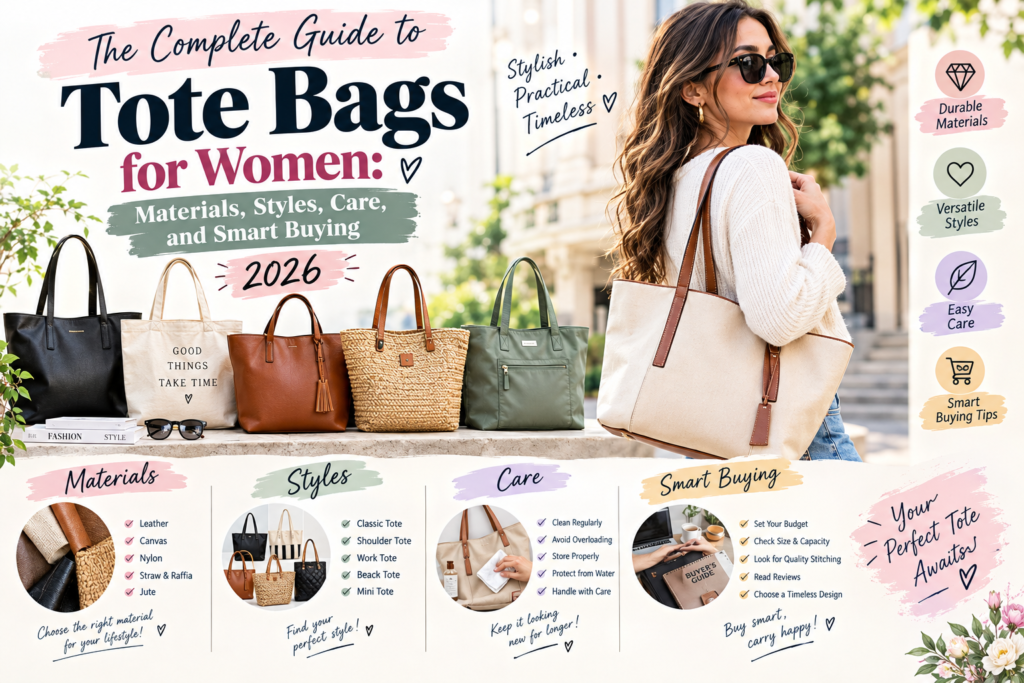
Choosing between these three core materials comes down to climate, lifestyle, and maintenance willingness. Canvas suits dry climates and casual errands but demands vigilance against dampness. Nylon excels in wet conditions and for carrying electronics, though it lacks the breathability and polish of natural fibers. Leather offers timeless aesthetics and durability but requires conditioning, protection from prolonged sun exposure, and careful storage to prevent cracking .
| Material | Best For | Water Resistance | Breathability | Care Level | Longevity |
|---|---|---|---|---|---|
| Canvas | Dry climates, casual use, markets | Low (unless coated) | High | Moderate (air-dry fully) | Moderate |
| Nylon | Commutes, rainy seasons, tech carry | High | Low | Low (wipe clean) | High |
| Soft Leather | Professional settings, polish | Low to moderate | Moderate | High (condition, store carefully) | Very high with care |
How to Organize a Tote Bag So Nothing Gets Lost
The open interior of a tote is a black hole for small items. Keys, lip balm, and pens vanish into the base, and finding anything requires a full excavation. The solution is not a better bag but a better system. Tote bag inserts, essentially a purse inside a purse with pouches and compartments, slide into the open interior and create instant structure . A well-designed insert includes dedicated spots for a water bottle, phone, notebook, and cosmetics, so everything has a home.
Not all inserts are created equal. Some “pockets” are open at the bottom, meaning small items slip through and pool at the base of the bag, defeating the purpose entirely . Look for organizers with sewn-closed pockets and at least one zippered compartment for valuables. The right insert transforms a chaotic carryall into a functional system where you can reach for your phone without looking and find it every time.
The Problem With Open Dividers and How to Spot Them
Many tote bags for women advertise “multiple compartments” that turn out to be useless in practice. The dividers are open at the bottom, so pens, chapstick, and small items simply fall through to the base and roam freely . From a user’s perspective, this is worse than having no dividers at all, because it creates the illusion of organization without delivering the reality. You reach into the “phone pocket” and find nothing but lint.
The fix is straightforward: before buying, check whether the pockets are sewn closed at the bottom. Product reviews often reveal this flaw, with frustrated buyers noting that their “pockets” are just loose dividers . If you already own a bag with this issue, a standalone insert with proper pockets solves the problem for a modest cost.
Why Some Tote Bags Refuse to Stand Up
A tote that collapses into a puddle of fabric every time you set it down is a daily annoyance. The bag tips over in the car, spills its contents on the floor, and refuses to stay upright while you load it. This is a structural problem, not a fabric problem. Bags that stand on their own typically include a reinforced base, a bottom board, or a laminated exterior that maintains rigidity .
If you value a self-standing bag, look for these features in the product description. A bottom gusset with a stiffener, a structured leather base, or a laminated finish all contribute to stability. The trade-off is usually weight; a bag with a rigid base weighs more than an unstructured canvas sack. For commuters who set their bag down frequently, that extra weight is often worth the convenience.
Choosing the Right Size for Your Daily Carry
Tote bags for women come in a spectrum of sizes, and choosing wrong means either cramming or drowning. A small tote, roughly the size of a sheet of paper, works for essentials: phone, wallet, keys, a paperback. A medium tote fits a tablet, a notebook, and a water bottle, making it ideal for meetings and light errands. A large tote accommodates a 15-inch laptop, a lunch container, and a change of shoes, serving as a full commuter or travel bag.
The mistake most people make is buying for the maximum rather than the average. If you carry a laptop twice a week, a large tote makes sense. If you carry a laptop once a month, a medium bag with a separate laptop sleeve is lighter and more comfortable the rest of the time. Measure the items you carry most frequently, add an inch of breathing room, and let that guide your size choice rather than the allure of “just in case” capacity.
The Weight Problem: Why Some Totes Hurt Your Shoulder
A tote loaded with a laptop, water bottle, and daily essentials can easily exceed ten pounds. When that weight hangs from a single shoulder strap, it creates asymmetric pressure on the trapezius and can lead to nagging shoulder and neck pain. The strap width matters enormously here. Thin straps concentrate pressure on a narrow area, while wider straps distribute it across more surface area, reducing discomfort.
If you regularly carry heavy loads, look for tote bags for women with padded or reinforced straps at least an inch and a half wide. Crossbody options distribute weight differently, using the torso rather than a single shoulder, though they change the bag’s visual profile. The most ergonomic solution is often a tote with a detachable crossbody strap, allowing you to switch carry modes based on load and comfort.
Leather Care: Conditioning, Cleaning, and Storage
Leather tote bags for women reward care with longevity, but they punish neglect with cracking, fading, and stiffness. The core routine is simple: clean gently, condition every three to six months, and store properly. Use a soft, dry cloth to remove dust from seams and hardware, then apply a pH-balanced leather cream sparingly with a cloth, never directly onto the bag . Buff off excess after a few minutes. A new bag needs no conditioning for roughly its first six months.
Avoid household oils like olive, coconut, or mink oil. These darken the hide, oxidize over time, and can actually harden the fibers they were meant to soften . If the leather feels dry at flex points, condition with a purpose-made cream and nothing else. For storage, stuff the bag with acid-free tissue to maintain shape, place it in its cotton dust bag, and keep it in a cool, dry place away from direct sunlight . Never store leather in plastic, which traps moisture and creates ideal conditions for mold.
Canvas and Nylon: Easier Care, Different Rules
Canvas and nylon totes are far more forgiving than leather, but they still have rules. Canvas can often be machine-washed on a gentle cycle with cold water if it is uncoated and free of leather trim, but printed or coated canvas should be spot-cleaned only to prevent cracking and fading . Always air-dry; high heat shrinks and warps fabric. Turn the bag inside out before washing to protect exterior prints and reduce abrasion.
Nylon is the simplest material to maintain. A damp cloth with mild soap handles most spills, and the bag dries almost instantly. Do not use bleach, which fades colors, and avoid machine washing unless the care label explicitly permits it. For both canvas and nylon, the most important habit is complete drying before storage. A damp bag, even slightly damp, invites mildew that leaves permanent stains and odor .
Why Humidity Destroys Bags and How to Prevent It
In humid climates, tote bags for women face a relentless enemy. Mildew spores flourish when relative humidity exceeds roughly seventy percent and temperatures sit between twenty and thirty degrees Celsius . A canvas bag left slightly damp in a closed closet can develop visible mold within days. Leather fares differently but no better: it absorbs ambient moisture, becomes tacky, and can develop a musty smell that lingers.
The prevention strategy is straightforward. Never store a bag until it is completely dry. In humid environments, use silica gel packets in storage areas and consider a dehumidifier for closets. For leather, condition slightly more often during humid months and keep bags away from air conditioning vents, which create localized dryness that accelerates cracking . If a bag does get wet, empty it, wipe excess moisture, and let it air-dry away from heat before putting it away.
Budget Totes Versus Investment Pieces
The price range for tote bags for women spans from under twenty dollars to several thousand. At the budget end, you find synthetic materials, basic construction, and limited durability. At the investment end, you find full-grain leather, reinforced stitching, and hardware designed to last decades. The question is not which is objectively better but which matches your usage and expectations.
A student who needs a bag for a semester might find a forty-dollar nylon tote entirely sufficient. A professional who carries the same bag daily for five years will likely get better value from a three-hundred-dollar leather tote that can be repaired and conditioned. The middle ground, roughly one hundred to two hundred dollars, often offers the best balance: quality materials, thoughtful construction, and enough durability to justify the spend without demanding excessive care.
The Quiet Luxury of Understated Tote Bags
There is a growing preference for tote bags for women that prioritize material quality and construction over visible logos. This “quiet luxury” approach favors clean lines, supple leather, and subtle hardware. A well-made tote in a neutral tone communicates polish without shouting, and it pairs with virtually any outfit. The appeal is not just aesthetic; it is practical. A bag without prominent branding is less likely to date, more versatile across contexts, and often better constructed because the value proposition rests on quality rather than recognition.
This does not mean branded bags are without merit. For some, the confidence of a recognized design or the status it conveys matters. The point is simply that a logo is not a proxy for quality. Evaluate the leather thickness, the stitching density, the weight of the hardware, and the comfort of the straps. These are the things that determine whether a bag serves you well, regardless of what is printed on the front.
Matching Your Tote to Your Lifestyle
The most common mistake in buying tote bags for women is choosing based on appearance alone. A beautiful cream leather tote is a poor choice for someone who commutes by bicycle in a rainy city. A structured black nylon bag is wrong for someone who wants a beach-ready carryall. The bag must match the life it will live.
Consider your primary use case. If it is work, prioritize laptop protection, organization, and professional aesthetics. If it is travel, prioritize lightweight materials, secure closures, and durability. If it is everyday errands, prioritize comfort, easy access, and washability. Most people need at least two totes: one for work or structured carry, and one for casual or messy tasks. Buying a single bag to do everything usually results in a bag that does nothing particularly well.
Sustainable Choices in Tote Bag Materials
Sustainability in bags is more nuanced than a single label. Natural fibers like organic cotton and linen are renewable and biodegradable, but they may require more water and land to produce than synthetics. Recycled nylon and polyester divert waste from landfills but are still plastic-based and shed microfibers during washing. Leather is a byproduct of the meat industry, which raises ethical questions for some, while plant-based leather alternatives are emerging but often rely on plastic binders .
The most sustainable choice is almost always the one you already own or the one you will use for years. Buying a well-made bag and caring for it properly reduces the total number of bags you consume over a lifetime, which matters more than the specific material. When buying new, look for brands that disclose their supply chains, offer repair services, and design for longevity rather than trend cycles.
Frequently Asked Questions
What size tote bag is best for work?
The best work tote depends on what you carry. If you need to transport a laptop, choose a size that accommodates your device with at least an inch of clearance on all sides, typically around fifteen by eleven inches for a standard laptop. Look for padded compartments, reinforced straps, and a professional appearance. If you only carry documents and small essentials, a medium tote around twelve by ten inches is lighter and more comfortable. Always measure your largest regular item before buying, and prioritize organization features like zippered pockets or a removable insert to keep contents secure and accessible.
How do I clean a leather tote bag without damaging it?
Start by wiping the bag with a soft, dry cloth to remove surface dust, focusing on handles and corners where contact is heaviest. For deeper cleaning, use a slightly damp cloth with a drop of mild soap or a dedicated leather cleaner, working gently in circular motions and avoiding soaking the seams. Dry immediately with a second cloth, then condition with a pH-balanced leather cream applied sparingly via a cloth, not directly onto the bag. Never use alcohol wipes, baby wipes, or household sprays, as these strip the finish that protects the dye beneath . For stubborn stains, consult a professional leather specialist rather than risking further damage.
Why does my tote bag keep falling over?
A tote bag falls over when it lacks structural rigidity at the base or when it is top-heavy. Bags with a reinforced bottom board, a laminated exterior, or a stiff leather base stand upright more reliably than unstructured fabric bags . If your bag collapses, try distributing weight more evenly, placing heavier items at the bottom and center, or using a structured insert that provides a rigid base. Some bags are simply designed to be soft and slouchy, and no amount of packing will make them stand. If self-standing is important to you, check product specifications for terms like “structured base” or “bottom board” before purchasing.
How often should I condition a leather tote bag?
Most leather care experts recommend conditioning every three to six months, depending on frequency of use and climate . A bag used daily in a dry climate may need conditioning more often than one used occasionally in a humid environment. The best indicator is touch: press a thumb into a flex point such as the base of a handle. If the leather feels dry or papery, it is time to condition. If it feels supple and slightly tacky, it has enough moisture. A new leather bag needs no conditioning for roughly its first six months, as it leaves the tannery fully nourished.
Can I machine wash a canvas tote bag?
Many uncoated canvas tote bags for women can be machine-washed on a gentle cycle with cold water, provided they have no leather trim, coated finishes, or delicate prints . Turn the bag inside out before washing to protect the exterior, use a small amount of mild detergent, and place it in a mesh laundry bag if you want extra protection. Always air-dry; high heat from a dryer can shrink or warp the fabric. If the bag has printed graphics, leather accents, or a waxed coating, spot clean only with a damp cloth and mild soap, as machine washing can crack prints and damage special finishes.
Conclusion
The right tote bag for women is not the most expensive one or the trendiest one. It is the bag that fits your daily carry, suits your climate, and feels comfortable on your shoulder from morning to evening. Understanding materials, organization, care, and sizing transforms the buying process from guesswork into informed choice. You stop replacing bags every year and start investing in one that serves you well for many.
The final takeaway is this: treat your tote as a system, not just a sack. Organize it with intention, care for it with consistency, and choose it with honesty about how you actually live. A well-chosen tote carries your laptop, your groceries, and your day with equal ease. It is the quiet workhorse of a functional wardrobe, and when you understand what makes it work, you never settle for one that does not.