

Few accessories carry the same instant recognition as a pair of Ray-Bans. When you think of rayban sunglasses women reach for, images of Audrey Hepburn, classic Hollywood glamour, and effortless street style come to mind. But beyond the cultural cachet lies a practical question: which styles actually work for your face, your lifestyle, and your budget? This guide digs into the details that matter, from frame geometry and lens technology to the subtle signs that separate a genuine pair from a convincing fake.
rayban sunglasses women
The brand’s history stretches back to 1937, when Ray-Ban introduced the Aviator for military pilots dealing with glare at high altitudes. That functional origin story matters because it explains why the brand still prioritizes optical performance alongside aesthetics. Over the decades, Ray-Ban expanded into acetate frames, partnered with designers, and became a staple of both runway fashion and everyday wear. For women, the appeal lies in that blend of heritage, versatility, and genuine protection for your eyes.
Understanding what makes a particular frame flattering involves more than trying on a few pairs in a store mirror. It requires knowing your face shape, the proportions that balance your features, and how different lens tints and frame materials change the overall effect. This guide walks through all of it with the depth that a significant purchase deserves.
Why Ray-Ban Remains a Benchmark for Women’s Eyewear
Ray-Ban occupies a rare position in fashion: it is simultaneously a luxury-adjacent brand and an accessible one. The frames appear on celebrities and in high-fashion editorials, yet they are also widely available at optical retailers and online. That accessibility does not diminish their status. Instead, it reinforces the idea that good design should be available to people who care about how they look and how well their eyes are protected.
The brand’s durability is another factor. A well-cared-for pair of Ray-Bans can last a decade or more. The acetate frames are thick and substantial without being heavy. The metal hinges are engineered to withstand daily opening and closing. The lenses, particularly the polarized and gradient options, maintain their optical clarity over time. For women who want a single pair of sunglasses that works across seasons and outfits, Ray-Ban delivers a reliability that cheaper alternatives rarely match.
There is also the matter of resale and repair. Ray-Ban maintains a network of authorized repair centers, and replacement lenses and temples are available for most current models. That infrastructure means a damaged pair is not necessarily a lost pair. Few fashion accessories offer that kind of long-term support, which is part of why the brand retains customer loyalty across decades.
The Iconic Shapes and What They Signal
The Aviator is the shape most people picture when they hear the brand name. Its teardrop lenses, thin metal frame, and double bridge create a look that is both utilitarian and glamorous. For women, the Aviator works particularly well in smaller sizes and softer tints like gradient grey or rose . The curved lens shape softens angular jawlines and adds a touch of vintage cool to casual outfits.
The Wayfarer represents the other pole of the Ray-Ban universe. Introduced in 1952 as a departure from metal frames, it used acetate to create a thick, angular silhouette that felt modern and rebellious . For women, the Wayfarer adds structure and confidence. It works especially well on rounder faces because the straight top line and angled corners create definition. The New Wayfarer and Wayfarer Way offer slightly softer interpretations for those who find the original too bold .
The Clubmaster sits somewhere between the two. It pairs a bold acetate browline with a slim metal lower rim, drawing the eye upward and outward. That balance makes it flattering for diamond, square, and heart-shaped faces, particularly when the goal is to offset a narrower chin . The Clubmaster reads as intellectual and polished, a good choice for professional settings or anyone who wants a frame that feels distinctive without being loud.
Round frames, including the Erika and the Oval Solid Evolve, offer a softer, more romantic option. The circular lens breaks up the straight lines of a square or angular face, creating a gentler overall impression . The Erika in particular has become a staple for women seeking an oversized, flattering shape with a bit of retro flair . Its nylon frame keeps it lightweight, and the range of lens treatments from green gradient to mirrored finishes allows for personalization.
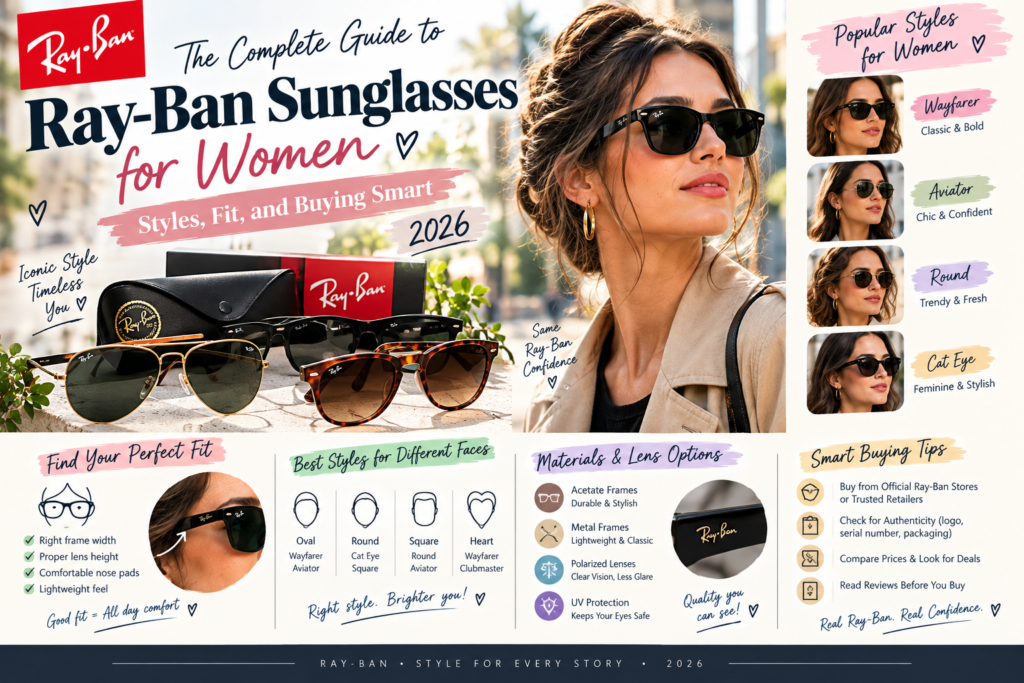
| Style | Shape Character | Best Face Shapes | Typical Material | Signature Detail |
|---|---|---|---|---|
| Aviator | Teardrop, curved | Oval, heart, square | Metal | Double bridge, thin temples |
| Wayfarer | Angular, thick | Round, oval | Acetate | Bold front, angled corners |
| Clubmaster | Browline, mixed | Diamond, square, heart | Acetate and metal | Two-tone construction |
| Round | Circular, retro | Square, angular | Metal or acetate | Wire rim or chunky rim |
| Cat-Eye | Upswept, feminine | Round, oval, heart | Acetate | Flared upper corners |
How to Match Ray-Ban Frames to Your Face Shape
Face shape is the single most useful variable when narrowing down options. An oval face is the most versatile and can carry almost any Ray-Ban shape, though Aviator, Clubmaster, and square frames tend to look particularly balanced . Round faces benefit from angular frames like the Wayfarer or a cat-eye, which add structure and prevent the face from appearing too soft. Square faces are softened by the curves of the Aviator, Round, or Erika styles .
Heart-shaped faces, characterized by a wider forehead and a narrower chin, look best in frames that are wider at the top, such as cat-eye or Aviator styles. These draw attention upward and balance the lower face. Diamond-shaped faces, with prominent cheekbones and a narrow forehead and chin, suit Clubmaster and oval frames that add width at the brow and soften the cheekbone line.
Beyond face shape, consider the scale of the frame relative to your features. Oversized frames can overwhelm delicate features, while small frames can get lost on a larger face. The goal is balance, not a rule. Trying on multiple pairs, either in person or through a retailer with a generous return policy, remains the most reliable way to find the right proportion.
Lens Technology and What It Means for Your Eyes
Ray-Ban lenses are not just tinted glass. They are engineered for specific visual outcomes. The classic G-15 lens, developed for military use, absorbs 85 percent of visible light while maintaining natural color perception. That makes it ideal for driving and everyday wear, because it reduces glare without distorting the colors around you . The green tint is the signature look of many vintage-inspired frames.
Polarized lenses take glare reduction further by blocking more than 99 percent of reflected light . For women who spend time near water, snow, or on the road, polarized lenses offer a meaningful upgrade in visual comfort. They eliminate the harsh reflections that bounce off surfaces and can cause eye strain. The trade-off is that polarized lenses can make some digital displays appear dark or distorted when viewed at certain angles, which is worth knowing if you frequently check your phone or car dashboard while wearing sunglasses.
Gradient lenses offer a different benefit. They are darker at the top and lighter at the bottom, which provides more protection when looking up and more visibility when looking down. That makes them practical for driving, reading, or any activity where you need to see close-up details. Mirrored lenses, available in blue, green, orange, and other finishes, add a bold fashion statement while still providing full UV protection .
Frame Materials and Build Quality
Acetate is the most common material for Ray-Ban women’s frames. It is a plant-based plastic derived from cotton fibers and wood pulp, and it can be produced in a wide range of colors and patterns, from classic black to tortoiseshell and translucent crystal. Acetate frames feel substantial and hold their shape well, but they can be adjusted by an optician if they become loose or misaligned.
Metal frames, typically made from monel, stainless steel, or titanium alloys, offer a lighter weight and a more delicate appearance. Titanium is particularly valued for its strength-to-weight ratio and resistance to corrosion. The Light Ray technology introduced by Ray-Ban uses titanium temples and a patented screwless hinge system to create frames that are both durable and exceptionally light . For women who find acetate frames too heavy or who prefer a more minimal aesthetic, metal options are worth exploring.
Nylon is another material used in some women’s styles, including the Erika and some newer Propionate models . It is lightweight, flexible, and resistant to impact, making it a good choice for active wear or for anyone who is hard on their accessories. The trade-off is that nylon frames can feel less premium than acetate or metal, though modern manufacturing has closed much of that gap.
Spotting Authentic Ray-Ban Sunglasses
Ray-Ban is one of the most counterfeited eyewear brands in the world, which means buying from an unauthorized seller carries real risk . A fake pair may look convincing at a glance, but it often skips proper UV protection, uses inferior lens materials, and falls apart within months. The good news is that genuine Ray-Bans have several telltale signs that are difficult to replicate.
The most reliable indicator is the laser-etched RB logo on the left lens. On a genuine pair, this etching is precise, subtle, and does not scratch off . A missing etching, a crooked one, or one that can be rubbed away is a clear warning. The right temple should carry the Ray-Ban logo and model details, while the inside of the temple shows the model number, lens size, country of origin, and the CE mark. The engraving should be crisp and evenly spaced, never shallow or smudged .
Build quality matters too. Genuine Ray-Bans feel solid and well-balanced. The hinges operate smoothly and firmly, without the loose wobble that plagues cheap frames. The acetate has a polished, substantial feel. Packaging is another clue: genuine pairs come with a branded case, a cleaning cloth, and a booklet, all with crisp printing and correct logos. But packaging alone is never proof, because counterfeiters have become skilled at replicating boxes and cloths. The frame itself is the final authority.
Price Expectations and Where to Buy
Ray-Ban maintains fairly consistent pricing across authorized retailers, which means significant discounts from unknown sellers are a red flag. Prices vary by model, lens type, and region, but as a general reference, classic styles like the Erika and Aviator typically fall in the mid-range for designer sunglasses. Polarized and specialty lens options add to the cost. The Propionate Woman Sunglass, for example, sits at a higher price point than the Erika Classic .
Buying from an authorized dealer or a reputable optical retailer is the safest route. These sellers offer genuine products, warranty support, and often complimentary adjustments and cleaning. Online marketplaces can be convenient, but they also carry a higher risk of counterfeits, particularly when the price is well below the standard retail range. If a deal seems too good to be true, it almost certainly is.
For women who need prescription lenses, many Ray-Ban frames can be fitted with prescription lenses by an optician. This transforms a fashion accessory into a functional medical device, which is a significant value proposition. The frame styles that work as prescription sunglasses are generally the same ones that work as standard sunglasses, though larger frames may require special lens considerations.
Care and Maintenance for Longevity
A pair of Ray-Bans is an investment, and treating it accordingly extends its life. The most common mistake is using a shirt or tissue to clean the lenses. Those materials can contain fibers that scratch the lens coating. A microfiber cloth, included with most genuine pairs, is the correct tool. For deeper cleaning, lukewarm water and a drop of mild dish soap can remove oils and residue without damaging the lens or frame.
Storage matters too. When not in use, the sunglasses should live in their case. Leaving them face-down on a surface invites scratches. Leaving them in a hot car can warp acetate frames and damage lens coatings. The temples should be folded gently, not forced. If the frames become loose or misaligned, an optician can adjust them, usually at no cost if you purchased from that retailer.
Lens replacement is an option if the frames are in good condition but the lenses are scratched or worn. Ray-Ban and authorized repair centers offer replacement lenses for most current models. This is often more economical than buying a new pair and allows you to keep a frame you love. It also reduces waste, which is a practical benefit for anyone concerned about the environmental impact of fashion consumption.
Styling Ray-Ban Sunglasses for Everyday Wear
The right pair of Ray-Bans can anchor an outfit. A classic Aviator with a gold frame and green G-15 lens pairs naturally with denim, white shirts, and neutral tones. It reads as effortless and slightly retro, a good match for casual days and weekend errands. A black Wayfarer adds edge to a monochrome outfit or a leather jacket. It is a frame that says you know what you like and you are not trying too hard.
Cat-eye and Erika styles lend themselves to more feminine, polished looks. They pair well with dresses, blouses, and softer color palettes. Gradient and rose-tinted lenses soften the overall effect and feel particularly appropriate for spring and summer . Mirrored lenses, by contrast, are bolder and more fashion-forward. They work well with minimal outfits where the sunglasses become the focal point.
The frame color should complement the wearer’s coloring. Warm undertones often look best in gold, tortoiseshell, and brown frames. Cool undertones tend to suit silver, black, and blue frames. This is not a rigid rule, but it is a useful starting point when choosing between two options. Trying on frames in natural daylight, rather than under artificial store lighting, gives the most accurate sense of how a color will look in real-world conditions.
Common Buying Mistakes to Avoid
One of the most frequent mistakes is choosing a frame based solely on how it looks on someone else. A style that flatters a friend or a celebrity may not work for your face shape or proportions. Social media and advertising create aspirational images, but sunglasses are functional objects that need to fit your face and serve your lifestyle. What works for one person may be entirely wrong for another.
Another mistake is prioritizing style over lens quality. A beautiful frame with poor lenses does not protect your eyes effectively. UV protection is not optional, especially for anyone who spends significant time outdoors. Ray-Ban’s commitment to optical performance is a major reason to choose the brand, and settling for a counterfeit pair undermines that benefit. The savings are not worth the risk to your eye health.
Finally, many people buy sunglasses without considering how they will be used. A pair meant for driving has different requirements than a pair meant for beach vacations or everyday city wear. Polarized lenses are excellent for driving and water activities but can interfere with some digital displays. Gradient lenses are versatile but offer less protection when looking directly at the sun. Thinking through your actual use cases before you buy leads to a more satisfying purchase.
Frequently Asked Questions
What are the most popular Ray-Ban sunglasses for women?
The most popular styles include the Aviator, Wayfarer, Clubmaster, Round, and Erika. The Aviator and Wayfarer are the two shapes most people associate with the brand, and both have remained largely unchanged for decades, which is a testament to their enduring design . The Erika has gained popularity more recently for its oversized, flattering shape and lightweight nylon frame . The best choice depends on your face shape and personal style rather than popularity alone.
Which Ray-Ban style suits an oval face?
An oval face is the most versatile and can carry almost any Ray-Ban shape. Aviator, Clubmaster, and square frames tend to look particularly balanced on oval faces because they complement the natural proportions without adding unnecessary width or length . Round frames can also work well, though they may soften the face more than angular styles. The key is to avoid frames that are significantly wider or narrower than the widest part of your face.
Are Ray-Ban lenses really polarized?
Not all Ray-Ban lenses are polarized. The brand offers both polarized and non-polarized options across its range. Polarized lenses block more than 99 percent of reflected light and are particularly useful for driving, water activities, and any situation where glare is a concern . Non-polarized lenses, including the classic G-15, still provide full UV protection and excellent optical clarity. When shopping, check the product description or the lens marking to confirm whether a specific pair is polarized.
How can I tell if Ray-Ban sunglasses are authentic?
Check for a laser-etched RB logo on the left lens that does not scratch off, crisp engraving inside the temple showing the model number, lens size, and country of origin, and clean, well-aligned logos on the frame . Genuine Ray-Bans feel solid and well-balanced, with hinges that operate smoothly. Packaging should be branded and high-quality, but the frame itself is the most reliable indicator. Buying from an authorized seller is the simplest way to guarantee authenticity.
Where are Ray-Ban sunglasses made?
Most authentic Ray-Ban sunglasses are made in Italy, and genuine frames are typically engraved with “Made in Italy” inside the temple . However, some models are manufactured in China. Both Italian-made and Chinese-made Ray-Bans can be genuine, though many enthusiasts prefer the Italian production for perceived quality differences . The country of origin is one factor to consider, but it should not be the sole basis for judging authenticity. The etching, engraving, and build quality are more reliable indicators.
Conclusion
Choosing a pair of rayban sunglasses women will actually wear and love comes down to understanding your face, your lifestyle, and the details that make a genuine pair worth the investment. The brand’s enduring appeal rests on a foundation of real optical engineering, not just marketing. The Aviator and Wayfarer earned their iconic status because they work, protecting eyes while looking effortlessly cool. The newer shapes and materials continue that tradition with options for every preference and face shape.
The final insight is this: sunglasses are one of the few accessories you wear on your face every day. They affect how you see the world and how the world sees you. A pair that fits well, protects your eyes properly, and makes you feel confident is worth seeking out. Whether you choose a classic G-15 Aviator for driving or a rose-tinted Erika for summer afternoons, the right Ray-Bans become more than an accessory. They become part of how you move through the world.