
Coach handbags have a rare distinction in fashion. They are simultaneously an entry point and a destination, a first designer purchase and a collector’s obsession. Walk through any city in the world and you will spot them: the slouchy Brooklyn tote slung over a shoulder, the structured Tabby with its signature C clasp, the vintage ergonomic shoulder bag that a Gen Z shopper hunted down on a resale site. The brand has spent more than eight decades building a reputation for leather goods that are well made, thoughtfully designed, and priced within reach of people who want quality without the theatre of European luxury pricing.
What makes Coach particularly interesting right now is that it has managed something few heritage American brands pull off. It lost its way for a period, became associated with mall discounts and logo-heavy canvas, and then rebuilt itself into something that fashion insiders and younger shoppers genuinely want to carry. The revival is not marketing spin. It is visible in the product, in the celebrity endorsements, and in the financial results. Understanding what changed, what the best styles actually offer, and how to buy wisely whether you are spending two hundred dollars or two thousand is the point of this guide.
What Coach Handbags Represent in Today’s Market
Coach occupies a specific and valuable position in the accessories landscape: accessible luxury. The brand sits below the pricing of European houses like Louis Vuitton and Chanel, but above mass-market labels, offering leather craftsmanship and design credibility at price points that typically range from around $200 to $500 for full-price handbags. This positioning has proven remarkably resilient because it meets a real consumer need. Many people want a bag that feels special, lasts for years, and does not require a financing plan to acquire.
The brand’s history explains its durability. Coach was founded in 1941 as a family-run leather workshop in New York, and its founding inspiration was practical rather than precious. The founders looked to the soft, worn patina of baseball mitts and developed glove-tanned leather that was durable, flexible, and aged beautifully, a marked departure from the stiff, boxy top-handle bags that dominated the mid-century market. That origin story matters because it shaped a design philosophy that still runs through the product line. These are bags built to be used, carried daily, and improved by wear rather than preserved in a dust bag.
The market has rewarded that consistency. Coach’s parent company Tapestry reported 25% year-over-year revenue growth for the brand in a recent quarter, with 2.9 million new customers globally and Gen Z shoppers driving a significant portion of that acquisition. The brand’s gross margins consistently exceed 75%, a figure that reflects genuine pricing power rather than promotional discounting. When people pay full price for a Coach bag, they are expressing a judgment about value that the financials confirm.
The Story Behind the Brand and Why Craftsmanship Matters
Understanding Coach’s approach to making bags requires going back to the beginning. The company was founded in 1941 by artisans who worked with leather, but the pivotal moment came in 1961 when Miles and Lillian Cahn acquired the business. Lillian Cahn was the one who pushed the company into women’s handbags, suggesting a design based on a paper shopping bag she remembered from her childhood, used to deliver homemade noodles to customers during the Depression. That tote became one of Coach’s first classics, and it established a pattern that would repeat throughout the brand’s history: functional design drawn from real life rather than abstract trend cycles.
The next major chapter arrived in 1962 when Bonnie Cashin joined as lead designer. Cashin was a forward-thinking creative who introduced the signature turn-lock hardware, popularized carrying two bags at once, and infused the label with a distinct New York energy that still resonates. Her contribution was not just aesthetic. She understood that women needed bags that worked for busy lives, and her designs reflected that. The brass turn-key hardware she introduced became a Coach signature and remains one of the most reliable authentication markers on both vintage and modern bags.
The brand has passed through several design eras since then, from Reed Krakoff’s modernist minimalism in the late 1990s to Stuart Vevers’s current direction, which has been credited with reviving Coach from a sleepy heritage label into a genuine fashion contender. Vevers has said his aim is to preserve what he calls the essential American-ness of the label while adding elements of youth and rebellion. The results are visible in styles like the Tabby, which draws on a 1970s archive design but feels entirely current, and the Brooklyn, which became the hottest fashion product of a recent quarter according to the global shopping platform Lyst.
The Iconic Coach Bag Styles Worth Knowing
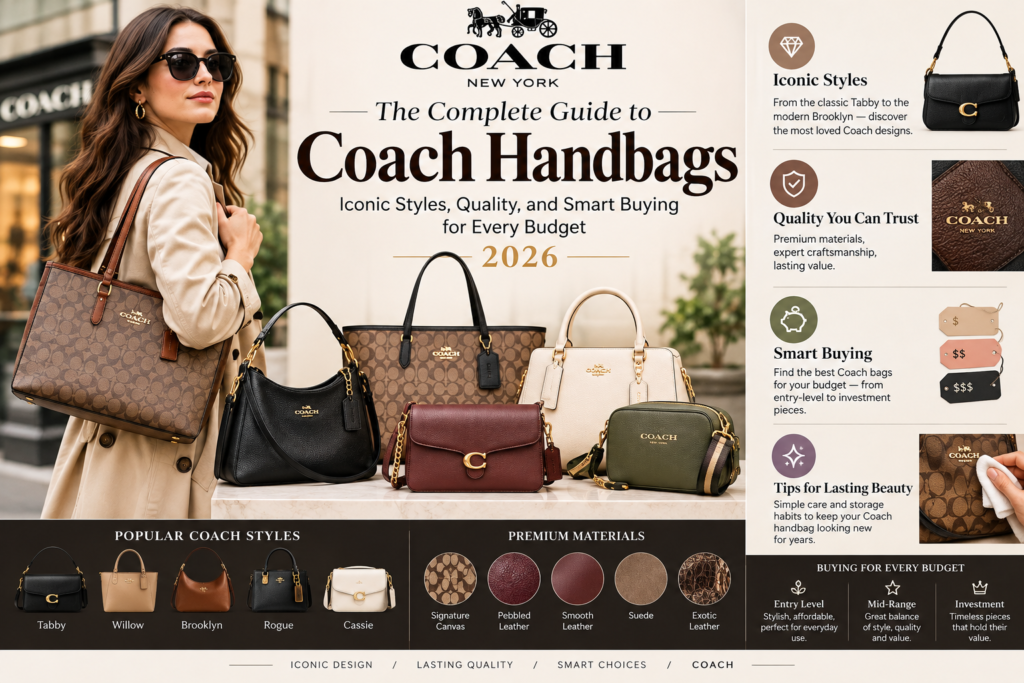
The current Coach lineup is anchored by a handful of franchises that have achieved genuine cultural traction. The Tabby is arguably the most important. It is a structured shoulder bag with a distinctive C-logo clasp, designed with personalization in mind. Shoppers can load it with pins, charms, and chains, and the brand stocks an extensive range of accessories including rhinestone cherries, enameled bows, and chunky strawberries. The Tabby draws from the archives, specifically a 1970s design, but its playful customization options have attracted a younger audience that includes Emily Ratajkowski, Jennifer Lopez, and brand ambassador Elle Fanning.
The Brooklyn represents a different sensibility entirely. It is Coach’s take on the does-it-all tote: roomy, refined, and relaxed enough to carry everything for work, travel, and beyond. Vogue describes it as available in a variety of sizes and an elegant range of suedes and leathers, and notes that it leads as a bestseller for the company. The Brooklyn was named the hottest fashion product of a recent quarter by Lyst, with demand for Coach products on the platform up 332% year-over-year. Charli XCX and Camila Morrone are among the celebrities who have been spotted carrying it.
Beyond these two anchors, the Chelsea offers a minimalist alternative with natural-grain leather and a supersoft texture, a favorite of Bella Hadid who styled hers with a Y2K-inspired sheer top at Cannes. The Empire Carryall prioritizes practicality with a New York state of mind, described by Vogue as a verifiable top-shopped handbag that ranks high as a goes-anywhere option. The Lana 23 rounds out the contemporary lineup, a bestseller with delicately slouchy sides, a spacious interior, and a convertible strap that lets you switch between handbag and crossbody style. The Bleecker Street Haversack, a design from the Reed Krakoff era, has become highly collectible on the secondhand market, with some examples selling for upwards of $2,500.
Coach Bag Styles and What They Offer
| Style | Best For | Key Features | Price Positioning |
|---|---|---|---|
| Tabby | Personalization, everyday wear | Structured shape, C-logo clasp, customizable with charms and pins | Accessible luxury, mid-range |
| Brooklyn | Work, travel, everyday carry | Slouchy tote, roomy interior, variety of suedes and leathers | Accessible luxury, mid-range |
| Chelsea | Minimalist daily use | Natural-grain leather, supersoft texture, clean lines | Accessible luxury, mid-range |
| Empire Carryall | On-the-go, practical use | Practical design, New York-inspired, goes-anywhere capacity | Accessible luxury, mid-range |
| Lana 23 | Versatility, day-to-night | Slouchy sides, spacious interior, convertible strap | Accessible luxury, mid-range |
| Vintage and archive styles | Collectors, unique finds | Glove-tanned leather, brass hardware, distinctive patina | Varies widely on resale |
Understanding Coach Leather Quality and Materials
The leather used in Coach bags is central to the brand’s value proposition, and understanding what you are actually buying helps you evaluate whether a particular bag is worth the price. Coach’s heritage is built on glove-tanned cowhide, a leather inspired by baseball mitts that is durable, flexible, and develops a rich patina over time rather than cracking or drying out. This material is the foundation of the brand’s reputation for bags that look better with age.
The hardware matters just as much. Coach uses brass and nickel for its hardware, materials chosen for their weight and durability. Brass, in particular, is a signature material that has been used since the Bonnie Cashin era, and it has a slightly duller, more substantial appearance than the bright gold plating common on counterfeit bags. The zippers are another quality marker. Coach bags typically feature smooth-gliding zippers with branded pulls, and the stitching throughout should be even, straight, and clean. Sloppy or crooked stitching, particularly around the edges and tips of the bag, is one of the most reliable signs that a bag is not authentic.
How to Spot Authentic Coach Handbags
The counterfeit market for designer bags is vast, and Coach is not immune to it. However, authenticating a Coach bag is often easier than people expect, because the brand has built in several features that are difficult to replicate convincingly. The most reliable starting point is the story patch, a leather patch inside most Coach bags that is embossed with the bag’s serial number and history. Counterfeiters struggle with these patches. A former Coach sales associate describes an instance where a customer brought in a bag for repair and the story patch had a serial number that had never existed in the Coach database.
The safest approach to buying authentic Coach is to purchase directly from Coach, Coach Outlet, or authorized department stores. For secondhand purchases, researching the seller and their authentication process is essential. Professional authentication services can provide a certificate of authenticity for a fee, and this is often worth the cost for higher-value purchases. The vintage market has also become a legitimate source for authentic Coach bags, particularly styles from the 1990s and early 2000s. Vogue’s senior shopping writer describes owning a vintage Coach shoulder bag with horsebit details and metal hardware that she says looks pretty different from other bags on the market and receives compliments regularly.
Coach Handbags as an Investment and Resale Consideration
The question of whether Coach handbags hold their value is more nuanced than the simple answer people often want. Coach is not a traditional investment brand in the way that certain Hermès or Chanel styles are. However, the brand offers strong value retention relative to its price point, and certain styles and eras have genuine collectible status. A commerce SEO expert quoted in Grazia notes that Coach pieces are high-quality and durable yet sold at relatively attainable price points, making them a smart investment for an everyday purse. The same expert points out that the brand has evolved far beyond the signature C-printed canvas that dominated the 2000s, now offering classic structures and neutral tones that appeal broadly.
How Coach Handbags Compare to Other Accessible Luxury Brands
The accessible luxury segment includes several brands competing for the same consumer, and understanding how Coach differentiates itself helps clarify whether it is the right choice for your needs. Kate Spade, now also owned by Tapestry, occupies a similar price point but with a more overtly feminine and playful aesthetic. Where Coach has moved toward a more restrained, New York-inspired design language, Kate Spade retains a brighter, more whimsical identity. Both brands run frequent sales, making them attainable for budget-conscious shoppers.
Stella McCartney and Furla occupy slightly higher price tiers but compete for the consumer who wants quality without the traditional luxury markup. The key differentiator for Coach is its combination of heritage, craftsmanship, and price accessibility. The brand’s gross margins above 75% demonstrate that it has pricing power, but those margins are lower than traditional luxury houses, which means the consumer is getting more product for the money. For someone seeking a well-made leather bag that will last for years without requiring a significant financial commitment, Coach remains one of the most compelling options in the market.
Finding the Right Coach Handbag for Your Needs
Choosing a Coach handbag comes down to matching the style to your actual life rather than to a trend or a celebrity sighting. The first consideration is capacity and carry method. If you need to carry a laptop, a water bottle, and a notebook, the Brooklyn tote or the Empire Carryall is the appropriate choice. If you carry a phone, wallet, keys, and a few small items, the Tabby or the Chelsea will serve you better. The convertible strap on the Lana 23 offers flexibility for people whose needs change between work and weekend.
Material choice is the second consideration. Leather bags are more durable and easier to maintain than suede or fabric, and they develop character over time. If you live in a rainy climate, pebbled leather is more forgiving than smooth leather. If you want a bag that feels soft and luxurious, smooth glove-tanned leather delivers that experience. Color is the third factor. Neutral tones like black, brown, and tan offer the most versatility and hold their value best on the resale market. A bright color or a seasonal print can be a wonderful addition to a collection, but it is less likely to be the bag you reach for every day.
Caring for Your Coach Handbag to Keep It Looking New
A Coach handbag is an investment, and the way you care for it determines how long it retains its appearance and structure. Leather is a natural material that responds well to regular attention. For smooth leathers, a leather conditioner applied every few months keeps the material supple and prevents cracking, particularly in dry climates or during winter months. For pebbled leathers, a simple wipe with a soft, damp cloth is usually sufficient to remove surface dust. Suede and nubuck require more specialized care, including a suede brush and a protective spray applied before first use.
Storage matters as much as cleaning. When not in use, a Coach bag should be stuffed lightly with tissue paper or bubble wrap to help it hold its shape, and stored in its dust bag. The dust bag that comes with every authentic Coach bag is not just packaging; it is a protective layer that keeps dust and light away from the leather. Storing bags on a shelf rather than hanging them by the strap prevents the strap from stretching or distorting. Direct sunlight should be avoided, as it can fade leather over time.
The hardware also benefits from attention. Brass and nickel hardware can develop a natural patina that many collectors appreciate, but if you prefer a polished look, a soft cloth and a small amount of metal polish will restore shine without damaging the finish. The zippers should be kept clean and free of debris; a toothbrush can help remove lint and dust from the teeth. Coach offers a one-year warranty on many products, covering repairs for non-human-caused damage to zippers, stitching, and hardware replacements, though normal wear and tear or damage from misuse is not covered. Registering your bag and keeping your receipt makes it easier to take advantage of this service if needed.
Frequently Asked Questions About Coach Handbags
Are Coach handbags considered luxury?
Coach is best described as accessible luxury rather than traditional high-end luxury. The brand uses quality leathers, durable hardware, and skilled craftsmanship, but its price points typically fall between $200 and $500 for full-price handbags, which is significantly below European luxury houses like Louis Vuitton, Chanel, and Hermès. This positioning is deliberate and has proven commercially successful. The brand’s gross margins consistently exceed 75%, indicating genuine pricing power, but the pricing remains within reach of a broad consumer base. For many people, a Coach bag represents their first meaningful designer purchase, and the quality is sufficient to make it a lasting one.
Do Coach bags hold their value?
Coach bags hold their value reasonably well for an accessible luxury brand, though they are not investment pieces in the traditional sense. A commerce expert notes that Coach pieces are high-quality and durable yet sold at relatively attainable price points, making them a smart investment for an everyday purse. On the resale market, mid-range brands like Coach bought for $15 to $30 often resell for $60 to $110 after fees. Certain vintage styles and collectible designs, particularly from the Reed Krakoff era, can command significantly higher prices, with some examples selling for upwards of $2,500. Classic styles in neutral colors with original packaging tend to retain the most value.
How can I tell if a Coach handbag is authentic?
The most reliable authentication markers on a Coach handbag include the leather story patch inside the bag, which should be embossed with a serial number that exists in the Coach database. The hang tag should be made from the same leather as the bag and feel thick and substantial rather than flimsy.
What is the most popular Coach bag style right now?
The Tabby and the Brooklyn are currently the two most prominent styles in the Coach lineup. The Tabby is a structured shoulder bag with a distinctive C-logo clasp, designed for personalization with charms and pins, and has attracted a celebrity following including Emily Ratajkowski and Jennifer Lopez. The Brooklyn is a slouchy tote that was named the hottest fashion product of a recent quarter by Lyst, with demand for Coach products on the platform up 332% year-over-year. Other notable styles include the Chelsea, a minimalist favorite of Bella Hadid, and the Empire Carryall, which prioritizes practicality and capacity.
Where is the best place to buy Coach handbags?
The safest places to buy authentic Coach handbags are the brand’s official website, Coach Outlet, and authorized department stores. These channels guarantee authenticity and provide access to the brand’s warranty and repair services. The outlet channel offers the same quality at lower prices, often with previous-season styles, and Coach has been working to elevate the outlet experience through its One Coach strategy. For secondhand purchases, the vintage market has become a popular source for authentic Coach bags, particularly styles from the 1990s and early 2000s, but buyers should research sellers carefully and consider using professional authentication services for higher-value purchases.
Conclusion
Coach handbags occupy a genuinely useful place in the market, offering leather craftsmanship, design credibility, and everyday functionality at prices that do not require a significant financial commitment. The brand’s history is one of practical innovation, from the glove-tanned leather inspired by baseball mitts to the Bonnie Cashin turn-lock hardware that remains a signature today. The recent revival under Stuart Vevers has restored the brand’s cultural relevance without abandoning its core identity as a maker of well-made, accessible leather goods. The financial results, including 25% revenue growth and the acquisition of millions of new customers, confirm that this approach resonates with a broad audience that includes a significant number of younger shoppers.
The deeper takeaway for anyone considering a Coach handbag is that value in this category is not solely about price. It is about the relationship between what you pay and what you receive: the quality of the leather, the durability of the hardware, the thoughtfulness of the design, craftsmanship, and accessibility that few competitors match. A well-chosen Coach handbag is not an impulse purchase or a trend statement. It is a practical investment in something you will carry and enjoy for a long time.