
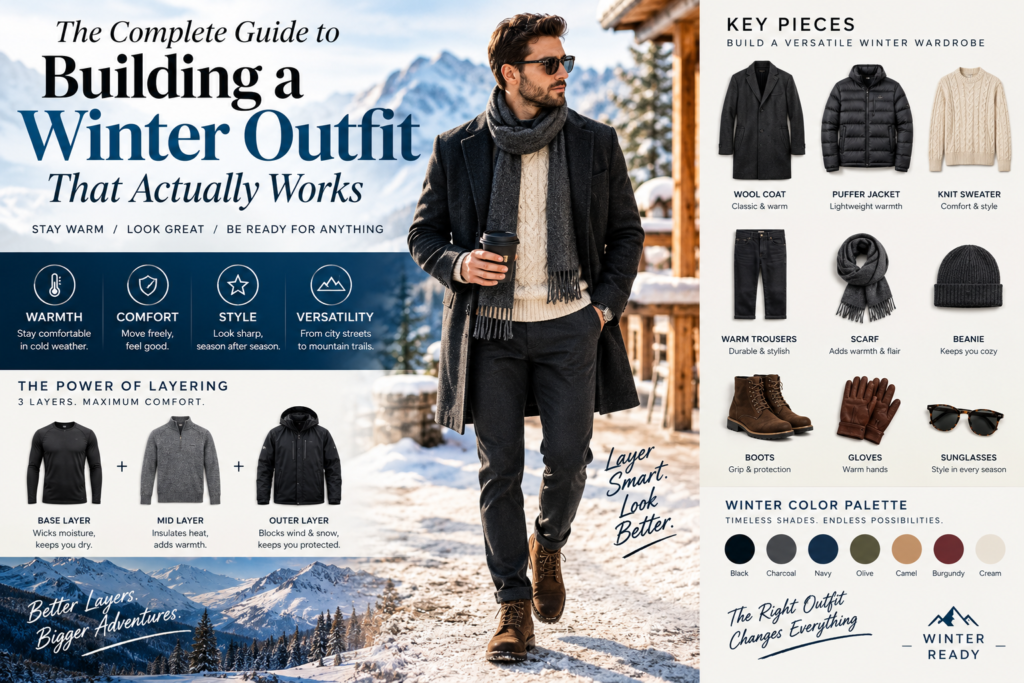

A winter outfit is more than a stack of warm clothes. It is a functional system built from layers, fabrics, and fit decisions that work together to regulate body temperature, block wind and moisture, and still look intentional when you walk out the door. When the temperature drops below freezing and the wind picks up, the difference between a great winter outfit and a miserable one comes down to how well you understand a few core principles. This guide breaks all of them down, from thermal layering science to fabric selection, footwear engineering, color coordination, and everything in between.
Most people treat cold-weather dressing as a chore, grabbing the thickest coat they own and hoping for the best. That approach fails because warmth is not about thickness. It is about trapping still air close to your body, managing moisture so sweat does not chill you, and sealing gaps where wind and water sneak in. The moment you understand those mechanics, dressing for winter stops being a guessing game and becomes a repeatable skill you can apply to any climate, any budget, and any occasion.
This article walks through the entire process in depth. You will learn how layering systems work, which fabrics earn their place in your closet, how to style a winter outfit for work, weekends, and formal events, how to handle extreme cold, and how to care for the garments that keep you comfortable. Along the way, you will find real-world examples, practical problem-solution breakdowns, and the kind of detail that only comes from years of testing gear in genuine winter conditions. By the end, you will be able to assemble a winter outfit with confidence, whether you are facing a mild coastal drizzle or a brutal prairie cold snap.
Why a Winter Outfit Is a System, Not a Single Garment
Think of your winter outfit the way an engineer thinks about a building envelope. A house stays warm not because of one thick wall but because of insulation, weather sealing, and a vapor barrier working together. Your clothing does the same job. The base layer manages sweat, the mid layer traps heat, and the outer layer blocks wind and precipitation. Remove any one of those components and the whole structure underperforms. This is why a person wearing a single heavy parka over a cotton T-shirt often feels colder than someone in three lighter, smarter layers.
The concept of trapping dead air is central here. Still air is a poor conductor of heat, which means it acts as insulation. Lofted materials like down and fleece create thousands of tiny air pockets that hold warmth generated by your body. When you compress those pockets with tight clothing or soak them with sweat, insulation collapses. That is why fit matters as much as fabric, and why breathability is not a luxury feature but a functional necessity. A winter outfit that cannot vent moisture will eventually make you cold from the inside out.
There is also a psychological dimension that experienced dressers recognize. When you feel restricted, bulky, and awkward, you move less, and moving less means generating less body heat. A well-constructed winter outfit allows full range of motion, which keeps circulation strong and warmth distributed. This is the hidden reason why technical mountaineering layers often feel warmer than fashion coats of similar weight. They are designed around movement, and movement is heat.
The Science of Layering and Thermal Regulation
Your body maintains a core temperature near 37 degrees Celsius, and it defends that number aggressively. When you get cold, blood vessels in your extremities constrict to preserve core heat, which is why fingers and toes feel cold first. A proper winter outfit works with this physiology rather than against it. The goal is to reduce heat loss through conduction, convection, evaporation, and radiation, the four pathways your body sheds warmth. Conduction happens when you touch cold surfaces, convection when wind strips heat from your skin, evaporation when sweat dries and cools you, and radiation when heat simply leaves your body as infrared energy.
Layering addresses all four. A base layer reduces evaporative cooling by wicking sweat away from skin. A mid layer traps radiative and conductive heat in lofted fibers. An outer shell defeats convection by blocking wind, and insulation in your boots and gloves reduces conduction into cold ground and cold air. When you see a seasoned winter traveler dressed in what looks like surprisingly thin layers, you are watching someone who has optimized each pathway deliberately. They are not tougher than you. They are better organized.
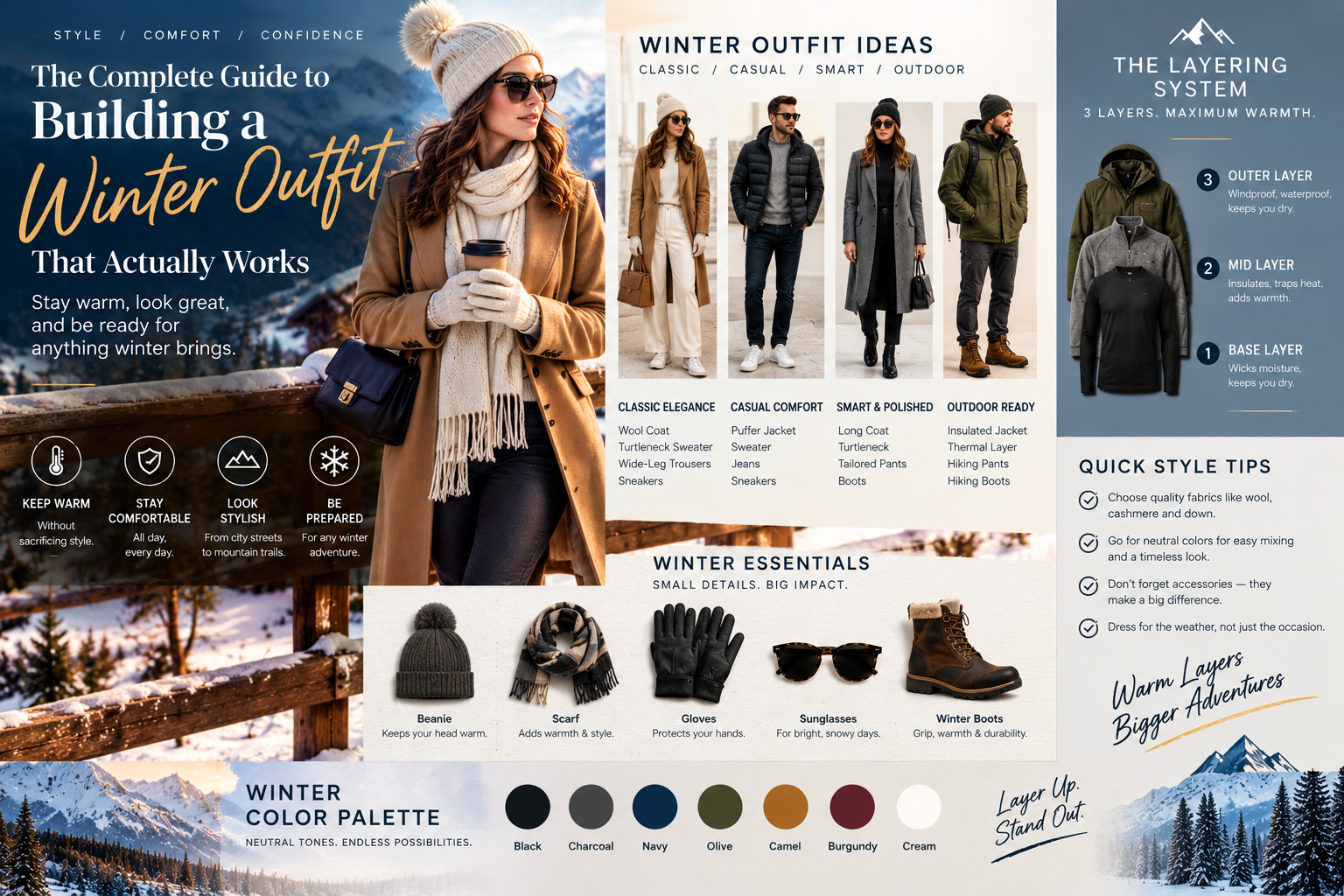
The three-layer system is the standard framework, but real conditions often call for a fourth or a modified version. In extreme cold, people add a heavy static insulation layer, sometimes called a belay jacket, that goes over everything when they stop moving. In mild winters, the shell and mid layer merge into a single softshell garment. The framework is flexible, and understanding why each layer exists lets you adapt intelligently instead of memorizing rigid rules. Expertise in winter dressing is really expertise in thermal management, and thermal management is a solvable problem.
Base Layers: The Foundation of Every Warm Winter Outfit
The base layer is the most underrated part of a winter outfit and the one most people get wrong. Its job is moisture management, not warmth in the traditional sense. Cotton is the classic mistake here. It absorbs sweat, holds it against your skin, and then chills you rapidly once you slow down. This is why outdoor instructors repeat the phrase “cotton kills” in cold environments. Merino wool and synthetic fabrics like polyester and polypropylene move moisture to the surface where it can evaporate, keeping your skin dry and your temperature stable.
Merino wool deserves special attention because it occupies a rare middle ground. It regulates temperature across a wide range, resists odor naturally thanks to its antimicrobial structure, and feels soft against skin in fine gauges. The downside is cost and durability. Synthetics dry faster and cost less but tend to retain odor over time. Many experienced winter dressers own both and choose based on activity. A high-output activity like snowshoeing favors synthetics, while a low-output day of walking and commuting favors merino for its comfort and odor resistance.
Fit matters enormously at this layer. A base layer should sit close to the skin without compressing it, like a second skin rather than a tourniquet. Wrinkles and folds create pressure points and cold spots. Look for flatlock seams that lie smooth under mid layers, thumbholes on sleeves for hand coverage, and a hem that stays tucked. Weight also matters. Lightweight base layers around 150 grams per square meter suit active days, while midweight options near 200 to 250 grams per square meter serve colder, more sedentary conditions. Choosing the right weight is the difference between comfortable and clammy.
Mid Layers: Insulation That Traps Warmth Efficiently
The mid layer is your engine room. It creates the lofted air pockets that hold heat, and it comes in a spectrum from thin fleece to heavyweight down. Fleece, made from polyester, offers breathability, quick drying, and affordability. It works beautifully during activity because it vents excess heat before you overheat. Its weakness is bulk relative to warmth, and it does not block wind at all, so it depends on a shell in gusty conditions. Grid fleece, with its patterned texture, improves breathability further and has become a favorite among people who move fast in cold weather.
Down insulation delivers the best warmth-to-weight ratio available, which is why alpinists prize it. Fill power measures how much space one ounce of down occupies, with ratings like 600, 800, and 900 indicating increasing loft and efficiency. Higher fill power means more warmth for less weight and better compressibility. The catch is moisture. Down loses insulating ability when wet, so it belongs in dry cold conditions or under a waterproof shell. Synthetic insulation like PrimaLoft solves the wet-weather problem at a modest weight penalty and remains the safer choice for damp climates.
The decision between fleece, down, and synthetic insulation is really a decision about your conditions and activity level. A commuter in a rainy city may never need down. A ski tourer in dry alpine air may live in it. Many people build a quiver of mid layers and swap them based on the day, which is exactly how a modular winter outfit is supposed to function. If you own only one mid layer, a midweight fleece is the most versatile starting point because it handles activity, layering, and unexpected temperature swings without fuss.
Outer Shells: Windproof and Waterproof Protection
The outer shell is your armor against the elements. Wind is the great thief of warmth, capable of stripping away the insulating boundary of still air around your body in seconds. A windproof shell restores that boundary and can make a light winter outfit feel dramatically warmer without adding insulation. Waterproofing matters just as much in wet climates, where rain or heavy snow can saturate insulation and destroy its loft. The gold standard is a membrane like Gore-Tex, which blocks liquid water while allowing water vapor from sweat to escape.
Understanding waterproof ratings helps you choose intelligently. A rating of 10,000 millimeters handles rain and typical snow. Ratings of 20,000 millimeters and above suit sustained downpours and wet snow. Breathability ratings, measured in grams of vapor per square meter per day, tell you how well the shell vents sweat. A shell with high waterproofing but low breathability turns into a sauna during activity, which is why serious winter athletes prioritize both numbers. Pit zips, adjustable cuffs, and hem drawcords give you manual control over ventilation when the numbers alone are not enough.
Hard shells are fully waterproof and best for harsh, wet conditions. Soft shells stretch, breathe exceptionally well, and resist wind and light precipitation but eventually soak through in sustained rain. Many winter wardrobes include both, using the soft shell for dry cold days and the hard shell for storms. Fit should allow a mid layer underneath without compressing it, and the hood should accommodate a hat or helmet without restricting vision. A shell that fits perfectly over a T-shirt will fail you over a fleece, so always test layers together.
Fabrics and Materials That Define Modern Winter Clothing
Fabric knowledge separates confident winter dressers from frustrated ones. Wool, down, fleece, and technical synthetics each behave differently, and matching material to purpose is the core skill. Wool regulates temperature, resists odor, and stays warm even when damp, which is why it has clothed cold-climate cultures for centuries. Down provides unmatched warmth-to-weight but fears moisture. Fleece breathes and dries fast but offers limited wind resistance. Technical membranes block weather while venting vapor.
Beyond the classics, modern textiles expand the options. Thinsulate uses microfibers to trap air in a thin profile, ideal for gloves and slim coats. Polartec Alpha was engineered for high-output activity, letting heat escape during exertion while retaining warmth at rest. Softshell fabrics like Schoeller weave stretch and abrasion resistance into weather protection. Even denim has entered the conversation through flannel-lined and thermal variants that bring casual style into cold weather without the chill of standard cotton twill.
The practical takeaway is to read labels and understand what each fabric contributes. A winter outfit built from wool, down, fleece, and a membrane shell covers nearly every condition on Earth. Add waterproof-breathable footwear and moisture-wicking socks and you have a complete kit. When you know why a fabric exists, you stop overpaying for marketing and start investing in performance. That is the difference between owning clothes and owning a system.
| Fabric | Primary Strength | Main Weakness | Best Use Case |
|---|---|---|---|
| Merino wool | Temperature regulation and odor resistance | Higher cost, slower drying | Base layers, sweaters, socks |
| Down | Best warmth-to-weight ratio | Loses loft when wet | Dry cold, static insulation |
| Synthetic insulation | Retains warmth when damp | Bulkier and heavier than down | Wet climates, active use |
| Fleece | Breathable and quick drying | No wind resistance | Mid layer during activity |
| Gore-Tex membrane | Waterproof and windproof | Premium price | Hard shell in storms |
| Softshell fabric | Stretch and breathability | Limited waterproofing | Dry cold, high movement |
Winter Footwear and Sock Strategy for Cold Conditions
Cold feet ruin an otherwise perfect winter outfit, and the cause is usually the footwear-sock combination rather than the temperature itself. Boots need insulation, waterproofing, and traction. Insulation ratings measured in grams, such as 200g, 400g, and 800g, indicate warmth for different activity levels and conditions. A 200g boot suits active winter walking, while 800g serves prolonged standing in deep cold. Waterproof membranes keep slush and snowmelt out, and aggressive rubber outsoles with lug patterns grip ice and packed snow.
Socks follow the same moisture logic as base layers. Cotton socks absorb sweat and chill your feet, while merino and synthetic blends wick moisture and cushion impact. Sock thickness must match boot volume. A thick sock in a tight boot compresses insulation and restricts circulation, which paradoxically makes feet colder. The right combination allows a little room to wiggle toes, because toe movement drives circulation and generates warmth. Many winter specialists also carry spare socks on long outings, since dry feet are warm feet.
Traction deserves its own mention because falls on ice cause real injuries. Removable traction devices with carbide studs or coiled wire slip over boots and transform grip on frozen surfaces. For everyday wear, look for soles with soft rubber compounds that stay flexible in cold, because hard rubber loses grip as temperatures drop. If you walk on icy sidewalks regularly, a dedicated winter boot with embedded grip technology is a worthwhile investment that pays for itself the first time it prevents a fall.
Styling a Winter Outfit Without Sacrificing Warmth
Function and style are not opponents. The most elegant cold-weather wardrobes simply apply layering principles to tailored garments. A wool overcoat over a cashmere sweater over a merino base layer delivers serious warmth while looking sharp enough for a boardroom. The trick is choosing thin, high-quality layers rather than bulky ones, which keeps the silhouette clean. Tailored fit at each layer also traps air more effectively than loose, flapping fabric, so polish and performance align.
Color coordination elevates the result. Neutral bases like charcoal, navy, camel, and cream create a versatile foundation that mixes effortlessly, while one accent color adds personality. Monochrome dressing in tonal shades of the same hue reads as deliberately stylish and simplifies matching. Texture becomes your pattern in winter, so combining a smooth wool coat, a chunky knit, and smooth leather boots creates visual interest without loud prints. Accessories like scarves, gloves, and hats are the finishing touches that also happen to be functional necessities.
Proportion matters when layering. A long coat over slim trousers balances volume, while a cropped puffer pairs well with wider pants. Boots should harmonize with hem length, and a scarf should complement rather than swallow your face shape. The goal is a winter outfit that looks intentional from every angle, which happens naturally when each piece is chosen for fit and function rather than filler. People notice when clothing fits well, and fit is free.
Winter Outfit Ideas for Work, Weekends, and Evenings
Work settings demand a balance of professionalism and warmth. A tailored wool coat in navy or charcoal anchors the look, layered over a fine-gauge merino sweater and thermal trousers. Leather gloves and a cashmere scarf add refinement, and waterproof leather boots handle slush without looking casual. For business formal environments, a three-piece wool suit with a thermal base layer underneath preserves the silhouette while adding invisible warmth. The key is thin, high-quality layers that never bulge.
Weekend winter outfits lean casual and rugged. Flannel-lined jeans, a heavyweight hoodie, a quilted jacket, and sturdy boots create a look that handles errands, dog walks, and coffee runs. Add a beanie and touchscreen-compatible gloves and you are ready for anything. For outdoor recreation, technical layers take over, with moisture-wicking base layers, fleece mid layers, and weatherproof shells. Each context has its own uniform, and recognizing that prevents the common mistake of wearing technical gear to dinner or fashion coats on a trail.
Evening winter outfits call for elegance with hidden warmth. A long wool coat over a silk-blend base layer and a midi dress with fleece-lined tights keeps you warm without visible bulk. Heated insoles and a slim down vest under the coat add invisible insulation. For formal events, a velvet blazer, thermal undershirt, and tailored trousers look sharp while quietly managing temperature. The principle across all three contexts is the same. Build the outfit from the base outward, and let each layer earn its place.
Problem-Solution Fixes for Common Winter Outfit Failures
Overheating indoors is one of the most common complaints. You dress for the cold outdoors, then sweat through a meeting or a train ride, and later freeze when you step back outside in damp clothes. The fix is ventilation and modularity. Choose layers you can remove easily, favor fabrics that breathe, and use pit zips or unbutton collars when you feel warmth building. Carrying a lightweight packable tote for shed layers keeps you comfortable and organized.
Wet feet and cold hands follow predictable patterns. Wet feet usually trace back to non-waterproof footwear or cotton socks, while cold hands often result from gloves that are too tight or lack wind protection. Mittens outperform gloves for warmth because fingers share heat, and liner gloves under mittens add versatility. For feet, waterproof boots plus merino socks plus gaiters in deep snow solve nearly every scenario. These are not expensive fixes. They are correct fixes.
The bulkiest problem is looking like a marshmallow. The solution is thin, high-loft layers rather than thick, low-quality ones. A 800-fill down jacket is warmer and slimmer than a bulky synthetic parka of similar warmth. Tailored fits, dark colors, and vertical lines in coats create a streamlined appearance. When layers are thin and warm, you can add more of them without adding visual weight, which is the secret behind every stylish winter outfit you have ever admired.
Winter Outfit Planning for Extreme Cold and Harsh Climates
Extreme cold demands a different mindset, because the margin for error shrinks. In temperatures below minus 20 degrees Celsius, exposed skin can freeze quickly, and every gap in your clothing becomes a liability. The expedition standard is a multi-layer system with a dedicated static insulation layer, often a high-fill down parka worn over everything during rest stops. Balaclavas, goggles, and insulated mittens protect the face and hands, and vapor barrier liners in boots prevent sweat from degrading insulation.
Harsh climates also reward redundancy. Experienced travelers pack spare gloves, spare socks, and a spare hat because losing one critical item in deep cold is not an inconvenience but a safety issue. Hand warmers, both chemical and rechargeable, provide backup warmth. Windproof and waterproof coverage becomes non-negotiable, and every closure, from cuffs to hem drawcords, gets cinched down. The winter outfit becomes a sealed, regulated environment you carry with you.
Acclimatization plays a role as well. People who spend time outdoors regularly develop both physiological tolerance and practical judgment about what to wear. They learn to start slightly cool because activity generates heat, and they learn to add layers before they feel cold rather than after. This anticipatory approach is the mark of experience. Beginners react to cold. Experts prevent it.
Caring for Your Winter Wardrobe So It Lasts
Technical fabrics and natural fibers both require care to maintain performance. Down needs occasional washing with a down-specific detergent followed by tumble drying with dryer balls to restore loft. Waterproof shells need periodic washing to remove oils and dirt that clog membranes, followed by a heat treatment or spray-on durable water repellent to renew beading. Merino wool benefits from gentle washing and air drying to preserve fibers and shape.
Storage matters too. Down and synthetic insulation should be stored loosely, never compressed in a stuff sack for months, because long-term compression damages loft. Hanging heavy coats on sturdy hangers preserves shoulder shape. Boots should be dried at room temperature, never on direct heat, which cracks leather and degrades adhesives. Rotating between two pairs of boots extends their life dramatically.
Repairs are almost always cheaper than replacements. Zipper repairs, seam sealing, patch kits for shells, and resoling boots keep a good winter outfit in service for years. Brands like Patagonia, Arc’teryx, and REI offer repair services, and many gear shops do the same. Treating your wardrobe as equipment rather than disposable fashion is both economical and sustainable, and it deepens your understanding of what actually works in the cold.
Seasonal Transitions and Adapting Your Winter Outfit
Late autumn and early spring blur the lines between seasons, and a rigid winter outfit feels wrong in a 12-degree drizzle. Transitional dressing relies on a lighter shell, a packable mid layer, and base layers you can adjust. A softshell over a light fleece handles cool and breezy days, and adding a vest extends warmth without bulk. The principle is modularity, allowing you to add or remove pieces as the day warms and cools.
Temperature swings within a single day are the trickiest challenge. Morning commutes can be near freezing while afternoons reach double digits. The solution is a packable puffer that compresses into a bag, a breathable base layer, and a shell that vents. People who master transitional layering get far more use from their wardrobes because each piece works across multiple seasons rather than sitting idle for months.
Geographic variation matters as well. A winter outfit in Seattle looks nothing like one in Minneapolis. Coastal climates emphasize waterproofing and breathability, while continental climates emphasize insulation and wind protection. Desert winters swing wildly between day and night, favoring layers you can strip and restore. Knowing your climate’s specific failure modes tells you where to invest and where to save.
Building a Capsule Winter Outfit on Any Budget
A capsule wardrobe applies minimalism to cold weather, and it works because layering multiplies combinations. Start with two base layers, two mid layers, one versatile shell, one insulated coat, two pairs of boots, and a handful of accessories. From those pieces you can assemble dozens of distinct outfits for work, weekends, and travel. Fewer, better items outperform a closet full of compromise purchases.
Budget allocation should follow impact. Spend on footwear, outerwear, and base layers, because those determine comfort and durability. Save on mid layers and accessories, where affordable options perform nearly as well as premium ones. A quality down jacket and waterproof boots will serve you for a decade, while a trendy accent scarf can be replaced cheaply when styles change. This prioritization delivers the best comfort per dollar.
Thrifting and end-of-season sales stretch budgets further. Wool coats, cashmere sweaters, and leather boots appear constantly in secondhand markets at a fraction of retail, and quality construction lasts. Buying off-season, such as purchasing a parka in March, routinely saves 40 to 60 percent. A thoughtful winter outfit does not require a large budget. It requires correct decisions, and correct decisions are free.
Frequently Asked Questions About Winter Outfits
What is the most important layer in a winter outfit?
The base layer is the most important because it controls moisture, which determines whether you stay warm or get chilled. A moisture-wicking merino or synthetic base layer keeps sweat off your skin, allowing mid and outer layers to do their jobs. Without it, even expensive insulation fails once it absorbs perspiration. Build every winter outfit from a proper base layer outward.
How many layers should a winter outfit have?
Three layers cover most conditions. A base layer manages moisture, a mid layer traps heat, and an outer shell blocks wind and water. In extreme cold, add a fourth static insulation layer over everything, and in mild winters, combine the mid and outer layers into a single softshell. The count matters less than the function each layer performs.
Is cotton ever acceptable in a winter outfit?
Cotton works for short exposure in dry cold, such as walking from a car to a building, but it fails during activity or wet conditions. It absorbs sweat and holds it against your skin, causing rapid chilling when you slow down. For anything active or prolonged, choose merino wool or synthetics instead. Reserve cotton for casual pieces like flannel shirts in dry conditions.
How do I stop my winter outfit from feeling too bulky?
Choose thin, high-loft materials rather than thick, low-quality ones. An 800-fill down jacket is warmer and slimmer than a bulky synthetic equivalent. Favor tailored fits, dark colors, and vertical lines in coats, and keep each layer close to the body without compressing insulation. Thin layers stack efficiently, so you stay warm without looking inflated.
What should I wear on my feet in a winter outfit?
Waterproof insulated boots matched to your conditions are essential, with 200g insulation for active days and 400g or more for prolonged cold. Pair them with merino or synthetic socks that wick moisture and match boot volume so toes can move freely. Add traction devices for ice. Dry, roomy feet stay warm, while tight, damp feet get cold fast.
Conclusion
Building a dependable winter outfit comes down to understanding a few enduring principles. Manage moisture at the base layer, trap heat in the mid layer, block wind and water with the shell, and protect your extremities with insulated, waterproof footwear and accessories. When those pieces work together, you stay warm, dry, and comfortable regardless of what the forecast throws at you. The winter outfit becomes a system you trust rather than a daily gamble.
The deeper takeaway is that cold-weather dressing rewards knowledge over spending. Fabric science, layering logic, and fit decisions matter more than brand names or price tags. Once you internalize how wool, down, fleece, and membranes behave, you can assemble effective combinations from almost any closet or budget. You stop guessing and start choosing, and that confidence shows in both your comfort and your style.
Invest in the pieces that carry the most weight, care for them properly, and treat your wardrobe as equipment built for a purpose. A well-planned winter outfit will serve you for years, adapt across seasons and climates, and keep you moving through the coldest months with ease. That is the real payoff, and it starts with the very next layer you put on.


