
The slick back hairstyle has a reputation problem and a redemption arc happening at the same time. On one hand, it conjures images of Wall Street excess, mob movies, and the kind of guy who uses too much gel and not enough self-awareness. On the other, it is the single most reliable way to look deliberately put-together in under five minutes, and it has been quietly adopted by everyone from red-carpet celebrities to Gen Z guys discovering that looking sharp actually gets them taken more seriously .
What makes the style worth understanding rather than dismissing is its flexibility. The slick back is not one look. It is a family of looks, ranging from the tightly sculpted wet-look finish to a relaxed, textured sweep that leaves natural movement intact . The difference between a good slick back and a bad one comes down to preparation, product choice, and knowing which version of the style suits your hair type and the occasion.
What the Slick Back Hairstyle Actually Is
At its core, the slick back hairstyle involves brushing, combing, or sweeping the hair away from the face and toward the back of the head, creating a smooth, controlled surface with visible shine . It is defined less by length than by direction and finish. The hair is coaxed flat against the scalp, flyaways are tamed, and the overall effect is one of precision rather than volume.
The style has a long history that predates its modern associations. It was first introduced in France in the eighteenth century and has cycled in and out of fashion ever since, becoming a red-carpet staple for everyone from Brad Pitt to Harry Styles . That longevity matters because it signals something practical: the slick back works across decades and contexts because it solves a basic problem. It keeps hair out of the face while projecting intentionality.
What separates the modern version from the greasy, helmet-like iterations of the past is restraint. The contemporary approach favors a finish that looks polished but not rigid, with enough flexibility that the hair moves naturally rather than sitting like a lacquered shell . The goal is controlled texture, not absence of texture.
The Different Versions of the Slick Back Hairstyle
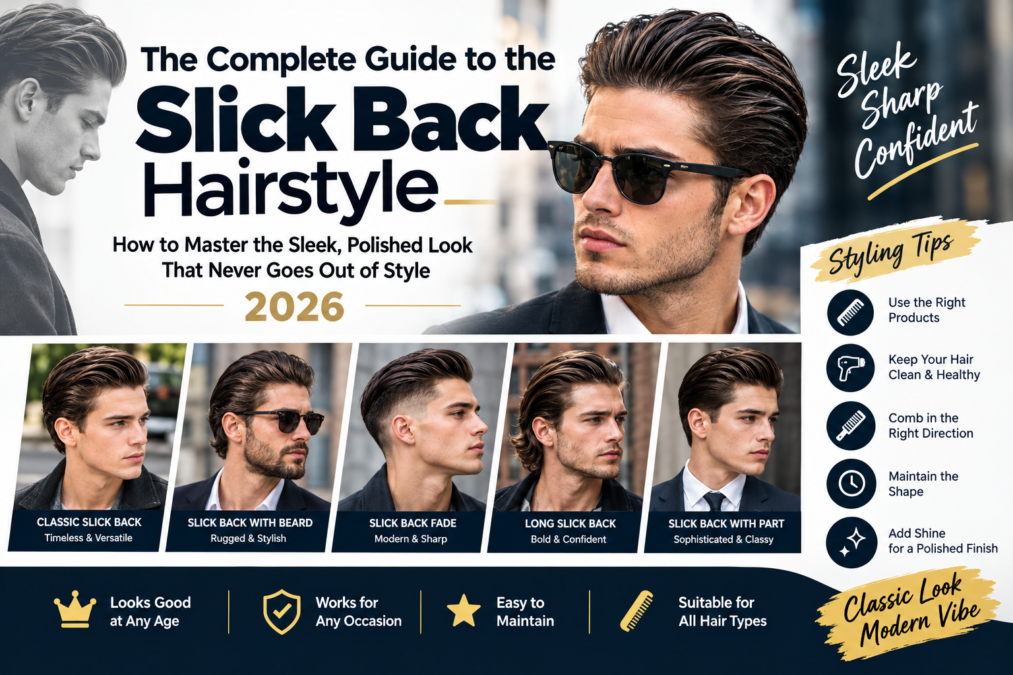
The classic slick back is the most straightforward interpretation: hair combed straight from the hairline to the nape, with a high-shine finish and not a strand out of place . It works on short, medium, and long hair, and it reads as formal without requiring a suit. For anyone testing the style for the first time, this is the version to start with because it requires the least structural commitment.
The slick back bun and ponytail take the same front-smoothing technique and gather the lengths into a secured shape. The bun sits at the nape for a formal, elegant look or higher on the crown for something bolder, while the ponytail offers a cleaner, more athletic silhouette . These variations are particularly useful for longer hair that would otherwise be difficult to manage with product alone.
There is also a relaxed, modern interpretation that has gained traction more recently. Instead of slicking every strand into submission, this version sweeps the front section away from the face while leaving natural texture and movement through the lengths . For curly or wavy hair, this hybrid approach is often the most flattering because it creates a deliberate contrast between a sleek hairline and untouched texture behind it. It acknowledges that not everyone wants to fight their hair into straightness, and it looks more natural as a result.
The undercut fade pairing deserves its own mention because it solves a common problem. A basic slick back with an undercut fade keeps the sides tight and the top long enough to comb straight back, creating stark contrast that makes the style look intentional rather than accidental . The fade does the structural work, so the product only has to manage the top.
How to Prepare Your Hair for a Slick Back
Preparation is where most slick back attempts fail, and the failure is usually invisible until the hair dries. The single most important rule is to start with clean hair . Product buildup, natural oils, or yesterday’s styling residue will prevent the new product from gripping properly, and the result will be patchy, uneven, and prone to collapsing by mid-morning.
Towel-dried hair is the ideal starting point. It should be damp enough that the product spreads evenly from root to tip, but not so wet that it dilutes the hold . If the hair is fully dry, a light mist from a spray bottle restores the pliability needed for smooth application. Hydration matters too: a small amount of conditioner or leave-in product massaged into the hair before styling keeps the finished look healthy rather than brittle .
The comb choice is more consequential than it seems. A wide-tooth comb is generally the better tool for the initial detangling and distribution because it prevents pulling and tugging, while a finer comb or a boar bristle brush handles the final smoothing and flyaway control . Working from the ends toward the roots during detangling reduces breakage and makes the subsequent slicking more even.
Choosing the Right Product for Your Hair Type
Product selection is not a one-size-fits-all decision, and the wrong choice produces the two most common slick back failures: crunch and flaking. Gels deliver the strongest hold and the highest shine, which is why they dominate the classic wet-look version, but they can leave hair stiff and susceptible to white residue if applied too heavily . Pastes offer a more matte finish with flexible hold, making them better suited to relaxed or textured interpretations. Pomades sit between the two, providing shine with a bit more malleability than a hard-hold gel.
Hair type should guide the decision more than personal preference. Curly and wavy hair benefits from a lighter product like a paste, which provides control without flattening the natural pattern entirely . Thick hair needs higher hold and more hydration, so a gel or a strong pomade paired with a leave-in conditioner is the more reliable combination. Thin or thinning hair should stay away from heavy products that weigh strands down; a lightweight paste or cream provides enough grip without strain . Long hair requires a strong pomade and a sturdy comb to manage the additional length and keep everything secured .
Application technique matters as much as the product itself. Warming the product between the palms before applying softens it and helps it glide through the hair instead of clumping in one spot . Starting at the roots, where control is most needed, and working the remaining product through the lengths prevents the stiff, product-heavy look that gives slick backs a bad name. A pea-sized amount is sufficient for fine hair, while thick or textured hair can handle a quarter-sized amount, and it is always easier to add more than to remove excess .
Step-by-Step Technique for a Flawless Finish
The actual styling sequence is simpler than the preparation, provided the groundwork is right. After detangling and applying product, the comb runs from the forehead straight back toward the nape, repeating until the shape and texture are consistent . The direction should be deliberate and uninterrupted; stopping and restarting creates ridges and unevenness that become more visible as the product sets.
Once the hair is combed back and the shape is satisfactory, the most important instruction is to stop touching it. Hands carry natural oils that disrupt the product’s hold and introduce shine where it is not wanted, and every adjustment after the initial styling risks breaking the smooth surface . A light layer of hairspray applied from about twenty centimetres away sets the finished look without making it rigid . For a deeper side part, as demonstrated by celebrity stylist Brian Fisher on Lisa Rinna’s Emmys look, the key is “finessing the root” with a volume spray to lock the parting in place before sweeping the sides back and tucking behind the ears to keep the nape tight .
For longer hair being gathered into a bun or ponytail, the sequence adds a few steps. The hair is smoothed back with a fine-tooth comb, gathered at the chosen height, and secured with an elastic that matches the hair colour for a clean aesthetic . Spraying the brush with high-shine hairspray rather than applying it directly to the lengths prevents clumping and bumps while ensuring a sleek finish . Any remaining flyaways around the hairline or nape are tamed with a detailing brush and a small amount of pomade or edge control.
Adapting the Slick Back Hairstyle for Different Hair Types
The slick back is not exclusive to straight hair, and the assumption that it is has kept a lot of people from trying a style that would suit them well. For curly and coily hair, the technique shifts from total smoothing to strategic control. The front section is slicked down with gel or edge control while the lengths retain their natural curl pattern, creating a contrast that looks intentional and modern rather than like a failed attempt at straightening . The key is keeping the hair damp throughout the process, because type 4 hair dries quickly and becomes harder to manipulate once it does .
For natural hair being pulled into a slicked-back bun, sectioning is essential. Working in sections with clips allows each layer to be brushed flat before moving to the next, and a boar bristle brush ensures there are no knots or uneven areas beneath the surface . A mixture of water and leave-in conditioner misted over the hair provides moisture, followed by gel applied section by section. A silk scarf tied over the finished style sets the hair in place while it dries, and a final mist of hairspray locks in the shine .
Fine or thinning hair requires a gentler approach. Heavy products and tight pulling can stress the hairline, so a lightweight paste or cream is the safer choice, and the style should be secured loosely enough that it does not pull at the roots . The visual goal is the same polished finish, but the method prioritizes hair health over maximum hold. For anyone concerned about the hairline, a style that sweeps back rather than pulling tightly back achieves the same effect with less tension.
Common Mistakes and How to Fix Them
The most frequent complaint about the slick back hairstyle is that it looks greasy rather than glossy, and the cause is almost always product overload. More gel does not mean more hold; it means more weight, more shine in the wrong places, and a higher likelihood of flaking as the product dries. The fix is to start with less product than feels intuitive and build up only where needed, focusing on the roots and the front hairline rather than saturating every strand .
The second common failure is bumps and ridges at the crown or along the sides. These usually come from insufficient brushing or from starting with hair that is not damp enough for the product to distribute evenly. A boar bristle brush run firmly over the problem areas, combined with a small additional amount of product, smooths the surface without requiring a full restyle . If the bumps persist, the hair underneath may not have been detangled thoroughly enough before styling began.
The third issue is the style collapsing midway through the day. This is a hold problem, and it usually traces back to a product that is too light for the hair type or an insufficient setting step. A finishing spray is not optional for a style that needs to last through a workday or an event; it is the layer that locks everything in place . For very thick or resistant hair, a stronger pomade and a tighter initial combing technique provide the structural foundation that a finishing spray alone cannot supply.
When to Wear a Slick Back and When to Choose Something Else
The slick back’s versatility is one of its strongest arguments. It reads as formal enough for a wedding or a professional setting, relaxed enough for a casual weekend, and sharp enough for a night out, depending on how tight and shiny the finish is . The relaxed version with visible texture works well for everyday wear, while the tightly sculpted wet-look interpretation suits events where a polished appearance is the point.
There is, however, a cultural dimension worth acknowledging. The slick back carries associations that have shifted over time, from Wall Street power to mob cinema to a certain kind of self-conscious toughness . Celebrity stylist Clayton Hawkins framed the dichotomy bluntly: “To me, slicked back is pure ’80s Wall Street excess. Forward is 2000s MySpace” . That association is not a reason to avoid the style, but it is a reason to be deliberate about the version you choose. A softer, textured slick back reads as modern and relaxed; a high-shine, tightly pulled version reads as more traditional and more formal.
The style is also less forgiving for certain hairlines. Hawkins noted that whether a slick back looks good is “very hairline-dependent,” and the risk of pulling hair back too tightly over a receding hairline is that it draws attention to exactly what the wearer might prefer to soften . For those with a strong hairline and enough length on top, the slick back is one of the most flattering and efficient styles available. For others, a textured forward sweep or a shorter crop may achieve the same polished effect with less exposure.
A Quick Reference Guide to Slick Back Variations
The table below summarizes the main interpretations of the slick back hairstyle, the hair types they suit best, and the products that produce the most reliable results.
| Variation | Best For | Key Product | Finish |
|---|---|---|---|
| Classic wet-look slick back | Straight to wavy hair, formal occasions | Strong-hold gel or pomade | High shine, tightly controlled |
| Relaxed textured slick back | Curly, wavy, or thick hair, everyday wear | Lightweight paste or cream | Natural shine, movement retained |
| Slick back with undercut fade | Short to medium hair, low-maintenance routines | Gel applied to damp hair | Clean contrast, structured |
| Slick back bun | Long hair, formal or professional settings | Gel pomade plus edge control | Smooth front, secured bun |
| Slick back ponytail | Long hair, active or casual settings | Mousse or lightweight gel | Sleek front, practical shape |
| Curly slick back | Type 3 and type 4 hair | Gel plus leave-in conditioner | Sleek hairline, natural texture behind |
The table makes one thing clear: there is no single correct way to wear a slick back. The variation that works best is the one that matches the hair you actually have rather than the hair you wish you had. Fighting a strong curl pattern into a wet-look finish is a losing battle that produces frustration and damaged strands.
Working with the texture and focusing the smoothing effort on the front section produces a result that looks intentional and lasts through the day.
Frequently Asked Questions About the Slick Back Hairstyle
How long does hair need to be for a slick back hairstyle?
The general recommendation is at least six inches of length on top for a classic slick back, because the hair needs to be long enough to lay back with product without standing up on its own . Shorter hair can still be swept back, but it will read more as a textured forward-and-back style than a true slick back. For a slicked-back bun or ponytail, the hair needs to be long enough to gather, which typically means shoulder length or longer. The undercut version can work with less length on top as long as the sides are kept short enough to create contrast.
What is the difference between a slick back and a pompadour?
The two styles are often confused because both involve sweeping hair back, but the direction and silhouette are different. A pompadour sweeps the hair up and back, with the front sitting higher than the crown to create a soft wave or roll, while a slick back lies flat and straight back against the head . The pompadour adds height and volume at the front, while the slick back prioritizes a smooth, low-profile finish. Sides are often kept longer with a slick back and shorter with a modern pompadour paired with a taper or fade .
How do I stop my slick back from looking greasy?
Greasiness usually comes from applying too much product or using a product with a high oil content on hair that is already prone to oiliness. Start with a smaller amount than feels sufficient, warm it between the palms, and apply primarily at the roots rather than saturating the lengths . A paste or a water-based pomade produces less grease than an oil-based product. If the hair still looks heavy, a dry shampoo spray at the roots before styling can absorb excess oil and provide grip without adding weight.
Can I do a slick back with curly hair?
Yes, and the curly version is one of the most striking interpretations of the style. Rather than attempting to straighten the entire head, the curly slick back focuses on smoothing the front section and the hairline with gel or edge control while leaving the natural curl pattern intact through the lengths . The key is working with damp hair and using enough product to control the front without flattening the texture behind it. A boar bristle brush helps smooth the front section, and a silk scarf can set the style while it dries .
How do I keep a slick back in place all day?
A lasting slick back depends on three things: clean hair, the right product for your hair type, and a finishing spray. Starting with clean, towel-dried hair ensures the product can grip properly. A strong-hold gel or pomade provides the structural foundation, and a light layer of hairspray applied from about twenty centimetres away sets the style without making it rigid . For very thick or resistant hair, a tighter initial combing technique and a product with higher hold are necessary. Touching the hair throughout the day disrupts the hold, so the fewer adjustments after styling, the better.
Conclusion
The slick back hairstyle has survived centuries of fashion cycles because it solves a problem that never goes away: how to look deliberate and put-together without spending an hour in front of a mirror. The versions that work best are the ones that respect the hair’s natural texture rather than fighting it, whether that means a high-shine classic on straight hair or a textured hybrid on curls. The technique is learnable, the products are accessible, and the margin for error is smaller than most people assume once the preparation is right.
The final takeaway is about intention. A slick back that looks good is not the result of more product or tighter pulling. It is the result of clean hair, a comb run in the right direction, a product matched to the hair type, and the discipline to stop adjusting once the style is set. The style projects confidence because it looks controlled, and that control starts before the gel comes out of the tube. Master the preparation and the rest of the slick back follows naturally.