


Quiet luxury bags represent a deliberate shift away from logomania and toward something more enduring: craftsmanship you can feel, leather that ages gracefully, and silhouettes that won’t look dated in five years. This isn’t about hiding wealth—it’s about redefining what luxury actually means when the noise fades and only quality remains.
The term itself has become shorthand for a broader aesthetic movement. But understanding quiet luxury bags requires going deeper than the surface-level definition. It’s about recognizing why certain designs transcend trends, how to evaluate craftsmanship beyond brand names, and why the most sophisticated wardrobes often contain the least obvious pieces.
What Quiet Luxury Bags Actually Mean in Practice
Quiet luxury bags are handbags defined by their absence of overt branding, reliance on exceptional materials, and commitment to timeless design principles rather than seasonal trends. The category prioritizes tactile quality, structural integrity, and versatility over recognizable logos or status-signaling hardware.
This definition matters because it separates genuine quiet luxury from what some brands market as “minimalist” while still slapping a giant logo on the front. True quiet luxury bags communicate their value through touch and construction, not through symbols that anyone can recognize from across a room.
Consider the difference between a bag that announces itself and one that rewards closer inspection. A quiet luxury bag might feature hand-painted edges, a suede lining that feels luxurious every time you reach inside, or hardware finished with such precision that it operates with satisfying smoothness. These details don’t photograph well for social media. They don’t need to. The person carrying the bag experiences them every single day.
The aesthetic has deep roots in Italian and French craftsmanship traditions, where the philosophy has always been that true quality speaks softly. Loro Piana, for instance, has embodied this approach for nearly a century, creating pieces that whisper sophistication rather than shout for attention . The brand’s Ghiera Shopper exemplifies this ethos—a bag with a soft, rounded structure and a distinctive Sun Gold clasp that’s been hand-finished to eliminate hard edges in favor of a sensorial experience .
The Materials That Separate Genuine Quality From Marketing Claims
Materials form the foundation of any quiet luxury bag, and the hierarchy of leather quality is something every informed buyer should understand. Full-grain leather sits at the top—it’s the outermost layer of the hide, retaining the natural grain and developing a patina over time that becomes uniquely yours. Top-grain leather is sanded to remove imperfections, making it more uniform but less characterful. Genuine leather, despite the reassuring name, is the lowest grade, often split and reconstituted with a polyurethane coating that will eventually peel.
The tactile difference is immediate when you handle a bag made from full-grain leather. It feels substantial without being stiff, supple without being flimsy. The surface has subtle variations that catch light differently across the bag’s surface. This isn’t a defect—it’s evidence of authenticity.
Hardware matters just as much, though it’s often overlooked. Solid brass hardware, for example, develops a patina over years of use, while cheaper zinc alloy with gold plating will eventually reveal its base metal. The weight of the hardware when you lift a bag tells you something about its quality. So does the sound it makes when it closes. These sensory details add up to an experience that cheap bags simply cannot replicate.
Interior materials receive far less attention than they deserve. A fully leather-lined bag represents a significant investment in craftsmanship—it means the maker didn’t cut corners on the parts you don’t see. Suede linings are also a mark of quality, particularly when they’re color-matched to the exterior. Some of the most respected quiet luxury bags feature contrasting interior linings as a subtle signature, like the bold red interior hidden inside Totême’s leather Mercer bag, inspired by the lining of a classic leather jacket .
The Silhouettes That Define Modern Quiet Luxury
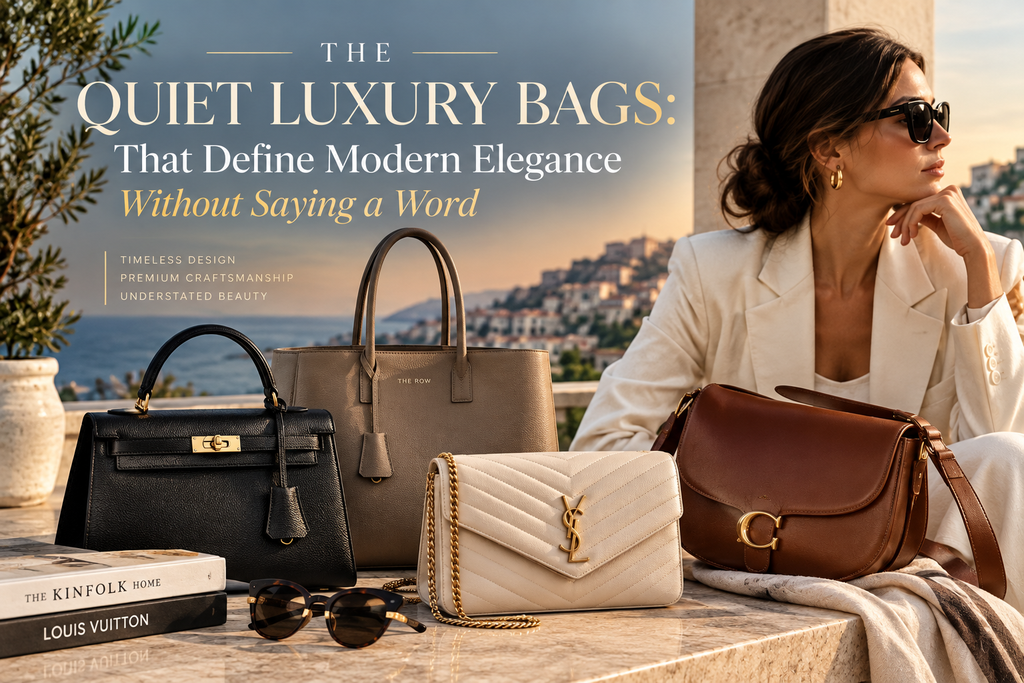
The most successful quiet luxury bags tend to fall into a handful of recognizable but unbranded shapes. The structured tote remains the workhorse of the category—spacious enough for daily essentials, refined enough for professional settings, and designed with clean lines that don’t compete with whatever you’re wearing.
The Row’s Margaux became something of a cultural touchstone for this silhouette, described by Vogue as “a future heirloom in the making” and by Glamour as the “epitome of quiet luxury” . Its appeal lies in its softly structured shape, rolled double handles, and the absence of any visible branding. The bag communicates through proportion and material rather than logos.
Shoulder bags with elongated silhouettes have also found renewed relevance through the quiet luxury lens. The baguette shape, originally popularized in the late 1990s, has been reinterpreted by brands like The Row with buttery leather and impeccable proportions that strip away the Y2K excess while retaining the flattering under-arm fit . The result feels both nostalgic and entirely contemporary.
Slouchy hobos and bucket bags round out the essential silhouettes. These shapes prioritize ease and wearability, often featuring drawstring closures or magnetic openings that make them practical for daily use. Longchamp’s Le Cadence bag, inspired by the relaxed elegance of Parisian women, exemplifies this approach—a grain leather bag with no lining, allowing the natural softness of the material to define its shape .
| Silhouette | Best For | Key Design Elements | Notable Examples |
|---|---|---|---|
| Structured Tote | Work, travel, daily carry | Rolled handles, trapezoidal shape, minimal hardware | The Row Margaux, DeMellier Stockholm |
| Shoulder Bag | Evening, weekends, transitional dressing | Elongated profile, under-arm fit, refined strap | The Row Alma, Saint Laurent Le 5 à 7 |
| Slouchy Hobo | Casual use, effortless styling | Soft structure, drawstring or magnetic closure | Bottega Veneta Veneta, Loro Piana Ghiera |
| Top-Handle Mini | Versatile day-to-night | Compact proportions, dual handles, clean lines | The Row Marcel, Totême Mercer |
How Craftsmanship Distinguishes Quiet Luxury From Fast Fashion
Craftsmanship in quiet luxury bags manifests in ways that become apparent over time rather than immediately. The stitching on a well-made bag is consistent, with even spacing and no loose threads. The edges are finished—painted, burnished, or folded—rather than left raw. The zipper glides smoothly and the pulls feel substantial in your hand.
Hand-painted edges deserve particular attention because they represent a significant labor investment. This technique involves applying multiple thin layers of edge paint, allowing each to dry before adding the next, then sanding and polishing to create a smooth, sealed finish that protects the leather and looks refined. It’s a detail that takes time and skill, which is why you won’t find it on mass-produced bags.
The construction method also matters. Bags that are turned inside out during assembly (called “turned construction”) can hide interior finishing, while bags constructed with visible seams require every stitch to be perfect. Neither method is inherently superior, but understanding the difference helps you evaluate what you’re actually paying for.
Consider how a bag’s handles are attached. Simple stitching through the leather can eventually tear under weight. Reinforced attachments—rivets, D-rings, or leather patches—distribute stress more effectively and extend the bag’s life. This is the kind of engineering that doesn’t photograph well but makes a tangible difference after a year of daily use.
The Price Spectrum: Where Value Lives in Quiet Luxury Bags
Price alone doesn’t determine whether a bag qualifies as quiet luxury. The category spans from accessible contemporary brands to heritage houses, and the value proposition varies significantly across that spectrum. Understanding where your money goes—materials, labor, brand positioning, or marketing—helps you make informed decisions.
At the more accessible end, brands like DeMellier have built their reputation on what founder Mireia Llusia-Lindh describes as pricing “with integrity.” The British label’s bags, which range from around $345 to under $1,000, have found favor with everyone from Kate Middleton to Emily Blunt . The brand’s philosophy centers on offering luxury quality and ethical manufacturing without the inflated margins of traditional luxury houses .
The mid-range category, roughly $500 to $1,500, offers some of the most compelling value in quiet luxury bags. Brands like Savette, founded by a former The Row and Khaite designer, have gained attention for bags that echo the aesthetic of far more expensive pieces at a fraction of the price. The Symmetry Pochette, for instance, has been called a perfect alternative to the Hermès Kelly Pochette, offering similar geometric elegance and Italian handcraftsmanship at roughly one-tenth the cost .
At the upper end, brands like Loro Piana and The Row command prices that reflect not just materials and labor but also scarcity and heritage. The Row’s Margaux ranges from $3,650 to $4,900 and frequently sells out . Loro Piana’s Ghiera Shopper sits in the $4,000 to $6,000 range depending on size and material . These prices reflect decades of brand-building, exceptional materials, and the intangible value of owning something that few others have.
The question of whether the price difference between a $500 bag and a $5,000 bag is justified depends entirely on what you value. A $500 bag from a brand like DeMellier might use excellent leather and thoughtful construction but skip the hand-painted edges or the cachet of a heritage name. A $5,000 bag might offer materials that are genuinely rare—like Loro Piana’s signature cashmere—and a level of finishing that’s difficult to find elsewhere.
Why Quiet Luxury Bags Have Become the Antidote to Logomania
The rise of quiet luxury bags corresponds with a broader cultural shift away from conspicuous consumption. For decades, luxury branding operated on a simple principle: the more recognizable the logo, the more status it conferred. That logic has inverted. Today, the most sophisticated consumers often gravitate toward pieces that only other knowledgeable people will recognize.
This shift has practical dimensions. Logos have become ubiquitous through counterfeiting and mass production, diminishing their signaling power. A monogram that once indicated exclusivity can now be found on products at every price point. The result is that overt branding no longer guarantees the perception of wealth or taste—it may even suggest the opposite.
Stylist Upasna Singh told the Daily Mail that her high-net-worth clients “are intentionally stepping away from overtly expensive bags and opting for design-forward, well-made mid-range options that feel understated” . The dynamic is fascinating: people who can afford anything are choosing bags that don’t announce their cost, precisely because the announcement has lost its meaning.
There’s also a practical appeal. A quiet luxury bag works with everything. It doesn’t compete with your outfit, doesn’t date itself to a particular season, and doesn’t require you to build a wardrobe around it. The versatility is its own form of value. A bag you can carry to a client meeting, a dinner, and a weekend trip without feeling over- or under-dressed is worth more than three bags that each serve only one purpose.
How to Evaluate a Quiet Luxury Bag Before You Buy
Evaluating a quiet luxury bag requires engaging all your senses, not just your eyes. The first thing to do when considering a bag is to pick it up. Weight tells you something about materials and hardware quality. A bag that feels surprisingly light for its size may have thinner leather or hollow hardware. A bag with heft suggests substantial materials.
Run your hand across the leather. It should feel smooth but not plastic, with a slight give that indicates natural material rather than synthetic coating. Look closely at the grain—if the pattern is perfectly uniform across every inch, it may be embossed rather than natural. Natural leather has subtle variations that catch light differently across the surface.
Open the bag and examine the interior. Is it lined in leather, suede, or fabric? Leather and suede indicate a higher level of investment. Fabric linings aren’t necessarily a dealbreaker, but they should be tightly woven and securely attached. Check the seams where the lining meets the exterior—are they clean and straight, or are there loose threads and gaps?
Test the hardware. Zippers should glide smoothly without catching. Clasps and closures should operate with a satisfying sense of precision. If the bag has metal feet on the bottom, they should be securely attached and substantial enough to actually protect the leather. Plated hardware will eventually show wear; solid brass or stainless steel will develop character without deteriorating.
Finally, consider how the bag will age. Full-grain leather will darken and soften over time, developing a patina that reflects your use. Cheap leather will crack and peel. A well-constructed bag should look better after a year of regular use, not worse. This is the real test of quality—not how it looks in the store, but how it looks after you’ve actually lived with it.
The Role of Brand Heritage and Design Philosophy
Quiet luxury bags often come from brands with distinct design philosophies that inform everything they make. Understanding a brand’s heritage helps you evaluate whether a particular bag aligns with its values or represents a departure aimed at capitalizing on a trend.
The Row, founded by Mary-Kate and Ashley Olsen, built its reputation on anonymous luxury—clothing and accessories that prioritize material and cut over visible branding . The brand’s bags, including the Margaux and Marcel, reflect this philosophy. They’re recognizable not by logos but by their proportions and the quality of their leather. Hailey Bieber has been photographed carrying the Marcel bag, a top-handle mini tote that’s become an alternative for those who want The Row’s aesthetic at a slightly more accessible price point .
Totême, founded in Stockholm in 2014, approaches design from a Scandinavian perspective—clean, considered, and built to transcend seasons . The brand’s T-Lock bag became a breakout star of the quiet luxury movement, and its newer Mercer bag continues the evolution, adding subtle moto-inspired details like silver rivets and a hidden red interior that references classic biker jackets . The Mercer is named after Totême’s New York flagship on Mercer Street, a nod to the intersection of Scandinavian restraint and downtown edge .
Loro Piana represents a different kind of heritage—nearly a century of textile expertise and a commitment to materials that borders on obsession . The brand’s bags, like the Ghiera Shopper, are designed to complement rather than dominate. They’re the kind of pieces that people who know materials recognize instantly, even without any visible branding.
Gucci’s recent Giglio and Borsetto bags represent an interesting case study in how a heritage brand adapts to the quiet luxury moment. The Giglio, named after the lily that symbolizes Florence, softens the idea of a tote with a gently structured, roomy shape and Gucci’s Double G hardware as the only visible branding . The Borsetto, whose name combines “borsa” (bag) and “morsetto” (horsebit), features the house’s iconic horsebit detail on a relaxed, slightly elongated silhouette . These bags register as Gucci to those who know, but they don’t shout.
Common Mistakes When Shopping for Quiet Luxury Bags
One of the most common mistakes is confusing minimalism with quiet luxury. A plain bag from a fast-fashion brand isn’t quiet luxury—it’s just plain. The category requires genuine quality underneath the understated exterior. A bag can be simple in design and still be poorly made.
Another mistake is assuming that price guarantees quality. Some bags command high prices primarily because of brand name and marketing, not because of superior materials or construction. The smart approach is to evaluate the bag itself—the leather, the stitching, the hardware, the lining—rather than relying on the price tag as a proxy for quality.
Buying for the wrong reasons represents a third pitfall. Some people purchase quiet luxury bags because they want to signal that they’re above signaling. This is its own form of performance. The most satisfying purchases tend to come from genuine appreciation for the object itself—the way it feels in your hand, the way it functions in your life, the way it makes you feel when you carry it.
Finally, overlooking the practical dimensions of a bag leads to regret. A beautiful bag that’s too small for your daily essentials will sit in your closet. A bag with uncomfortable straps will become a burden. A bag that doesn’t match your actual lifestyle—whether that’s professional, casual, or somewhere in between—won’t get used. The best quiet luxury bag is the one that fits your life, not the one that photographs best.
How to Care for Quiet Luxury Bags So They Last
Caring for a quiet luxury bag is an investment in its longevity. Leather is skin, and like skin, it needs moisture, protection, and occasional rest. A bag that’s used every single day will age faster than one that’s rotated with others. Giving your bag a day off between uses allows the leather to recover its shape and release moisture.
Storage matters more than most people realize. A bag stuffed with tissue or a pillow retains its shape better than one that’s collapsed in a dust bag. The dust bag itself should be breathable—cotton or flannel rather than plastic, which traps moisture and can promote mold. Storing bags in a cool, dry place away from direct sunlight prevents fading and drying.
Cleaning should be gentle and infrequent. A soft, dry cloth removes dust after each use. For deeper cleaning, a leather conditioner specifically formulated for the type of leather can restore moisture and shine. Avoid harsh chemicals, alcohol-based cleaners, and anything that might strip the leather’s natural oils.
Handle wear is inevitable, especially on lighter-colored bags. Some people embrace the patina that develops on handles as evidence of use and affection. Others prefer to minimize it by keeping hands clean and avoiding lotions or oils that can transfer to the leather. There’s no wrong answer—it depends on your relationship with the object.
For suede bags, the care routine is different. Suede should be brushed regularly with a suede brush to lift the nap and remove dust. Water and oil are the enemies of suede, so protection spray is essential. If suede gets wet, let it dry naturally away from heat, then brush to restore the texture. Loro Piana’s suede versions of the Ghiera Shopper, for instance, feature tonal linings and require this kind of mindful maintenance .
The Future of Quiet Luxury Bags
The quiet luxury movement shows no signs of slowing, but it is evolving. Early iterations of the trend focused on extreme minimalism—bags with virtually no hardware, no visible branding, and neutral colors. More recent designs suggest a loosening of that austerity.
Totême’s Mercer bag exemplifies this evolution. It maintains the brand’s signature clean lines but adds silver rivets, sculptural leather panels, and a hidden red interior that references moto jackets . The effect is still understated, but with more personality. It’s quiet luxury that’s willing to be a little cool, a little downtown, a little unexpected.
Gucci’s Giglio and Borsetto bags represent a similar shift from a different direction. These are heritage-brand bags with recognizable codes—the Double G, the horsebit—but presented in a way that feels understated rather than ostentatious . They suggest that quiet luxury doesn’t require abandoning brand identity entirely. It’s about how that identity is expressed.
The mid-price segment continues to expand as more brands recognize the demand for well-made bags that don’t require a mortgage payment. DeMellier’s success—with bags that balance quality, ethics, and accessibility—demonstrates that there’s a market for quiet luxury at every price point . Savette’s rise, built on the reputation of a designer who trained at The Row, shows that craftsmanship and design sensibility can be communicated without a heritage name .
What’s unlikely to change is the fundamental appeal of the category. Quiet luxury bags offer something that logo-heavy bags cannot: the pleasure of owning something that reveals itself slowly. The leather softens. The patina develops. The bag becomes more yours with every use. That’s not a trend. It’s a relationship.
FAQ
What makes a bag qualify as quiet luxury?
A quiet luxury bag is defined by three core characteristics: the absence of prominent branding or logos, the use of exceptional materials like full-grain leather or suede, and a design that prioritizes timeless silhouettes over seasonal trends. The quality is communicated through tactile details—hand-painted edges, solid hardware, supple leather—rather than through recognizable symbols. Brands like The Row, Loro Piana, and Totême exemplify this approach, creating bags that only knowledgeable observers recognize.
Are quiet luxury bags worth the investment?
Whether a quiet luxury bag is worth the investment depends on how you measure value. If you’re looking for a bag that will remain stylish for years rather than months, that will develop character rather than deteriorate, and that will work across multiple contexts without needing to be changed, then yes—the investment often pays off in cost-per-use terms. A $1,500 bag carried three hundred times a year costs $5 per use. A $200 bag replaced annually costs more in the long run.
How can I tell if a leather bag is genuinely high quality?
Start with touch. High-quality leather feels smooth but not plastic, with a slight give that indicates natural material. Look for subtle variations in the grain rather than a perfectly uniform pattern, which can indicate embossing. Check the edges—are they painted, burnished, or left raw? Painted edges take time and skill. Examine the stitching for consistency. Test the hardware for smooth operation and substantial feel. And consider the weight: quality materials and solid hardware have heft.
Which brands are known for the best quiet luxury bags?
The most recognized names in quiet luxury bags include The Row, known for the Margaux and Marcel silhouettes; Loro Piana, celebrated for its exceptional materials and the Ghiera Shopper; Totême, whose T-Lock and Mercer bags blend Scandinavian minimalism with subtle edge; Bottega Veneta, with its intrecciato weave and Veneta bag; and DeMellier, which offers accessible quiet luxury with a royal following. Savette has also emerged as a notable name, particularly for its Symmetry Pochette.
How should I care for a quiet luxury bag to make it last?
Rotate your bags so each one gets rest between uses. Store them stuffed with tissue or a pillow in a breathable dust bag, away from direct sunlight. Clean gently with a soft dry cloth after each use. Condition leather periodically with a product formulated for its specific type. For suede, brush regularly and protect with spray. Handle wear is inevitable but can be minimized by keeping hands clean and avoiding lotions that transfer to the leather.
The Quiet Confidence of Choosing Less
The most sophisticated wardrobes are built on restraint. Not because restriction is virtuous, but because editing creates clarity. A quiet luxury bag embodies this principle: it does one thing exceptionally well rather than trying to do everything adequately.
The bags that endure—the ones that become heirlooms rather than donations—share certain qualities. They’re made from materials that improve with time. Their designs are resolved rather than trendy. They function in the life you actually live, not the one you imagine you might live someday. They communicate something about your values without saying a word.
Choosing a quiet luxury bag is ultimately an act of self-knowledge. It requires understanding what you actually need from a bag, what you actually wear, and what actually makes you feel good when you catch your reflection in a shop window. The answer is rarely the most expensive option or the most recognizable one. It’s usually the one that fits—literally and figuratively—without effort.
That’s the final insight worth carrying: the best quiet luxury bag is the one you stop thinking about. It becomes an extension of your arm, a natural part of your routine, invisible in the best possible way. The luxury isn’t in the price or the recognition. It’s in the ease. And ease, unlike logos, never goes out of style.

