

The maxi dress is one of those rare wardrobe pieces that manages to be both effortlessly simple and endlessly versatile. It sweeps the floor, catches the breeze, and somehow works for a beach wedding, a summer office day, and a casual brunch with equal grace. Yet for all its popularity, most people only scratch the surface of what this garment can actually do. They buy one, wear it a handful of times, and never quite unlock its full potential.
That ends here. This guide takes a deep, expert-level look at the maxi dress, from its bohemian origins to the technical details of fabric drape, silhouette engineering, and seasonal layering. Whether you are shopping for your first one or refining a collection you already own, you will walk away with practical, experience-backed knowledge that changes how you dress.
Fashion is not just about trends. It is about understanding how a garment interacts with your body, your environment, and your daily life. The maxi dress sits at the intersection of comfort and elegance, and once you understand its construction and styling logic, it becomes one of the hardest-working pieces in your closet. Let’s break it all down.
What Exactly Is a Maxi Dress and Why Does It Matter
A maxi dress is a long, floor-length or ankle-length dress that typically falls between the ankle and the floor, though definitions vary slightly by designer and region. The term “maxi” emerged in the late 1960s as a counterpoint to the “mini,” which had dominated fashion through the mid-sixties. Where the mini was rebellious and youth-driven, the maxi signaled a return to romantic, flowing, bohemian aesthetics influenced by hippie culture and global travel.
The defining characteristic is not just length but proportion. A true maxi dress usually features a continuous line from shoulder to hem, often with a relaxed or semi-fitted bodice and a skirt that skims rather than clings. This creates a vertical visual line that elongates the body, which is why stylists frequently recommend a maxi dress for creating the illusion of height and slenderness.
From a design standpoint, the maxi dress is a study in fabric economy and drape. Because there is so much surface area, the choice of material dramatically changes how the garment behaves. A cotton maxi behaves like a casual everyday piece, while a silk or chiffon maxi reads as evening wear. The same silhouette can look completely different depending on weight, weave, and finish. That is the first lesson in mastering this garment: length is only one variable, and fabric is the other half of the equation.
A Brief History and Cultural Evolution of the Long Dress
The maxi dress did not appear out of nowhere. Long dresses have existed for centuries across cultures, from ancient Greek chitons to South Asian anarkalis and West African boubous. What changed in the twentieth century was the idea of a long dress as a casual, everyday option rather than strictly formal or traditional wear. The 1960s counterculture embraced floor-length skirts and dresses as a rejection of corporate, structured fashion, and designers like Oscar de la Renta and Halston refined the look for luxury markets.
By the 1970s, the maxi dress had become a mainstream staple, worn at discos, dinner parties, and protests alike. It faded slightly in the 1980s when power dressing and shorter hemlines returned, but it never disappeared. The 1990s brought a minimalist revival, and the 2000s turned it into a red-carpet and resort-wear favorite. Today, the maxi dress exists in every tier of fashion, from fast-fashion basics to couture runway pieces.
Understanding this history matters because it explains why the garment carries so many associations. It can be bohemian, glamorous, modest, or edgy depending on styling. That flexibility is not an accident. It is the result of decades of reinvention, and it is why the maxi dress continues to reappear season after season rather than cycling out entirely.
The Psychology of Choosing a Floor-Length Silhouette
There is a reason people feel different when they put on a maxi dress. Psychologically, longer garments are associated with calm, coverage, and confidence. They reduce the mental load of worrying about posture, leg positioning, or whether a hemline is appropriate for a given setting. This is particularly valuable in social situations where comfort affects how present and engaged you can be.
Beyond comfort, the maxi dress offers a kind of visual security that shorter dresses rarely provide. You can sit cross-legged on a picnic blanket, walk through a windy plaza, or climb into a car without a second thought. Behavioral scientists who study enclothed cognition note that what we wear influences how we think and perform. A garment that makes you feel composed and covered can genuinely shift your confidence in meetings, social events, and travel.
This is not about modesty being superior. It is about matching the garment to the moment. A maxi dress gives you a low-stress default that still looks intentional and polished. That combination of ease and elegance is precisely why so many people describe it as their go-to piece for days when they want to look put together without overthinking it.
Decoding Silhouettes: A-Line, Column, Wrap, and Empire
Not all maxi dresses are shaped the same way, and understanding silhouette is the fastest route to a flattering fit. The A-line maxi flares gradually from the shoulders or waist, creating a triangle shape that balances broader shoulders or a fuller bust. It is one of the most universally flattering cuts because it skims the hips rather than hugging them.
The column maxi falls in a straight, narrow line from shoulder to hem. It is elegant and minimal, but it demands more precise fit because there is no room to hide tailoring issues. Wrap maxis cross at the front and tie at the waist, creating a customizable V-neckline and an adjustable waist that adapts to your body throughout the day. Empire-waist maxis have a seam just under the bust, which draws the eye upward and elongates the lower body.
There are also fit-and-flare, slip, halter, off-shoulder, and tiered versions, each with its own visual logic. A tiered maxi, for example, uses horizontal seams to create volume and movement, which is ideal for beachwear but can add visual weight on curvier frames if the tiers are too wide. Knowing these categories lets you shop with intention rather than guessing.
How to Match the Maxi Dress to Your Body Type
Body-type styling is not about hiding flaws. It is about directing attention and creating balance. For an hourglass figure, a wrap or fit-and-flare maxi accentuates the natural waist without obscuring the hips. For an apple shape, an empire waist or a flowing A-line draws the eye up and creates a smooth vertical line. Pear-shaped figures often look best in A-line or fit-and-flare styles with detailing on the bodice to balance the lower body.
For a rectangle or athletic build, a belted maxi or one with ruching creates curves that the body does not naturally emphasize. Inverted triangle shapes benefit from full skirts that add volume at the bottom. Petite frames should look for high necklines, vertical prints, and hems that sit just above the ground with a small heel or sandal. Tall frames can carry bold prints, dramatic sleeves, and horizontal details with ease.
The key is to test in person when possible. Fabric behavior, seam placement, and your own proportions interact in ways that no size chart can fully predict. A maxi dress that looks boxy on one person can look sculpted on another simply because of where the waist seam lands.
Fabric Science: Why Material Determines Everything
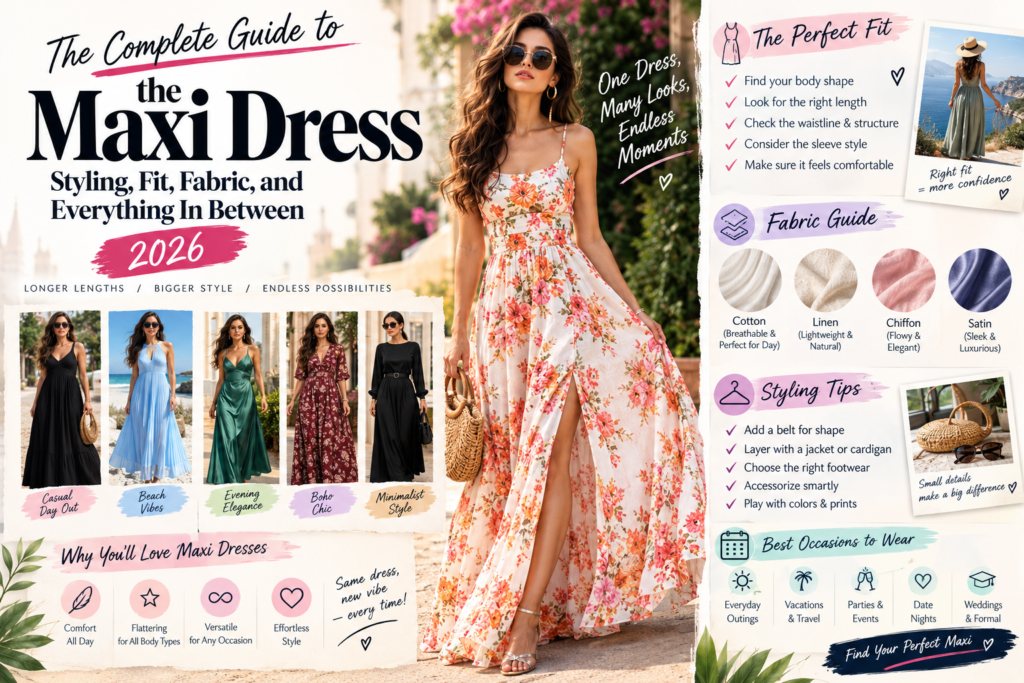
Fabric is the silent architect of a maxi dress. Cotton and cotton-blend maxis are breathable and casual, ideal for daytime and warm climates, but they wrinkle and can lack drape. Viscose and rayon drape beautifully and feel cool against the skin, though they require gentle washing. Silk and satin create fluid, luminous movement, making them perfect for evening wear, but they show water spots and need careful care.
Chiffon and georgette are lightweight and semi-sheer, often used as overlays. Jersey knit is stretchy and forgiving, great for travel and casual settings. Linen is breathable and textural, ideal for summer, but it creases easily. Polyester blends are durable and wrinkle-resistant, which makes them practical for packing, though lower-quality versions can feel less breathable.
There is also the question of lining. A well-made maxi dress often includes a lining in the bodice or throughout, which affects opacity, comfort, and structure. An unlined chiffon maxi may require a slip. A lined jersey maxi feels more substantial. When you evaluate a maxi dress, touch the fabric, hold it up to light, and check the seams. These small inspections reveal more than any product description.
| Fabric | Best For | Breathability | Drape | Care Level |
|---|---|---|---|---|
| Cotton | Casual daytime, warm weather | High | Moderate | Easy, machine washable |
| Viscose/Rayon | Everyday wear, travel | High | Excellent | Gentle wash, hang dry |
| Silk/Satin | Evening, formal events | Moderate | Luxurious | Dry clean or hand wash |
| Chiffon | Layering, summer events | High | Flowy, sheer | Hand wash, delicate |
| Jersey Knit | Casual, travel, comfort | High | Soft, stretchy | Machine washable |
| Linen | Summer, resort wear | Very high | Textural | Machine wash, wrinkles easily |
| Polyester Blend | Budget, packing, durability | Low to moderate | Variable | Easy, wrinkle-resistant |
Prints, Patterns, and Color Theory for Long Dresses
Because a maxi dress covers so much vertical space, print scale matters enormously. A small ditsy floral can read as delicate and romantic, while an oversized botanical print becomes a statement. Vertical stripes elongate, horizontal stripes widen, and diagonal or abstract prints create movement and energy. The larger the print, the more visual weight it carries, which is why petite frames often do better with smaller motifs.
Color theory also plays a role. Darker tones like navy, black, and deep green create a slimming, grounding effect. Brights and pastels lift the complexion and feel fresh in daylight. Monochrome dressing, where the maxi dress matches your shoes or accessories, creates an unbroken vertical line that makes you look taller. Contrasting accessories break that line and add visual interest but can shorten the silhouette.
Seasonality influences color choice too. Warm-weather maxi dresses lean toward white, coral, yellow, and sky blue, while cold-weather versions favor burgundy, charcoal, forest green, and camel. Understanding this helps you build a collection that works year-round rather than sitting unused for half the calendar.
Seasonal Styling: From Beach Days to Winter Layers
In summer, a lightweight cotton or viscose maxi dress paired with flat sandals, a straw hat, and a woven tote is nearly unbeatable. It handles heat, moves with you, and transitions from beach to lunch without a change of clothes. Add a denim jacket for breezy evenings or a light cardigan for air-conditioned interiors.
For spring and fall, layering is everything. A maxi dress becomes a base layer under a leather jacket, an oversized blazer, or a cropped knit. Ankle boots and a structured bag shift the look from casual to urban. Tights underneath extend the dress into cooler months, especially with a slip-style or column maxi.
Winter styling requires more intention. Choose heavier fabrics like wool blends, velvet, or lined jersey. Layer with thermal tights, knee-high boots, a long coat, and a chunky scarf. A turtleneck worn under a sleeveless maxi dress is a classic cold-weather trick that adds warmth without bulk. The goal is to treat the maxi dress as a foundation piece rather than a single-season garment.
Footwear, Accessories, and the Art of Proportion
Footwear changes the entire message of a maxi dress. Flat sandals say relaxed and casual. Heeled mules or strappy sandals say evening and elegant. Sneakers say urban and practical. Ankle boots add edge, while knee-high boots add drama and warmth. The hem length interacts with all of this. A maxi that grazes the floor needs a heel or a platform to avoid dragging, while one that stops at the ankle works with almost anything.
Accessories should be chosen with proportion in mind. A long pendant necklace draws the eye downward and complements a V-neckline. A statement belt defines the waist and breaks up a large expanse of fabric. Layered bracelets and rings add detail without competing with the dress. Bags matter too: a crossbody bag adds a diagonal line, while a clutch keeps the silhouette clean.
The most common mistake is over-accessorizing. Because a maxi dress already occupies a large visual area, restraint often looks more sophisticated. Choose one focal point, whether that is a bold earring, a patterned scarf, or a distinctive bag, and let the rest support it.
Occasion Guide: Where a Maxi Dress Works Best
The maxi dress is one of the few garments that genuinely spans occasions. A simple jersey maxi with sandals is perfect for errands, travel days, and casual lunches. A printed cotton maxi with a denim jacket works for festivals, farmers markets, and weekend trips. A silk or satin maxi with heels and delicate jewelry is appropriate for weddings, galas, and formal dinners.
For the workplace, a structured maxi dress in a solid neutral, paired with a blazer and closed-toe shoes, can be entirely professional in creative or business-casual environments. Beach weddings, resort dinners, and vacation evenings are natural fits. Even black-tie-adjacent events can work with a well-tailored, luxurious maxi in a dark tone with elegant accessories.
The real skill is reading the dress code and adjusting. A maxi dress is a canvas, and the styling determines whether it reads as casual, professional, or glamorous. That adaptability is what makes it worth the closet space.
Common Fit Problems and How to Solve Them
One of the most frequent complaints is that a maxi dress is too long. The fix is simple: hem it. A tailor can shorten a maxi to your exact preferred length, and the cost is usually modest compared to the improvement in wearability. If you want to avoid tailoring, choose a maxi that sits at the ankle rather than the floor, or wear a heel that raises you to the right height.
Another common issue is a gaping or ill-fitting bodice. This often happens with wrap and button-front styles. Fashion tape, a hidden safety pin, or a camisole underneath can solve minor gaps. If the bust is consistently too loose, sizing down or choosing a style with adjustable straps helps. For waistlines that sit too high or too low, a belt can visually reposition the seam.
Sheerness is another frequent problem, especially with light-colored or thin fabrics. A slip, nude undergarments, or a lined version solves this. Finally, static cling is a seasonal annoyance that anti-static spray or a light application of lotion on your legs can manage. Most fit problems have practical solutions that cost far less than replacing the garment.
Care, Storage, and Longevity Tips
A maxi dress takes up more fabric than almost any other garment, which means it also takes more wear and tear. Washing according to the care label is essential. Delicate fabrics like silk, chiffon, and viscose should be hand-washed or dry-cleaned. Cotton and jersey can usually be machine-washed on a gentle cycle with cold water.
Storage matters too. Hanging a heavy maxi dress by thin straps can stretch them over time. Fold heavier fabrics and store them flat, or use padded hangers for lightweight ones. Keep dresses out of direct sunlight to prevent fading, especially bright colors and prints. Rotate your seasonal pieces so that winter fabrics are not crushed under summer ones.
Stains should be treated immediately, particularly on silk and satin, which absorb oils quickly. Hemlines are the most vulnerable area because they drag and brush against surfaces. A quick check of the hem after each wear can catch small tears before they become large ones. With proper care, a quality maxi dress can last years and remain a reliable favorite.
Shopping Smart: What to Look For Before You Buy
When shopping for a maxi dress, start with the fabric content. A blend with some natural fiber usually feels better against the skin than pure synthetic. Check the seams, especially at the waist and straps, because these bear the most stress. Look at the hem finish: a clean, even hem suggests better construction than a rushed, uneven one.
Consider the print placement. On a well-designed maxi, patterns are matched at the seams and positioned thoughtfully on the body. Poorly matched prints look chaotic and cheap. Check the lining and opacity by holding the dress up to light. If you can see your hand clearly through it, you will likely need a slip.
Fit is more important than size on the label. Different brands use different blocks, and a maxi dress has more room for variation than a fitted garment. Try sitting, walking, and raising your arms before deciding. A dress that restricts movement will rarely get worn, no matter how beautiful it looks on the hanger.
Sustainability and Ethical Considerations
The fashion industry has a significant environmental footprint, and long dresses use more fabric than shorter garments. That makes material choice and longevity especially important. Natural fibers like organic cotton, linen, and Tencel lyocell are generally more sustainable than virgin polyester, though the full picture depends on farming, processing, and transport.
Buying fewer, better-made maxi dresses and caring for them properly is one of the most effective ways to reduce impact. Choosing timeless silhouettes over trend-driven ones extends wear. Supporting brands with transparent supply chains and fair labor practices adds an ethical dimension to your purchase.
Secondhand and vintage maxi dresses are also excellent options. Because the style is classic, older pieces often remain relevant, and the fabric quality of vintage garments is frequently higher than modern fast-fashion equivalents. Repairing rather than replacing, and tailoring rather than discarding, keeps garments in circulation and out of landfills.
Expert Perspectives on Timeless Style
Fashion historians often point out that enduring garments share certain traits: adaptability, comfort, and a strong visual identity. The maxi dress checks all three. Designers have returned to it repeatedly because it offers a blank canvas for fabric experimentation while remaining wearable.
As the late designer Yves Saint Laurent once observed, “Fashions fade, style is eternal.” The maxi dress embodies that idea. It has survived decades of shifting trends not because it chases novelty but because it solves a real problem: how to look elegant and feel comfortable at the same time.
Stylist and author Kate Young has similarly noted that “the best-dressed people are the ones who understand their own proportions.” That principle applies directly to the maxi dress. When you understand your body, your lifestyle, and the fabrics that work for you, the dress becomes a tool rather than a gamble.
Real-World Styling Scenarios
Consider a destination wedding in Tuscany. A guest chooses a silk chiffon maxi in a muted sage tone, paired with strappy gold sandals, a simple clutch, and a single statement earring. The fabric moves in the breeze, the color photographs beautifully against stone and cypress, and the length is appropriate for a formal ceremony.
Now consider a freelance designer working from home who has a client lunch at noon and a school pickup at three. She wears a jersey maxi in navy, adds a denim jacket and white sneakers, then swaps the jacket for a blazer and the sneakers for flats before the meeting. After lunch, the blazer comes off and the sneakers go back on. One garment, three modes.
Or imagine a traveler spending two weeks in Southeast Asia. She packs two maxi dresses, one cotton and one viscose, plus a light cardigan, a scarf, and sandals. These pieces cover temples, beaches, dinners, and flights. The dresses roll into a carry-on without wrinkling badly, and they handle humidity far better than jeans or structured trousers.
These scenarios are not hypothetical luxuries. They are the practical reality of why the maxi dress earns its place in a functional wardrobe.
Sizing, Petite, Plus, and Maternity Considerations
Petite shoppers often find that standard maxi dresses overwhelm their frame. The solution is to look for petite-specific lines, which adjust both length and proportions such as waist placement and strap width. Hemming is also an option, but shortening a dress without adjusting the waist seam can throw off the intended silhouette. Petite maxis with vertical details and higher necklines tend to work best.
Plus-size maxi dresses have improved dramatically in recent years, with more brands offering extended sizing and thoughtful design rather than simply scaling up straight-size patterns. Look for styles with proper bust support, well-placed waist seams, and enough fabric in the skirt for comfortable movement. Wrap and A-line styles are particularly forgiving.
Maternity maxi dresses are a natural fit because the silhouette accommodates a growing belly without constant refitting. Empire waists, stretchy jersey, and wrap styles are popular choices. Many maternity maxis also work well postpartum, which extends their value. The key is choosing fabric with enough stretch and a waistline that can adapt.
Layering Techniques for Every Season
Layering is where the maxi dress truly shines. In cool weather, a fitted turtleneck or long-sleeve tee under a sleeveless maxi creates warmth without hiding the dress. A cropped sweater over a slip maxi defines the waist and adds texture. Denim jackets, leather jackets, and blazers all work as outer layers, each shifting the overall aesthetic.
For transitional weather, a long cardigan or duster coat layered over a maxi creates a dramatic, flowing line. A belt over both the dress and the cardigan can define the waist. Scarves add color and warmth around the neck, while tights and boots handle the lower half.
In hot weather, layering is about sun protection rather than warmth. A lightweight linen shirt worn open over a maxi dress adds coverage without heat. A wide-brimmed hat and sunglasses complete the look. The principle is always the same: add layers that serve a purpose and complement the dress rather than competing with it.
The Maxi Dress in Different Cultures and Modest Fashion
The long dress holds significance in many cultural and religious contexts. In modest fashion, the maxi dress offers coverage without sacrificing style, and it is embraced by Muslim, Jewish, Christian, and other communities with modesty traditions. Designers have responded with maxi dresses that feature long sleeves, high necklines, and opaque fabrics, often with beautiful embroidery and detailing.
In South Asia, the anarkali and floor-length kurta are close relatives of the maxi dress, combining traditional embroidery with modern silhouettes. In West Africa, the boubou and kaftan share the flowing, floor-length aesthetic. Latin American and Mediterranean cultures have their own long-dress traditions tied to festivals and celebrations.
This global presence means the maxi dress is not owned by any single culture or trend. It is a universal form that adapts to local aesthetics, climate, and values. Recognizing that breadth deepens appreciation for the garment and opens up styling inspiration from around the world.
Common Mistakes to Avoid
One of the biggest mistakes is choosing a maxi dress that is too long and then never wearing it because it drags or gets dirty. Fit should always come before aesthetics. Another is ignoring fabric weight. A heavy maxi in summer or a flimsy maxi in winter will sit unworn regardless of how good it looks.
Over-accessorizing is another frequent error. A maxi dress already makes a statement with its length and volume. Piling on necklaces, belts, scarves, and bold bags creates visual noise. Editing down usually produces a more polished result.
Finally, many people treat the maxi dress as a single-occasion garment, wearing it only to the beach or only to weddings. That limits its value. The same dress can serve multiple purposes with different styling, and viewing it as a versatile foundation rather than a one-note piece unlocks far more wear.
Frequently Asked Questions
What is the difference between a maxi dress and a midi dress?
A midi dress typically falls between the knee and the ankle, usually around mid-calf, while a maxi dress extends to the ankle or floor. The distinction is primarily about length, though proportion and styling differ as a result. A maxi dress creates a longer vertical line and tends to feel more dramatic or relaxed, while a midi dress is often more practical for everyday activities like cycling or navigating stairs. Both can work for similar occasions, but the maxi dress generally makes a stronger visual statement and requires more attention to hem length and footwear.
Can a maxi dress work for a formal event?
Absolutely, provided the fabric, cut, and styling match the formality of the occasion. A silk, satin, or velvet maxi dress in a dark or jewel tone, paired with elegant heels and refined jewelry, is entirely appropriate for weddings, galas, and formal dinners. The key is avoiding casual fabrics like jersey or cotton and choosing a silhouette that fits well and skims the floor cleanly. A maxi dress can be just as formal as a gown when the construction and materials support it.
How do I keep a maxi dress from dragging on the ground?
The most reliable solution is tailoring. A professional hem adjustment ensures the dress sits at your preferred length with the shoes you plan to wear. If you prefer not to tailor, choose a maxi that stops at the ankle rather than the floor, or wear a heel that lifts the hem just above the ground. Fashion tape can temporarily shorten a hem in a pinch, and a belt can raise the waistline slightly, which lifts the entire dress. Always try the dress on with your intended footwear before deciding.
Are maxi dresses flattering on petite frames?
Yes, when the proportions are right. Petite frames benefit from high necklines, vertical prints, and waist seams that sit at the natural waist rather than dropping too low. Avoid overwhelming prints and excessive fabric volume, which can swallow a smaller frame. Petite-specific maxi dresses are designed with adjusted lengths and proportions, and hemming a standard maxi is a straightforward alteration. Pairing the maxi dress with a heel or platform sandal adds height and helps the hem clear the ground.
What is the best way to wash and store a maxi dress?
Always follow the care label first. Delicate fabrics like silk, chiffon, and viscose should be hand-washed in cold water or dry-cleaned, while cotton and jersey can usually be machine-washed on a gentle cycle. Avoid wringing or twisting delicate fabrics, and dry them flat or on a padded hanger away from direct sunlight. For storage, fold heavy fabrics flat to prevent strap stretching, and hang lightweight dresses on padded hangers. Keep dresses out of direct sun to prevent fading, and rotate seasonal pieces to avoid crushing.
Conclusion
The maxi dress is far more than a long piece of fabric. It is a design solution, a cultural artifact, and a practical wardrobe workhorse rolled into one. From its bohemian roots to its current status as a staple across formal and casual settings, it has proven its staying power by adapting to bodies, climates, and occasions without losing its essential character.
Understanding fabric, silhouette, proportion, and care transforms the way you shop for and wear a maxi dress. You stop buying on impulse and start building a collection that genuinely serves your life. You learn which lengths work with which shoes, which prints flatter your frame, and which layers extend the dress across seasons. That knowledge is what separates a closet full of clothes from a wardrobe that works.
The final takeaway is simple: treat the maxi dress as a foundation, not a finishing piece. Style it with intention, care for it properly, and let it move with you through every season of your life. Few garments offer this much versatility with this little effort, and that is exactly why the maxi dress remains timeless.