Leather shoes represent one of the few investments in a modern wardrobe that genuinely gets better with time. Unlike synthetic alternatives that degrade and crack within months, a well-made pair of leather footwear develops a unique patina, molds to the shape of your foot, and can last for decades with proper care. The global footwear market reflects this enduring appeal, with leather shoes maintaining a dedicated following among professionals, enthusiasts, and anyone who values craftsmanship over disposable fashion. Understanding what separates an exceptional pair from a mediocre one requires knowledge of leather grades, manufacturing techniques, and the care rituals that preserve these investments for years.
The journey from raw hide to finished shoe is remarkably complex. A single pair of quality leather shoes can involve over 200 individual steps, from selecting the right section of the hide to the final polish that gives it that unmistakable luster . This guide explores every aspect of leather footwear, from the tanning processes that determine durability to the welt construction methods that allow for resoling and repair. Whether you are building a professional wardrobe, seeking boots that can handle years of daily wear, or simply curious about why some shoes command premium prices, understanding the fundamentals of leather craftsmanship will transform how you evaluate and care for your footwear.
Understanding Leather Grades and Quality
The quality of leather shoes begins with the hide itself, and not all leather is created equal. Full-grain leather represents the highest tier, cut from the outermost layer of the animal skin with the natural grain surface left completely intact. This preserves the dense fiber structure that gives full-grain its exceptional durability, breathability, and ability to develop a rich patina over years of wear . You will notice small natural marks on full-grain shoes—insect bites, minor scars, variations in texture—and these are not defects but rather evidence that the leather is authentic and unaltered. A well-maintained full-grain shoe can easily last twenty years or more, making the higher upfront cost a genuine long-term investment.
The Tanning Process and Its Impact on Durability
Tanning transforms raw animal hides into stable, durable leather, and the method used has profound implications for how your shoes will perform over time. Vegetable tanning, an ancient technique dating back to Roman times, uses natural tannins from tree bark and other plant sources to preserve the hide. This process is extraordinarily time-consuming, often taking a year or more to complete, but it produces leather with exceptional longevity and a suppleness that synthetic methods cannot replicate . Oak-bark tanned soles, prized in traditional British shoemaking, demonstrate remarkable durability—divers recovered vegetable-tanned leather from a shipwreck in 1973 that had been submerged since 1786, and the material remained workable and suitable for bespoke shoe production .
Chrome tanning, developed in the late nineteenth century, uses chromium salts to tan hides in a matter of hours rather than months. This method dominates modern leather production because it is faster and cheaper, but the resulting leather often lacks the depth and aging characteristics of vegetable-tanned material. Many quality shoemakers use combination tanning, employing chrome for the upper and vegetable tanning for the soles, balancing cost and performance. The tanning method also affects how leather responds to conditioning and care products—vegetable-tanned leather tends to absorb conditioners more readily, while chrome-tanned leather may require different formulations to penetrate the surface treatment.
Construction Methods: Goodyear Welting and Beyond
The construction method used to attach the upper to the sole is one of the most important indicators of a leather shoe’s quality and repairability. Goodyear welting, invented in the nineteenth century and still used by traditional makers like Crockett & Jones, involves stitching a strip of leather (the welt) to both the upper and the insole, then stitching the sole to the welt . This creates a durable, water-resistant bond that can be repaired repeatedly—when the sole wears out, a cobbler simply removes the stitching, attaches a new sole, and restitches the welt. A quality Goodyear welted shoe can be resoled three, four, or even more times over its lifetime, making it a genuinely sustainable investment .
The Anatomy of a Quality Leather Shoe
A well-constructed leather shoe comprises numerous distinct components, each contributing to comfort, durability, and appearance. The upper is the part that covers your foot, typically made from the finest section of the hide—the tighter, more uniform grain from the back or shoulder. The vamp covers the front of the foot, while the quarters wrap around the heel. The lining, usually a softer, thinner leather, provides internal comfort and helps manage moisture. The insole forms the foundation, and in quality shoes it is made from thick vegetable-tanned leather that molds to your foot over time, creating a personalized fit .
Why Leather Outperforms Synthetic Alternatives
The case for genuine leather footwear over synthetic alternatives rests on measurable differences in comfort, durability, and long-term value. Leather is naturally breathable, with an open pore structure that allows moisture vapor to escape, keeping feet drier and more comfortable than non-porous synthetic materials . Over time, leather molds to the contours of your foot, creating a custom fit that improves with each wearing. Synthetic materials, by contrast, remain rigid and unyielding, often causing discomfort and blistering that never fully resolves .
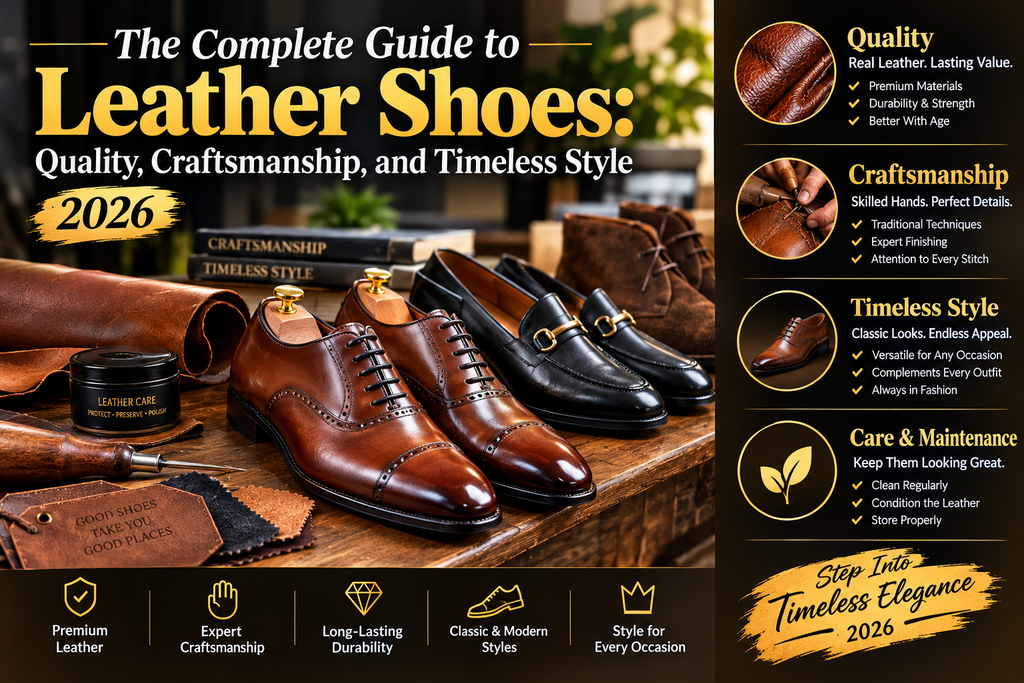
The Enduring Appeal of British Shoemaking
Northampton, England, has been the heart of British shoemaking since the twelfth century, and the town’s name remains synonymous with quality leather footwear worldwide. The region’s rise as a shoemaking center was no accident—it offered abundant water sources essential for tanning, access to hides from local cattle markets, and proximity to distribution networks that could reach both London and international markets . Companies like Crockett & Jones have maintained their Northampton factories for over a century, preserving techniques and standards that mass production has largely abandoned. The Crockett & Jones facility, operational since 1890, still uses methods that would be recognizable to a shoemaker from the Victorian era, with skilled workers performing tasks by hand that machines could theoretically automate .
The Problem of “Genuine Leather” and How to Identify Quality
The term “genuine leather” represents one of the most persistent sources of consumer confusion in the footwear market. Technically, any product containing leather can be labeled genuine, but the term has become associated with the lowest quality materials—finished splits and bonded leather that offer minimal durability . As one leatherworker explained, saying a product is made of genuine leather is like saying a burger is made of real beef; it tells you nothing about quality, only that the material is technically what it claims to be .
The Art and Science of Leather Shoe Care
Proper care transforms leather footwear from a short-term purchase into a lifelong companion. The fundamental principle is regular maintenance—cleaning every two to five wears, conditioning every six months, and storing properly between uses . Cleaning begins with removing laces and brushing away surface dirt with a soft brush or dry cloth. For deeper cleaning, a damp cloth with mild soap or saddle soap can be used, but the leather should never be soaked, as excessive moisture damages the natural fiber structure . After cleaning, shoes should air dry at room temperature, away from direct heat sources like radiators or sunlight, which can cause leather to dry too quickly and crack .
Repair and Resoling: Extending the Life of Your Investment
One of the most compelling arguments for investing in quality leather shoes is their repairability. A Goodyear welted shoe can be resoled multiple times, with each resoling extending the shoe’s useful life by years. The process involves removing the worn sole, preparing the welt and insole, and attaching a new sole using the original welt stitching. A skilled cobbler can also replace heels, repair linings, and address damage to the upper through patching or stitching. This repairability stands in stark contrast to cemented construction, where a worn sole effectively condemns the entire shoe to the landfill.
Matching Leather Shoes to Occasions and Personal Style
The versatility of leather footwear extends across virtually every context, from boardroom formality to weekend casual. Oxford shoes, with their closed lacing system, represent the most formal option, appropriate for business settings, weddings, and events where a suit is required. Derby shoes, with open lacing, offer slightly more relaxed formality and greater adjustability for higher insteps. Loafers, whether penny, tassel, or horsebit, bridge the gap between dress and casual, working equally well with tailored trousers and dark denim. Chelsea boots provide a sleek, ankle-height option that pairs with everything from suits to jeans, while service boots and work boots bring rugged durability to casual and outdoor contexts.
A Comparison of Leather Types and Their Best Uses
The following table summarizes the key leather grades and their characteristics, helping you make informed decisions based on your needs and budget.
| Leather Type | Source | Durability | Breathability | Patina Development | Best Uses |
|---|---|---|---|---|---|
| Full-Grain | Outermost hide layer, grain intact | Exceptional (20+ years) | High | Rich, develops over years | Premium dress shoes, boots, long-term investments |
| Top-Grain | Sanded and refinished surface | Good (5-10 years) | Moderate | Limited | Fashion shoes, belts, wallets |
| Corrected-Grain / Genuine | Buffed and embossed | Moderate (2-4 years) | Low | Minimal | Budget footwear, casual shoes |
| Bonded Leather | Shredded scraps with binder | Poor (months) | Very Low | None | Low-cost fashion items, rarely shoes |
The choice between these grades depends on your priorities. For a pair of shoes you intend to wear frequently and keep for years, full-grain is the clear choice despite the higher initial cost. For occasional wear or fashion-forward styles where longevity is less critical, top-grain may suffice. Corrected-grain and bonded leather should be approached with realistic expectations—they can serve a purpose for short-term needs but will not provide the comfort, durability, or aesthetic rewards of higher-quality materials .
The Patina Factor: Why Leather Ages Beautifully
One of the most distinctive qualities of leather footwear is its capacity to improve aesthetically with age. This phenomenon, known as patina, results from the interaction of leather with light, moisture, oils from the skin, and the environment. Full-grain leather develops a depth of color and a soft sheen that cannot be replicated artificially—the surface gradually darkens and takes on a richness that reflects the shoe’s history . This is not a flaw but a feature, one that distinguishes leather from synthetic materials that simply wear out rather than evolve.
The patina process is particularly pronounced on lighter-colored leathers, where the contrast between high-wear areas and protected surfaces creates a natural gradient. Tan and cognac leathers are especially prized for the way they age, developing honeyed tones and subtle variations that give each pair a unique character. Conditioning products can influence patina development—neutral conditioners preserve the leather’s natural color evolution, while tinted products can restore or alter it. For many enthusiasts, the patina that develops over years of wear is the primary reason for choosing leather over alternative materials. It represents a visual record of experience, a quality that aligns with a broader cultural shift toward valuing authenticity and craftsmanship over mass-produced uniformity.
Common Problems and Practical Solutions
Leather footwear, despite its durability, encounters predictable problems that require specific solutions. Water stains, often caused by rain or snow, can be addressed by gently cleaning the affected area with a damp cloth and mild soap, then allowing the shoe to dry completely before conditioning to restore the leather’s natural oils . Salt stains, common in winter climates where roads are treated, respond well to a solution of equal parts water and white vinegar applied with a cloth and blotted until the mark fades . Grease stains can be treated by sprinkling cornstarch or talcum powder on the affected area and allowing it to sit overnight, drawing the oil out of the leather .
Building a Leather Shoe Collection That Lasts
A thoughtfully assembled collection of leather shoes provides versatility across contexts while allowing each pair to rest and recover between wears. The foundation typically begins with a pair of black Oxfords or Derbies for formal occasions, followed by brown leather shoes in a versatile style like wingtips or plain-toe Derbies for business and smart-casual settings. A pair of loafers adds convenience for warmer months, and Chelsea or service boots provide ankle support and weather resistance for colder seasons. This four-pair foundation covers virtually every situation, and each pair, if chosen wisely and cared for properly, can last for many years.
The temptation to accumulate many inexpensive pairs should be resisted in favor of fewer, higher-quality shoes. A single pair of well-made leather shoes that fits properly and is properly maintained will provide more comfort, durability, and satisfaction than several pairs of inferior alternatives. When building a collection, prioritize fit above all else—a beautiful shoe that causes discomfort will rarely be worn, regardless of its quality. Learn your size on different lasts, as sizing can vary between manufacturers, and take advantage of try-on opportunities or generous return policies. Over time, the collection can expand to include specialized styles for particular needs, but the core should remain focused on versatile, well-constructed pieces that serve multiple purposes.
FAQ
What Is the Difference Between Full-Grain and Top-Grain Leather Shoes
Full-grain leather retains the complete natural surface of the hide, including the dense outer layer that provides maximum durability, breathability, and patina development. Top-grain leather has been sanded to remove imperfections and then refinished, resulting in a more uniform appearance but reduced breathability and durability. Full-grain shoes are generally more expensive but represent a better long-term investment, while top-grain offers a middle ground for those seeking quality at a lower price point .
How Long Should Leather Shoes Last with Proper Care
A well-made pair of full-grain leather shoes with Goodyear welted construction can last twenty years or more with regular care and periodic resoling. The upper leather may develop a patina and character over time, but the structural integrity can be maintained almost indefinitely through proper cleaning, conditioning, and professional repair. Synthetic and lower-grade leather shoes typically last only one to three years with regular wear, as the materials degrade and cannot be effectively repaired .
Can Leather Shoes Be Repaired Once They Are Worn Out
Quality leather shoes constructed with Goodyear welting or similar recraftable methods can be resoled and repaired multiple times, significantly extending their useful life. Even significant damage to the upper can often be addressed by a skilled cobbler through patching, stitching, or leather replacement. Cemented shoes, where the sole is glued rather than stitched, generally cannot be economically repaired once the sole wears through or separates .
How Often Should Leather Shoes Be Conditioned
Leather shoes should be conditioned approximately every six months with regular wear, though frequency may increase in dry climates or during winter months when exposure to salt and moisture is more common. Conditioning restores natural oils that prevent drying and cracking, keeping the leather supple and extending its lifespan. Over-conditioning can clog the leather’s pores and attract dirt, so moderation is important—a small amount applied evenly and buffed in is sufficient .
Why Are Some Leather Shoes So Much More Expensive Than Others
The price difference reflects the quality of materials, construction methods, and labor involved in production. Full-grain leather from premium tanneries costs significantly more than corrected-grain or bonded leather. Goodyear welted construction requires skilled labor and more time than cemented construction. Brands that manufacture in countries with strong shoemaking traditions and fair labor practices incur higher costs but produce shoes that last far longer and can be repaired. The higher upfront cost is offset over time by superior durability and repairability .
Conclusion
Leather shoes occupy a unique position in modern wardrobes—simultaneously practical and aspirational, traditional and timeless. The leather shoes you choose reflect not only your personal style but also your values regarding quality, sustainability, and craftsmanship. Understanding the distinctions between full-grain and corrected-grain, recognizing the significance of Goodyear welting, and committing to regular care transforms footwear from a recurring expense into a lasting investment. The patina that develops over years of wear tells a story that no synthetic material can replicate, and the comfort that comes from leather molding to your foot is a daily reminder of why quality matters.
The final insight is that leather footwear rewards patience and attention. The shoes that look and feel best are rarely the ones purchased in haste or chosen solely for their initial appearance. They are the ones selected with care, broken in gradually, maintained consistently, and repaired when necessary. In a world of disposable products and fleeting trends, a well-made pair of leather shoes stands as a small but meaningful commitment to durability, craftsmanship, and the idea that some things are worth doing properly. Whether you are purchasing your first quality pair or adding to a collection built over decades, the principles remain the same.