A gold chain is the rare piece of jewelry that works as hard as it looks. It can sit quietly under a collar as a private detail, carry a pendant that means something, or stand alone as the only accessory a person needs. But the gap between a chain that survives decades and one that kinks, snaps, or fades within a year comes down to decisions most buyers make in about ninety seconds at a display case.
That is the problem worth solving. The chain is structural, not decorative, and the link type determines how a piece will behave over years of wear . Understanding what you are actually buying, from the geometry of the links to the difference between solid and hollow construction, turns a rushed purchase into a considered one. This guide covers the variables that matter and the ones that are mostly marketing noise.
What a Gold Chain Actually Is and Why Link Geometry Matters
A gold chain is a series of connected links, and the shape of those links dictates nearly everything about the finished piece. How it drapes against the neck, how it reflects light, how strong it is under the weight of a pendant, and even how easily a jeweler can repair it after a break all trace back to the link structure . Two chains of identical weight and karat can behave completely differently if one uses round interlocking links and the other uses square ones.
Flexibility is the first variable. A chain that moves freely in every direction lies flat against the collarbone and disappears under clothing without bunching. A stiff chain stands away from the body and creates a visible gap at the neckline, which looks awkward under a crewneck and worse under a collar. Repairability is the second variable, and it is the one buyers ignore until something goes wrong. Cable chains and box chains can be repaired at virtually any break point by a competent bench jeweler. Rope chains and wheat chains require more skill because the complex link structure makes a clean repair seam difficult to hide .
The third variable is how the chain handles the weight of a pendant. A chain that is too fine for a heavy pendant will stretch over time, and a stretched chain cannot be un-stretched. A chain that is too thick for a delicate pendant will visually swallow it. Matching the chain to the job it needs to do is not an aesthetic preference; it is a structural requirement.
The Main Gold Chain Link Types and What Each One Does Best
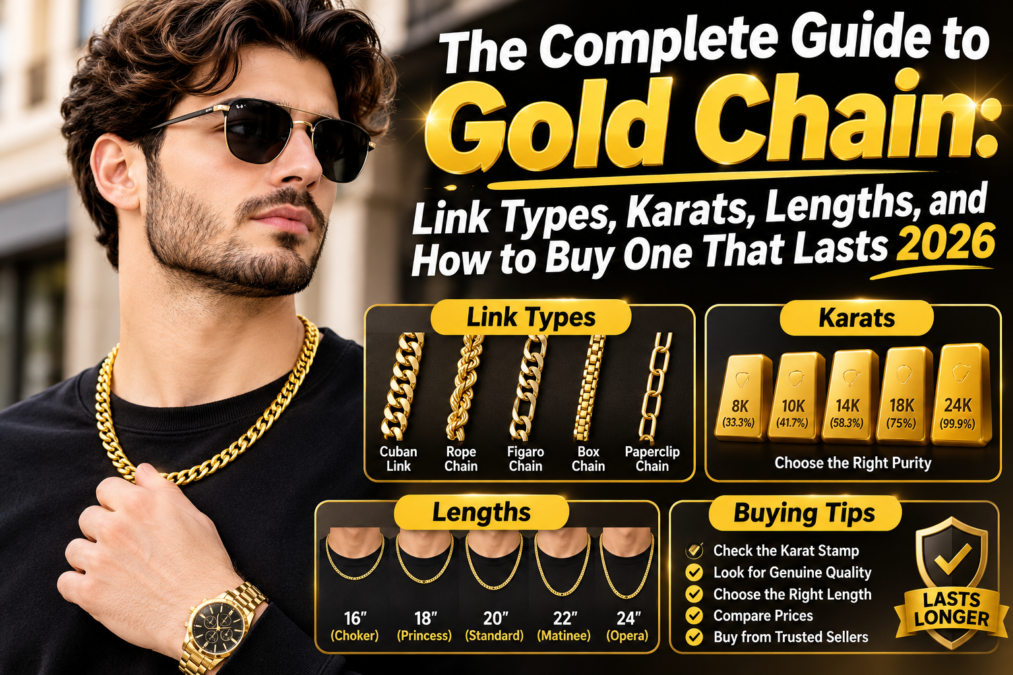
The gold chain landscape is crowded with names, but most styles fall into a handful of families with distinct personalities. The cable chain, also called a trace chain, uses identical oval or round links connected in a simple alternating pattern. It is the most flexible chain type available and the correct choice when the chain should disappear visually behind a pendant . The curb chain uses flattened, twisted links that catch light and lie smoothly against the skin, which makes it brighter and more substantial-feeling than a cable chain at the same weight . The figaro chain alternates short links with a single elongated link, creating a rhythm that reads as casual and works well worn alone under an open collar .
The rope chain twists multiple strands into a helical structure that glows under light because different facets catch illumination at different angles. It is a strong statement worn solo but competes with a pendant rather than supporting it, and it is the most vulnerable to permanent kinking under lateral stress . The box chain uses square links connected through their sides, producing a smooth, consistent surface with a clean geometric profile. It distributes pendant weight well and reads as modern and refined in finer gauges, though heavier box chains can look blocky rather than elegant .
Beyond these four, there are specialty styles worth knowing. The Cuban link is a tightly packed, thick chain that has moved from hip-hop culture into mainstream menswear. The herringbone uses tight, fluid patterns that glow at the slightest movement. The paperclip chain, with its elongated rectangular links, has become a layering staple because it adds visual texture without weight . The anchor or Gucci link places a bar across each oval link, adding ornamentation to a classic silhouette .
Solid, Hollow, and Plated: The Construction Question That Determines Longevity
The distinction matters most for anyone planning to wear the chain daily or attach a pendant. A hollow chain that looks impressive in the case will deform under the constant pull of a pendant within months. A solid chain in a modest gauge will outlast it by decades. The weight difference is real, and some people prefer the lighter feel of hollow construction for a large statement piece worn occasionally. But for a chain that becomes part of a daily routine, solid is the only construction that makes financial sense.
Karats add another layer. 24-karat gold is nearly pure and unmistakably yellow, but it is soft enough that a fine chain in 24k will stretch and scratch more readily than an alloy. 18-karat gold, at 75 percent purity, balances color richness with durability and does not oxidize, which means it can be worn in water without dulling . 14-karat gold is harder still and wears better over time in chain applications, making it the practical choice for a piece that will see daily use . The color difference between 14k and 18k is subtle to most eyes; the durability difference over years of wear is not.
How to Match Chain Length, Gauge, and Pendant Weight
The length of a gold chain determines where it sits on the body, and that placement changes the entire character of the piece. A 16-inch chain falls at the base of the neck and suits small, symbolic pendants that are meant to sit close to the skin. An 18-inch chain lands just below the collarbone and is the most versatile length for everyday pendants because it works with nearly every neckline. A 20-inch chain falls to the upper chest and accommodates medium pendants and layered looks. A 24-inch chain or longer drops onto the chest and suits bold statement pendants or a chain worn alone over knitwear .
Gauge, or the visual width of the chain, has to match the pendant it carries. A pendant weighing four grams or less works best on a chain between 1.0 and 1.5 millimeters. A pendant between four and eight grams needs a chain of 1.5 to 2.2 millimeters. Anything between eight and fifteen grams should sit on a chain of 2.5 to 3.0 millimeters or thicker, depending on the bail size . The bail, the loop on the pendant that the chain passes through, must be large enough to accommodate the chain’s widest link or clasp end, and a smooth, round bail reduces friction that wears down the links over time .
The problem-solution logic here is straightforward. A chain that is too fine for its pendant will stretch and eventually fail at the clasp or a solder joint. A chain that is too thick for its pendant will look unbalanced and draw attention away from the piece that is supposed to be the focus. The right pairing is the one where the chain does its job without calling attention to itself, unless the chain is the point.
A Reference Table for Choosing the Right Gold Chain
The table below summarizes the practical differences between the main gold chain types, karats, and construction methods, drawn from jewelry trade guidance on link behavior and durability.
| Decision Factor | Practical Guidance | Why It Matters |
|---|---|---|
| Cable chain | Fine gauge (0.8–1.2mm) for pendants | Most flexible; disappears visually behind the pendant |
| Box chain | 1.0–1.4mm for station or solitaire pendants | Smooth profile, distributes weight without distortion |
| Rope chain | Worn solo in 2.0–3.0mm; avoid heavy pendants | Strong visual statement but vulnerable to permanent kinking |
| Figaro chain | 2.0mm+ for casual solo wear | Alternating link pattern reads as informal and personal |
| 14k gold | Best for daily-wear chains | Harder alloy resists wear better than 18k or 24k |
| 18k gold | Rich color, water-safe | Does not oxidize; suitable for everyday wear |
| Solid construction | Required for pendants and daily wear | Hollow chains dent and cannot be repaired |
| Pendant weight ≤4g | 1.0–1.5mm chain | Prevents stretching and clasp failure |
| Pendant weight 4–8g | 1.5–2.2mm chain | Distributes load without distortion |
The row that catches the most buyers is the solid versus hollow distinction. A hollow chain at a large visual size will often cost less than a solid chain at a smaller size, and the hollow one looks like more gold in the case. Within a year of daily wear, that calculation reverses.
Clasps, Hallmarks, and the Details That Signal Quality
The clasp on a gold chain is a small component with an outsized role. A lobster clasp is the most secure and easiest to operate for daily wear, while a spring ring is adequate for lightweight chains but less reliable under repeated stress . A poorly made clasp will fail before the chain does, and a clasp replacement on a fine chain is an annoyance that a better initial choice would have avoided. The clasp should feel solid in the hand, open and close with a clean snap, and sit flush against the skin rather than catching on clothing.
The hallmark is the other detail worth checking before purchase. A hallmark is a stamp that indicates the metal purity and, in many jurisdictions, the maker and assay office. An 18-karat chain should be marked 750, meaning 75 percent fine gold. A 14-karat chain should be marked 585 . The absence of a hallmark on a piece sold as solid gold is a reason to walk away. Plated pieces often carry no purity mark at all, or carry a mark that describes the plating rather than the core . The hallmark is not a guarantee of quality craftsmanship, but it is a guarantee of material content, and that is the foundation everything else rests on.
A vintage or secondhand gold chain adds another layer of diligence. A reputable seller should be able to explain the hallmark and what it indicates about the maker and era. A chain bought from a source that cannot or will not discuss the hallmark is a chain bought on faith, and faith is not a useful strategy for precious metal purchases .
Layering and Styling Without Tangling or Regret
Layering gold chain necklaces has become a default styling move, and the formula that works is simpler than the photos suggest. Start with one fine chain at 16 to 18 inches carrying a small pendant or worn alone. Add a mid-length chain at 20 to 22 inches in a contrasting texture, such as a paperclip or a figaro, to create visual variation. Finish with a longer base chain at 24 inches or beyond in a curb or rope for weight and balance . The rule of thumb is to mix one fine, one medium, and one bold chain rather than stacking three pieces of the same visual weight.
The practical problem with layering is tangling, and the solution is deliberate spacing. Keep pendants on only one or two layers rather than every chain, because multiple pendants at similar lengths will twist around each other within an hour of wear. Mixing link textures also reduces tangling because smooth chains slide against textured ones rather than locking together. And a chain worn alone has a different job than a chain worn in a stack: a solo chain can carry more visual weight, while a layered chain should be finer than it would be on its own.
The style guidance that has aged best is the simplest. A chain lifts even a plain t-shirt and jeans into something more considered, and the beauty of a chain is that it never looks excessively thought through . The inverse is also true. A stack of chains, bracelets, rings, and watches worn all at once reads as effort rather than ease. A single gold chain worn consistently becomes part of the person wearing it rather than an accessory applied to an outfit.
Frequently Asked Questions About Gold Chain
What is the most durable gold chain link type for daily wear?
The curb chain and the box chain are the most practical choices for daily wear because their link structures distribute stress evenly and repair cleanly if damaged. Cable chains are also durable and flexible but can stretch under a heavy pendant if the gauge is too fine. Rope chains should be avoided for daily wear with a pendant because they kink permanently under lateral stress . The construction matters as much as the link type: a solid curb chain in 14k will outlast a hollow rope chain in 18k by a wide margin .
Is 14k or 18k gold better for a gold chain?
It depends on how the chain will be worn. 14k gold is harder and more resistant to scratching and deformation, which makes it the better choice for a chain that will be worn daily, especially with a pendant attached . 18k gold offers a richer yellow color and does not oxidize, so it can be worn in water without dulling, but it is softer and more prone to surface wear over years of constant use . For occasional wear or a piece where color is the priority, 18k is the stronger choice. For a chain that becomes part of a routine, 14k is the more practical investment.
How do I know if a gold chain is solid or hollow?
A solid gold chain feels heavier than its visual size suggests, and it will be marked with a purity hallmark such as 585 for 14k or 750 for 18k . A hollow chain feels unexpectedly light for its bulk, and the difference is most obvious when you compare two chains of the same dimensions side by side. A plated chain is the easiest to identify because the plating will eventually wear through at high-friction points like the clasp and the links nearest the neck, revealing a different color underneath . Any seller unable to confirm solid construction in writing is a seller to avoid for a significant purchase.
What chain length is best for a pendant?
The most versatile length for an everyday pendant is 18 inches, which places the pendant just below the collarbone and works with most necklines . Small symbolic pendants meant to sit close to the skin work better on a 16-inch chain. Medium pendants and layered looks benefit from a 20-inch chain, while bold statement pendants and chains worn over clothing suit 24 inches or longer . The pendant’s weight also dictates the chain’s gauge: anything above eight grams needs a chain of at least 2.5 millimeters to avoid stretching .
Can a gold chain be repaired if it breaks?
Cable chains and box chains can be repaired at virtually any break point by a competent jeweler, which is one of their practical advantages over more complex link styles . Rope chains and wheat chains are more difficult to repair cleanly because the twisted structure makes a visible seam likely at the repair point. Hollow chains are the hardest to repair because the thin walls crush under the heat and pressure of soldering, and a crushed hollow link often cannot be restored . The repairability of a chain is worth considering before purchase if the piece is intended for decades of wear.
Conclusion
A gold chain is one of the few purchases where the details that are hardest to see at the counter are the ones that determine whether the piece lasts five years or fifty. Link geometry controls drape, strength, and repairability. Karat controls color and hardness. Construction controls whether the chain can survive a pendant, a daily commute, and a decade of ordinary wear without deforming. None of these variables are visible in a photograph, and all of them matter more than the initial shine.
The final insight worth carrying into any purchase is that a chain should be chosen for the job it will do, not for how it looks in the case. A fine cable chain that disappears behind a meaningful pendant and a bold rope chain worn alone on a weekend are both correct decisions, but they are correct for different reasons. Buy the link type that matches the wear, the karat that matches the routine, and the construction that matches the commitment. The chain that gets worn every day without a second thought is the one that was chosen with a first thought.