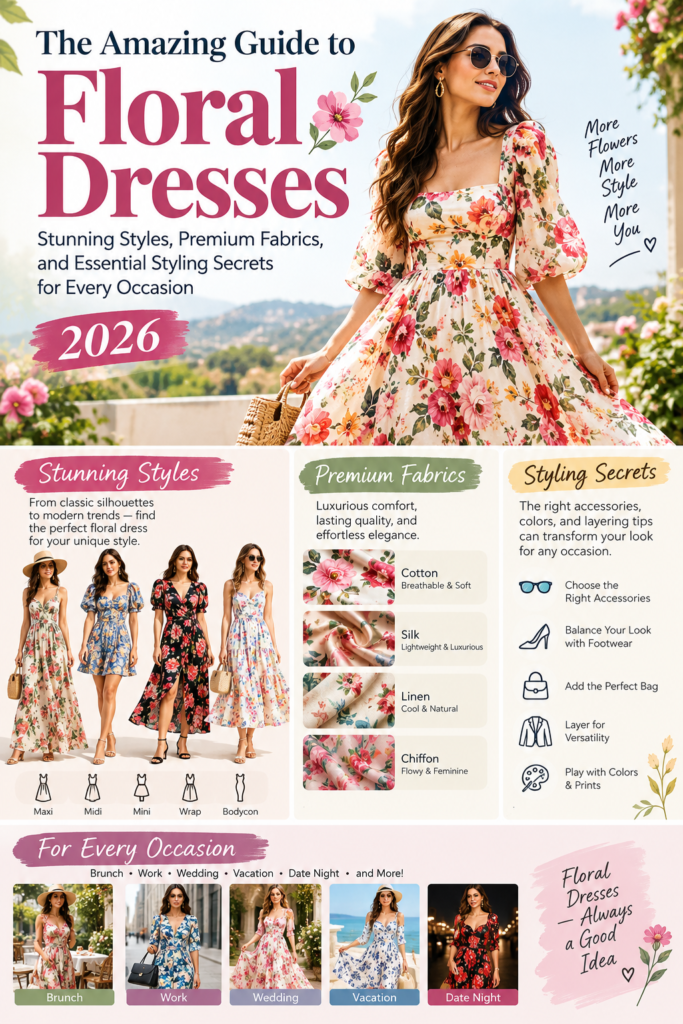

Floral dresses occupy a unique place in fashion history. They have never truly gone out of style, yet they constantly reinvent themselves with each passing season. From the delicate Liberty prints of Victorian England to the bold tropical blooms splashed across modern resort wear, flowers on fabric have remained one of the most enduring and expressive motifs in womenswear. There is something almost magical about the way a floral pattern can shift a garment’s entire personality, transforming a simple cotton midi into something romantic, playful, or effortlessly elegant.
What makes these garments so compelling is their remarkable versatility. A single dress can carry you from a garden brunch to a wedding reception, from a summer office day to an evening dinner, simply by changing how you accessorize it. That adaptability explains why they continue to dominate wardrobes across generations and cultures. Understanding the nuances of floral fashion, from pattern scale and fabric choice to silhouette and color theory, gives you the tools to choose pieces that genuinely flatter rather than just fill closet space. This guide covers everything you need to know.
What Are Floral Dresses and Why They Endure
A floral dress is any garment featuring flower motifs printed, embroidered, woven, or appliquéd onto fabric, constructed as a one-piece garment covering the torso and skirt. The definition is broad because the category itself is broad. It encompasses everything from a tiny ditzy print on a chiffon blouse-dress to a dramatic large-scale botanical print on a structured satin gown. The common thread is the presence of flowers, whether they are realistic botanical renderings, stylized abstract blooms, or watercolor washes that suggest petals without defining them precisely.
The endurance of these designs rests on something deeper than aesthetics. Flowers carry layered cultural meanings that shift across contexts. In Western fashion, floral prints have historically signaled femininity, romance, and spring renewal. In many Asian textile traditions, specific flowers carry symbolic weight, from the peony representing prosperity to the lotus signifying purity. When you wear a floral dress, you are participating in a visual language that stretches back centuries, even if your primary motivation is simply that it looks good. That depth of meaning gives the category a richness that purely geometric or abstract prints rarely achieve.
Psychologically, there is also the mood-lifting quality that floral motifs seem to possess. Color psychology research consistently links flower imagery to positive emotional responses, associations with nature, growth, and warmth. A wardrobe staple that reliably makes the wearer feel good is one that people return to season after season, which explains why retailers continue to stock them year-round rather than relegating them to spring alone.
The Language of Floral Prints: Scale, Density, and Style
Understanding print terminology transforms how you shop, because the vocabulary used to describe floral patterns directly affects how a garment will look and feel when worn. Print scale is the first and most important variable. Large-scale blooms make bold statements but can overwhelm petite frames or emphasize areas the wearer might prefer to de-emphasize. Small-scale ditzy prints, by contrast, read as texture from a distance and tend to be more universally flattering, functioning almost like a neutral in their visual effect.
Density matters just as much as scale. A tightly packed print creates a busy, vibrant surface with very little negative space, which can feel energetic and youthful but also visually heavy. Spaced-out prints with significant background showing through feel calmer and more sophisticated. Think of the difference between a vintage 1970s curtain print and a refined English garden motif: both are floral, but they communicate entirely different moods. Directional prints, where flowers appear to grow upward, can create a lengthening effect, while scattered prints feel more casual and organic.
There are several distinct floral print families worth knowing. Botanical prints aim for scientific accuracy with detailed leaves, stems, and identifiable species. Watercolor florals use soft, blended edges that mimic painting techniques, creating a dreamy, romantic aesthetic. Liberty prints, named after the historic London department store, feature intricate small-scale patterns with a distinctly English heritage feel. Tropical prints showcase large, exotic blooms like hibiscus and palm fronds, strongly associated with resort and vacation wear. Ditsy prints are the smallest and most delicate, often used on casual summer styles. Understanding these categories helps you articulate what you actually want rather than scrolling endlessly through options that do not quite match your vision.
Choosing Floral Dresses by Body Shape and Silhouette
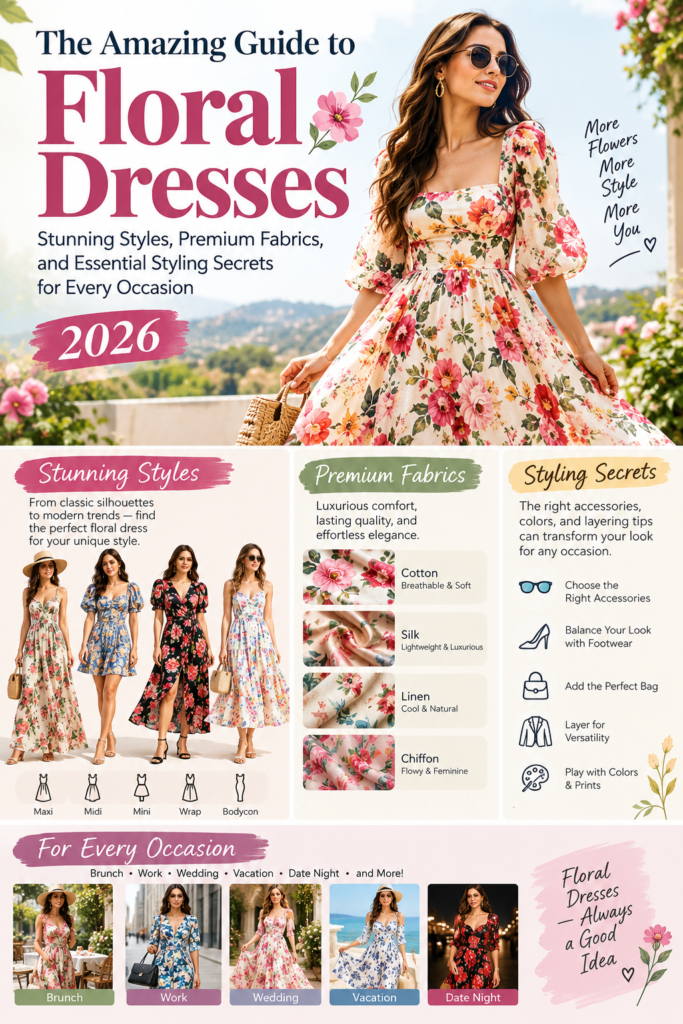
Silhouette is where floral fashion gets genuinely personal, because the interaction between print placement and body line determines whether a dress flatters or fights the wearer. The good news is that there is a floral silhouette for virtually every body type, provided you understand a few principles about how prints and cuts work together.
For hourglass figures, wrap styles and fit-and-flare silhouettes tend to work beautifully, as they follow the natural waist and allow the floral pattern to flow over the hips without clinging. A belts, empire waists, and shift shapes often suit apple-shaped bodies, drawing the eye upward and creating vertical lines that elongate. Pear shapes benefit from A-line skirts in floral prints, which skim over the hips while a solid or darker-toned bodice balances proportions. Petite frames generally do best with smaller-scale prints and shorter lengths, while taller figures can carry the drama of oversized blooms and maxi lengths with ease.
Beyond body shape, the placement of the print itself matters enormously. Prints that cluster heavily across the bust or hips draw attention to those areas, which can be intentional or problematic depending on your goals. Strategic print placement, where larger motifs sit on areas you want to highlight and smaller or darker patterns appear elsewhere, is a technique used by designers to sculpt the visual silhouette. This is why two dresses with identical cuts but different print distributions can look completely different on the same person. When trying on a floral dress, pay attention not just to the overall pattern but to where the largest and brightest flowers land on your body.
Floral Dress Fabrics and Seasonal Considerations
The fabric of a floral dress determines not only how it drapes and feels but also when and where it can be worn. Cotton is the workhorse of casual floral fashion, breathable, durable, and easy to care for, making it ideal for daytime summer wear. Cotton poplin holds a crisp print beautifully and resists fading, while cotton voile offers a lighter, more airy feel perfect for hot climates. Linen brings texture and a relaxed, slightly rumpled elegance that suits Mediterranean-inspired prints, though it wrinkles readily and requires a certain tolerance for imperfection.
For more formal occasions, floral dresses in silk, satin, or chiffon create a luxurious, fluid effect. Silk charmeuse catches light in ways that make printed flowers appear almost luminous, while chiffon’s sheer layers create depth and movement. The trade-off is care requirements, as these fabrics typically need dry cleaning or very gentle hand washing. Viscose and rayon offer a middle ground, draping softly like silk at a fraction of the cost, though they can shrink or distort if washed carelessly. Jersey knits provide stretch and comfort, making floral print maxi dresses and wrap styles exceptionally wearable for travel and everyday wear.
Seasonality plays a significant role in fabric and print selection. Spring and summer florals tend toward lighter fabrics, brighter colors, and smaller, fresher prints that echo the season’s new growth. Autumn and winter interpretations use darker base colors, heavier fabrics like ponte and wool blends, and moodier prints featuring deep burgundies, forest greens, and mustard yellows. Midi-length floral dresses in heavier fabrics layered with tights and boots become genuinely cold-weather appropriate. Understanding this seasonal logic helps you build a wardrobe that works year-round rather than confining floral fashion to a few warm months.
Floral Prints and Color Theory: A Practical Guide
Color is where floral fashion either sings or stumbles, and the difference often comes down to understanding how print colors interact with skin tone, hair color, and the other pieces in your outfit. The base color of the fabric, meaning the background against which the flowers sit, is arguably more important than the flowers themselves, because it creates the overall impression at a distance.
Warm undertones in skin generally harmonize with floral prints built on cream, ivory, warm coral, peach, golden yellow, and olive green backgrounds. Cool undertones tend to look most luminous against white, cool blue, lavender, magenta, and true black bases. Neutral undertones enjoy the widest range and can wear both warm and cool florals with equal ease. This is not a rigid rule, since personal contrast levels, hair color, and eye color all play a role, but it provides a useful starting framework when evaluating whether a particular print lights up your face or washes it out.
Beyond skin tone, consider how the print’s color story interacts with the rest of your wardrobe. A floral dress in a distinctive color combination, say burnt orange and teal, becomes a statement piece that needs neutral accessories and outerwear to avoid visual clutter. A floral print built on navy with white and soft pink blooms functions almost like a neutral, pairing effortlessly with denim jackets, beige trench coats, and black leather. The most wearable floral dresses typically have a limited palette of two to four colors, with one dominant base and accent flowers that repeat throughout the garment. Prints with too many competing colors tend to be harder to style and easier to tire of.
Styling Floral Dresses for Different Occasions
The true genius of a floral dress is its chameleon-like ability to shift register with a change of accessories and layers. A cotton midi with a ditsy print styled with white sneakers and a denim jacket reads as casual daytime wear perfect for a farmers market or coffee date. The same dress with strappy sandals, a woven bag, and delicate gold jewelry transforms into something appropriate for a garden party or summer wedding guest outfit. Adding a tailored blazer and heeled ankle boots takes it toward smart-casual office territory, particularly in creative workplaces where formal suiting would feel out of place.
For evening events, floral dresses in luxurious fabrics like silk or velvet create a sophisticated alternative to predictable cocktail attire. A dark-based floral print in deep jewel tones worn with statement earrings and a clutch feels festive without being overtly seasonal. Black-based florals, in particular, occupy a useful middle ground: they are print enough to feel interesting but dark enough to feel appropriately formal. Many women keep a black floral midi or maxi in their wardrobe specifically as a reliable event piece that works across seasons.
Occasion-specific considerations extend to footwear and outerwear as well. Weddings call for elevated fabrics, refined prints, and heels or elegant flats, with a wrap or pashmina for cooler evening receptions. Beach holidays favor breezy cotton or rayon maxis with flat sandals and sun hats. Work settings depend entirely on dress code, but floral blouses and shirt-dresses in subdued prints generally read as professional in business casual environments. The versatility is real, but it requires intentional styling rather than simply throwing a floral dress on and hoping for the best.
Common Styling Challenges and Practical Solutions
Even the most beautiful floral dress can present styling problems, and knowing how to solve them makes the difference between a piece that sits unworn in the wardrobe and one that becomes a weekly staple. The most frequent complaint is that a print feels too busy or overwhelming when worn. The solution is almost always simplification elsewhere. Pair the dress with solid-colored accessories, neutral shoes, and a plain jacket or cardigan. Let the dress be the star and give everything else a supporting role rather than competing for attention.
Another common issue is print fatigue, where a dress that seemed perfect in the shop feels dated or tiresome after a few wears. This usually happens with very trend-driven prints or those featuring unusual color combinations that do not integrate with the rest of the wardrobe. Choosing classic print styles, restrained palettes, and timeless silhouettes dramatically reduces this risk. A floral dress in a heritage-inspired print on a neutral base will still feel wearable in five years, while an aggressively trendy print may feel dated within a single season.
Fit problems specific to floral patterns also arise. Because the eye is drawn to the largest blooms, a dress where large flowers sit across the stomach or hips can create an unintended focal point. If you love the print but not its placement, layering with a solid cardigan, belt, or jacket can redirect attention. Alterations are another option, particularly shortening the hem to change the dress’s proportions and shift where the print sits relative to your body. Sometimes the difference between a floral dress that works and one that does not comes down to a few inches of hemline or a small adjustment at the waist.
There is also the question of undergarments, which matters more with floral dresses than with solid-colored ones because light-colored and thin fabrics can reveal what lies beneath. Seamless nude undergarments in a shade matching your skin tone are the safest choice under pale or sheer fabrics. For lightweight summer dresses, a slip or half-slip adds opacity without bulk. These practical details are rarely discussed but make an enormous difference in how a floral dress actually looks when worn.
Floral Dress Care and Longevity
Protecting the investment you have made in quality floral pieces requires understanding how different fabrics and dyes respond to washing, drying, and storage. Printed fabrics are generally more delicate than solid-dyed ones because the print sits on the surface of the fibers and can fade, crack, or bleed over time. Washing printed garments inside out in cold water is one of the simplest and most effective protective habits. Turning the garment inside out shields the print from friction against other items in the wash, while cold water prevents dye from loosening and transferring.
Drying method matters enormously for print longevity. Tumble drying on high heat is the fastest way to fade a vibrant floral print, as heat and agitation break down the dyes. Line drying in the shade, or laying flat to dry, preserves color far better. Direct sunlight should be avoided during drying because UV exposure fades prints just as it fades upholstery and curtains. For delicate fabrics like silk and chiffon, hand washing or professional dry cleaning is often the safest option, particularly for special-occasion pieces.
Storage also affects how long a floral dress stays beautiful. Hanging garments on padded hangers prevents shoulder stretching and allows air circulation, which discourages mustiness. For long-term storage of seasonal pieces, folding with acid-free tissue paper between layers prevents creasing and dye transfer. Cedar blocks or lavender sachets deter moths naturally without the chemical smell of mothballs. A well-cared-for floral dress can remain vibrant and wearable for a decade or more, which makes the modest effort of proper care more than worthwhile.
Floral Dress Fabric and Season Reference
The table below matches common floral dress fabrics with their ideal seasons, care requirements, and styling contexts, offering a practical reference for building a versatile wardrobe.
| Fabric | Best Season | Care Level | Drape and Feel | Ideal Occasions |
|---|---|---|---|---|
| Cotton poplin | Spring, Summer | Easy, machine washable | Crisp, structured | Daywear, casual events, work |
| Cotton voile | Summer | Easy, gentle machine wash | Light, airy, semi-sheer | Beach, holidays, warm weather |
| Linen | Summer | Moderate, wrinkles easily | Textured, relaxed, breathable | Resort wear, casual outings |
| Silk charmeuse | All seasons | High, dry clean preferred | Fluid, luminous, luxurious | Weddings, evening events, formal |
| Chiffon | Spring, Summer | High, hand wash or dry clean | Sheer, floaty, layered | Parties, romantic occasions |
| Viscose or rayon | All seasons | Moderate, hand wash recommended | Soft, silky, fluid | Everyday wear, travel |
| Jersey knit | All seasons | Easy, machine washable | Stretchy, comfortable, casual | Travel, casual wear, lounging |
| Ponte | Autumn, Winter | Easy, machine washable | Substantial, smooth, holds shape | Work, cool-weather events |
| Velvet | Autumn, Winter | High, dry clean | Rich, plush, dramatic | Evening events, holidays |
| Organza | Spring, Summer | High, dry clean | Crisp, sheer, voluminous | Weddings, special occasions |
Floral Dresses Through Fashion History and Cultural Context
The presence of flowers on clothing stretches back to antiquity, but the floral dress as a recognizable fashion category emerged in the eighteenth and nineteenth centuries. French toile de Jouy fabrics, printed with pastoral scenes and botanicals, decorated dresses worn by the European elite. By the Victorian era, advances in textile printing made floral patterns accessible to a growing middle class, and the language of flowers, floriography, gave specific blooms coded meanings that wearers could deploy to communicate without speaking.
The twentieth century transformed floral fashion repeatedly. The 1960s and 1970s saw floral prints become emblematic of bohemian and hippie culture, with flowing maxi dresses in psychedelic blooms. The 1980s brought exaggerated shoulders and bold graphic florals, while the 1990s grunge movement introduced dark-based floral prints worn with combat boots and slip dresses. In the 2000s, floral fashion went through a romantic revival, and by the 2010s and 2020s, the category had diversified so thoroughly that almost every aesthetic had its own floral interpretation, from minimalist Scandinavian prints to maximalist Dolce & Gabbana-esque blooms.
Culturally, floral prints carry different connotations across the world. In Japan, cherry blossom motifs on clothing evoke the transient beauty of spring and appear across both traditional kimono and contemporary fashion. Indian textile traditions use floral motifs extensively in block printing, embroidery, and weaving, with specific flowers carrying regional and religious significance. In many African wax print traditions, floral elements combine with geometric patterns to create distinctive visual languages. Recognizing this global context enriches appreciation for floral fashion as more than a Western trend, positioning it as a genuinely cross-cultural textile tradition with deep roots.
Shopping for Floral Dresses: What to Look For
Shopping for a floral dress that will genuinely earn its place in your wardrobe requires looking beyond the initial visual appeal. The first consideration is print quality, which can be assessed by examining the edges of the printed flowers. Crisp, well-defined edges indicate quality printing, while fuzzy or bleeding edges suggest cheaper production that will look tired quickly. The print should also be well-aligned at seams and pattern-matched where possible, particularly on higher-priced garments. Misaligned prints at side seams or across the center front are a clear sign of cost-cutting.
Fabric quality is the second critical factor. Hold the fabric up to the light and check for excessive sheerness, which can make a dress impractical without heavy layering. Feel the weight and drape, and check whether the fabric has a pleasant hand or feels rough and stiff. Look for finishing details like French seams, lined bodices, and quality zippers, all of which indicate a garment built to last. Examine the print’s coverage for consistency, as some cheaper fabrics have visible lighter patches where the print did not take evenly.
Fit and construction should be evaluated in the fitting room with an honest eye. Move around, sit down, and raise your arms to check whether the dress restricts movement or gapes at the bust. Check that the waist sits at the intended point on your natural waist rather than riding up or sagging down. Examine the hemline for evenness and the internal seams for fraying or loose threads. A floral dress that fits beautifully in the changing room and shows quality construction is likely to become a genuine wardrobe workhorse, while one that requires constant adjustment will end up forgotten at the back of the closet.
Building a Floral Dress Capsule
A thoughtfully curated capsule of floral pieces can cover almost every occasion in a typical year without overwhelming your closet or budget. The foundation piece is a midi-length floral dress in a versatile print, ideally with a base color that coordinates with your existing outerwear and shoes. Navy, black, cream, or soft sage bases work particularly well because they function almost like neutrals while still delivering the visual interest of a floral pattern.
The second key piece is a casual, easy-care floral dress for everyday wear. This might be a cotton or jersey style in a ditsy print, comfortable enough for running errands but polished enough for casual lunches. A maxi floral dress in a lightweight fabric serves summer holidays and warm-weather events, while a darker-based floral style in a heavier fabric handles autumn and winter occasions. Adding a floral blouse or skirt expands the palette further by allowing you to mix floral pieces with solid garments, creating variety from a relatively small collection.
Accessories should be selected to support rather than compete with floral pieces. Neutral shoes, bags, and belts in tan, black, navy, or cream work with almost any floral print. A denim jacket, a neutral trench coat, and a tailored blazer provide layering options that extend the wearability of floral dresses across seasons. Costume jewelry in simple gold or silver tones keeps the focus on the dress, while statement earrings can be reserved for evening events where the dress is more subdued. The goal is a coordinated system where every piece supports the others rather than a collection of beautiful but incompatible items.
Ethical and Sustainable Considerations in Floral Fashion
The fashion industry’s environmental footprint has become an increasingly important consideration for shoppers, and floral dresses are as affected by these concerns as any other category. Printed fabrics require water, dyes, and chemical treatments, and the synthetic fibers used in many budget floral garments, particularly polyester and acrylic, shed microplastics during washing and do not biodegrade. Being aware of these impacts allows you to make choices aligned with your values without abandoning floral fashion entirely.
Natural fibers like organic cotton, linen, and Tencel offer lower environmental impact than conventional synthetics, particularly when they carry certifications for sustainable production. Looking for garments made from certified organic materials, or from recycled fibers, reduces the resource intensity of your wardrobe. Print methods also matter: digital printing uses significantly less water and dye than traditional screen printing, and some brands now advertise their use of these lower-impact techniques. Buying fewer, better-quality floral dresses and caring for them properly extends their lifespan, which is ultimately one of the most effective sustainability strategies available to individual consumers.
Secondhand shopping has become a rich source of floral fashion, with vintage prints offering unique styles unavailable in current retail. Charity shops, online resale platforms, and vintage boutiques often carry floral dresses from previous decades at a fraction of new prices. These garments have already absorbed their original production footprint, and giving them a second life avoids the environmental cost of new manufacturing. The quality of vintage floral prints, often from an era when clothing was built to last, can exceed that of comparable new garments, making secondhand an attractive option for style and substance alike.
Frequently Asked Questions About Floral Dresses
What are the most flattering floral dresses for a curvy figure?
The most flattering options for curvy figures typically feature wrap silhouettes, fit-and-flare cuts, or empire waists that define and flatter rather than cling. Print scale matters too, as medium to small prints with a dark base tend to create a slimming effect, while oversized blooms can overwhelm curves. Look for dresses with a defined waist and an A-line or gently flared skirt that skims over the hips and thighs. Fabrics with some stretch, like jersey or ponte, provide comfort without sacrificing structure, and vertical elements within the print, such as trailing vines or tall stems, can create a lengthening effect.
How do I style a floral dress for a winter occasion?
Winter styling for a floral dress centers on layering and fabric choice. Choose a dress in a heavier fabric like velvet, ponte, or a lined wool blend, and opt for darker base colors with moodier prints. Layer with opaque tights, knee-high boots, and a tailored coat or leather jacket. Adding a turtleneck underneath a sleeveless or short-sleeved floral dress creates warmth and an interesting textural contrast. Accessories like a structured bag and warm scarf complete the look, and a longline cardigan or blazer adds both warmth and polish.
Can floral dresses work for professional office environments?
Floral dresses absolutely can work in professional settings, provided the print and cut are appropriate for the environment. In business casual offices, a floral midi or shirt-dress in a subdued palette with a tailored blazer reads as polished and appropriate. In more formal environments, floral prints may be less common but can still work when the print is small, the colors restrained, and the silhouette conservative. The key is avoiding very bright, large-scale, or overly casual prints, and pairing the dress with professional accessories and footwear.
What is the difference between a ditsy print and a botanical print?
A ditsy print features very small, densely scattered flower motifs that read as texture from a distance and generally create a delicate, casual effect. A botanical print, by contrast, aims for accuracy and detail, depicting recognizable plant species with leaves, stems, and realistic coloring. Ditsy prints tend to suit casual summer styles and petite frames, while botanical prints often appear on more sophisticated or formal garments and can carry a slightly vintage or heritage feel.
How can I prevent my floral dress from fading in the wash?
Preventing print fade starts with washing inside out in cold water and using a gentle cycle. Avoid harsh detergents and fabric softeners, which can break down dyes over time, and never use bleach. Skip the tumble dryer entirely, as heat and agitation accelerate fading, and instead line dry in the shade or lay flat. Turn the garment inside out before drying as well. For darker or more vibrant prints, washing less frequently and spot cleaning between wears further extends the life of the color.
Are floral dresses appropriate for wedding guests?
Floral dresses are among the most popular choices for wedding guests because they strike the right balance of festive and respectful without competing with the bride. The key considerations are the formality of the wedding, the dress code specified, and the color palette. For formal weddings, choose a floral dress in an elevated fabric like silk or chiffon, in a longer length and a more sophisticated print. Avoid white or cream bases, which can read as bridal, and consider the season and venue when selecting fabric weight and print style.
Conclusion
Floral dresses have earned their enduring place in fashion because they offer something few other garments can match: the ability to shift between moods, occasions, and seasons with nothing more than a change of accessories. A well-chosen floral piece is not just a dress but a flexible tool that can be dressed up for a celebration or dressed down for a casual weekend, worn with boots in autumn and sandals in summer. Understanding print scale, fabric behavior, color theory, and silhouette empowers you to shop with genuine intention rather than impulse.
The final takeaway is that the best floral dress is not the trendiest one or the most expensive one, but the one that fits your body well, suits your lifestyle, and integrates seamlessly with the rest of your wardrobe. Build slowly, favor quality prints on versatile base colors, and care for your garments properly. A floral wardrobe assembled with this kind of thought pays dividends for years, delivering outfits that feel fresh, personal, and reliably right for whatever the day holds.