

A boys hairstyle is never just a haircut. It is a daily negotiation between a kid who wants to look like his favorite athlete, a parent who wants something that survives a school week without becoming a bird’s nest, and a barber who has roughly twenty minutes to execute a vision that everyone in the chair agrees on. Get it right and mornings become easier, photos look better, and the kid walks out with a confidence boost that lasts longer than the fade.
Get it wrong and you are back in the chair three weeks later, or worse, dealing with a haircut that refuses to lie flat no matter how much product you apply. This guide covers the styles that actually work in the real world, the hair types that demand different approaches, and the practical details that separate a cut that looks good on day one from one that still works on day twenty-one.
What Makes a Boys Hairstyle Actually Work in Daily Life
The best boys hairstyle for any kid is the one that fits three constraints: his hair type, his daily routine, and the amount of effort his family is willing to invest each morning. A dramatic skin fade looks incredible in the barber’s chair, but if the kid refuses to sit still for a trim every two weeks, that sharp edge disappears fast and the style collapses into something shapeless. A longer flow looks effortless in photos, but it demands regular washing, conditioning, and detangling that many boys simply will not do without a fight.
Hair texture is the variable most parents underestimate. Straight, fine hair holds a crop or a fringe cleanly but falls flat without volume. Thick, wavy hair does incredible things with a middle part or a textured quiff but turns into a helmet if cut too bluntly. Coily and curly hair needs a completely different approach, one that respects the curl pattern rather than fighting it with tight fades that create awkward grow-out zones. The style has to work with the hair, not against it.
Age matters too, though less than people think. A five-year-old can absolutely rock a textured crop. A twelve-year-old who has strong opinions about his appearance deserves a say in the shape, even if the parent sets the boundaries on length and maintenance. The sweet spot is a cut that the boy feels good about and that the adult can manage without a daily battle.
The Cuts That Dominate Right Now and Why They Stick Around
The textured crop remains the most reliable boys hairstyle in the current landscape, and for good reason. It is short enough to be low-maintenance, textured enough to look intentional rather than buzzed, and it works on almost every hair type when the barber adjusts the length on top to match the texture. The fringe sits forward, which suits most face shapes, and the sides can be tapered rather than fully faded, which stretches the time between cuts.
The fade remains the default choice for boys who want something sharp, and the variations matter. A low fade keeps things conservative and grows out gracefully. A mid fade is the current sweet spot for most kids, balancing clean edges with enough hair on top to style. A high skin fade is the most dramatic option and the least forgiving, requiring touch-ups every ten to fourteen days to maintain the contrast. For boys with straight hair who want a clean, athletic look, a taper fade with a short textured top is nearly foolproof.
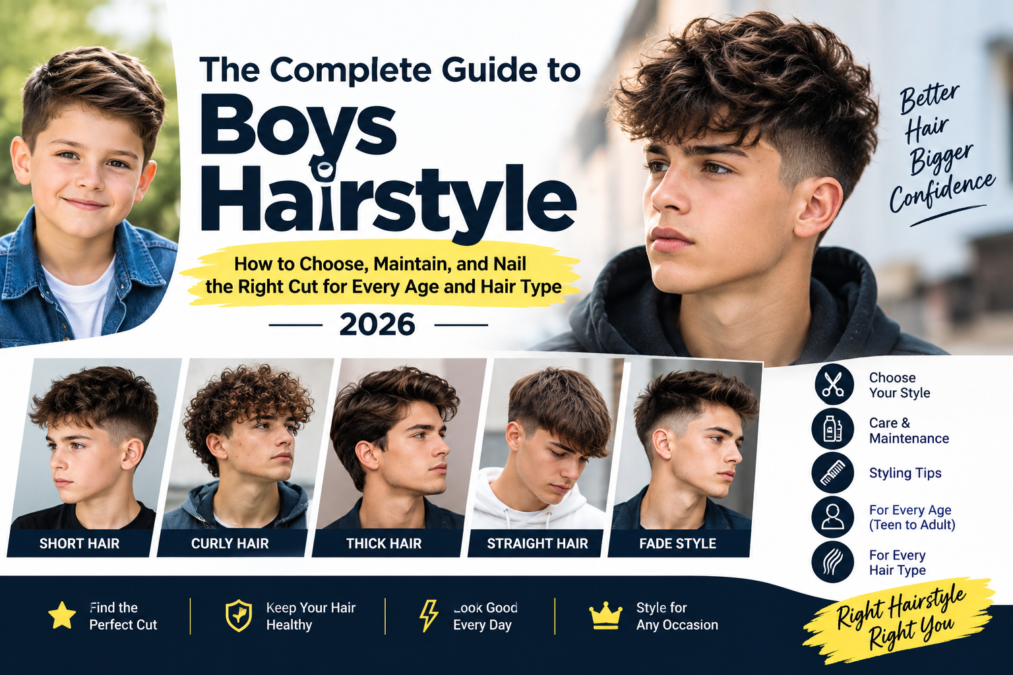
Matching the Cut to Hair Type Instead of Fighting It
Straight, fine hair is the most common type among boys, and it comes with a specific set of rules. This hair type shows every scissor mark, so the barber needs to use point-cutting or texturizing shears on top rather than blunt cuts that create visible lines. A textured crop or a short quiff works beautifully because the texture creates the illusion of volume. Heavier products should be avoided because they weigh fine hair down and make it look greasy by mid-morning. A light matte clay or a sea salt spray is usually enough.
Thick, wavy hair is a gift and a challenge. The wave gives natural movement, but the density means the hair can puff out at the sides if cut too short or too bluntly. The solution is a scissor cut on the sides rather than clippers, leaving enough length to lie flat, combined with a longer top that lets the wave do its thing. A middle part or a relaxed quiff with a soft fringe works well. The barber should avoid hard fades on this hair type unless the boy is committed to frequent trims, because the grow-out creates a distinct shelf where the fade ends.
Coily and curly hair requires the most specialized approach. Tight fades can look sharp on the sides, but the top needs to be shaped with the curl pattern in mind, not against it. A rounded silhouette that follows the natural curve of the head looks intentional and grows out well. Moisture is non-negotiable: a leave-in conditioner or a curl cream keeps the hair defined and prevents the frizz that makes the style look unkempt.
A Practical Reference Table for Choosing the Right Cut
The table below maps common scenarios to the boys hairstyle choices that tend to work best, along with the maintenance reality of each option. It is not a rulebook but a starting point for the conversation with the barber.
| Scenario | Recommended Style | Maintenance Reality |
|---|---|---|
| Fine, straight hair, wants low effort | Textured crop with tapered sides | Four to six weeks between cuts, minimal styling |
| Thick, wavy hair, wants movement | Middle part with scissor-cut sides | Five to seven weeks, needs conditioning to control frizz |
| Athletic kid, wants clean edges | Mid fade with short textured top | Three to four weeks to keep the fade sharp |
| Curly or coily hair, wants definition | Rounded cut with line-up, curl cream | Four to five weeks, daily moisture routine |
| Growing out a bad cut | Buzz cut or short crop with soft edges | Immediate reset, grows back evenly |
| First real haircut (younger boy) | Scissor cut with soft fringe | Six to eight weeks, forgiving grow-out |
The row that saves the most arguments is the grow-out scenario. When a boy has had a cut that did not work, the instinct is often to try to fix it with another complicated cut. A buzz cut resets the canvas. It removes the damaged shape, reveals the natural head shape, and gives everyone a clean starting point. It is not a defeat; it is a strategic retreat.
The Barber Conversation That Prevents Most Bad Haircuts
Most disappointing boys hairstyle outcomes trace back to a consultation that lasted ten seconds. A boy sits down, the parent says “just a trim” or “short on the sides, long on top,” and the barber makes assumptions that may not match what anyone actually wanted. The fix is simple and takes less than a minute: bring a photo. Not a photo of a model with a different hair type, but a photo of a boy with similar hair and face shape wearing the style you are considering.
The second rule is to name the number on the clipper guard if the sides are being faded. “Short” means something different to every barber. A number two on the sides is not the same as a number one. If the boy wants to be able to run his fingers through the sides, say so. If he wants a hard line, say that too. The barber would rather hear the specifics than guess.
The third rule is to ask the barber what he or she thinks will work with the hair in front of them. A good barber will tell you if the style you are requesting will collapse on this particular hair type or if it will require more styling than the boy is likely to do. That honesty is worth listening to. The best haircut is not the one in the photo; it is the one that fits the head in the chair.
Products and Morning Routines That Actually Get Used
The product aisle is full of promises, but most boys need three things at most: a gentle shampoo, a light styling product, and a brush or comb that suits the style. For textured crops and short quiffs, a matte clay or a styling paste gives hold without shine. For longer styles and curtains, a sea salt spray adds grip and volume without weighing the hair down. For curly hair, a curl cream or a leave-in conditioner is the single most important purchase.
The morning routine should take less than two minutes for short styles. Wet the hair, towel dry it to damp, work a small amount of product through the top, and shape it with fingers. That is it. If the routine requires a blow dryer and three products, it will not survive a busy school morning. The style has to be achievable at the level of effort the family can actually sustain.
Washing frequency matters more than most people realize. Daily shampooing strips natural oils and makes fine hair limp and curly hair frizzy. Every other day is usually enough for younger boys, and coily hair may only need washing once or twice a week with co-washing in between. A clean scalp is important, but over-washing creates more problems than it solves.
Frequently Asked Questions About Boys Hairstyle
How often should a boy get a haircut?
It depends entirely on the style. A sharp fade needs attention every three to four weeks to maintain the contrast between the sides and the top. A textured crop with tapered sides can stretch to five or six weeks. A longer middle part or flow might only need a trim every two to three months. The rule of thumb is that the shorter and more defined the cut, the more frequently it needs maintenance.
What is the best boys hairstyle for school?
The best school-friendly boys hairstyle is one that stays out of the eyes, does not require heavy styling, and holds its shape through a full day of activity. A textured crop with a short fringe, a taper fade with a neat top, or a short middle part all fit that description. Avoid styles that require constant readjustment or products that need reapplying midday. The simpler the routine, the more likely the style looks intentional every morning.
Can boys with curly hair get a fade?
Yes, but the approach matters. A fade on curly hair works best when the barber leaves enough length on the sides to avoid creating a hard shelf where the fade ends, or when the boy is committed to regular trims. A tapered cut that blends gradually into the curls is often more forgiving than a high skin fade. The key is to shape the top with the curl pattern, not against it, so the style looks deliberate rather than like a mismatch between the sides and the top.
What should I tell the barber if I don’t know the terminology?
Bring a photo and describe what the boy wants the hair to do, not just how short it should be. “He wants to be able to push it to the side” or “he wants it short enough that it doesn’t touch his ears” gives the barber more useful information than a number. Ask the barber to explain what they are doing as they go, especially for a first visit or a major change. A good barber will translate the request into a plan.
How do I handle a boy who refuses haircuts?
For younger boys, the resistance is usually about the sensory experience rather than the haircut itself. A barber who works with kids will often have a quieter chair, a tablet or toy for distraction, and a faster approach. For older boys, the resistance is often about control. Letting them choose the style, within boundaries the parent sets, turns the haircut from something happening to them into something they are participating in. A buzz cut is also a useful negotiation tool: it is fast, it is over quickly, and it resets the conversation.
Conclusion
The right boys hairstyle is not the trendiest one on the playground or the one that looks best in a barber’s Instagram feed. It is the cut that fits the hair in front of you, the routine the family can actually maintain, and the boy’s own sense of what feels right. A textured crop that the kid can style himself in thirty seconds will always beat a complicated fade that requires a professional touch-up every ten days. The style has to live in the real world, not just in the chair.
The final insight worth carrying into the next appointment is this: the consultation is the haircut. The ten seconds before the clippers come out determine whether the next four weeks are easy or annoying. Bring a photo, name the specifics, and listen when the barber tells you what the hair wants to do. A boys hairstyle that respects the hair type and the daily reality will look better on day twenty than a style that only worked on day one.