A wedding invitation arrives, and with it a familiar flicker of panic. The couple has planned for months, the venue is set, and somewhere between the RSVP and the big day sits a question that has derailed countless otherwise rational adults: what on earth do I wear? The wedding guest dresses market has exploded in recent years, yet the sheer volume of options has made the decision harder rather than easier, not simpler.
The good news is that the rules are more forgiving than they once were, provided you understand the handful that still matter. Black is no longer forbidden at evening celebrations. Color and print are actively welcomed. What remains non-negotiable is narrower but firmer: never compete with the couple, never ignore the dress code, and never treat the outfit as an afterthought. This guide walks through the codes, the colors, the silhouettes, and the practical decisions that separate a guest who looks effortlessly right from one who spends the reception tugging at a hemline.
Decoding the Dress Code on the Invitation
The single most useful piece of information on any invitation is the dress code line, and it is also the most frequently misread. “Cocktail attire” is not a suggestion or a starting point for creative interpretation. It means a knee-length or midi dress, a dressy skirt and top, or a tailored suit, and it should be followed as stated rather than bent toward personal preference . The couple chose those words deliberately, and treating them as loose guidance is the fastest route to standing out for the wrong reasons.
When the invitation offers no dress code at all, the venue and the hour fill in the blanks. A six o’clock ballroom reception and a noon vineyard lunch communicate entirely different registers, and the safest default is semi-formal: a polished midi or maxi that reads as intentional without tipping into gown territory . The general principle that experienced guests apply is simple. When torn between two options, choose the dressier one. Visible underdressing reads as indifference toward a day the couple spent a year creating, while slight overdressing has never offended anyone .
The distinction between black tie and formal trips up even seasoned guests. Black tie means floor-length gowns for guests, with fabric carrying real weight: silk, chiffon, velvet, crepe, and lace all read as appropriately formal, and sequins and beading are welcome rather than excessive . Formal, sometimes written as black tie optional, offers more flexibility and accommodates a sophisticated midi or a dressy cocktail-length dress. A ball gown at a formal wedding would be over the top; a structured midi at a black tie event would be underdressed. Reading the specific words matters more than the general vibe.
The Colors That Still Carry Real Rules
The white rule remains the one genuine fashion crime in guest dressing, and its logic is straightforward. White, ivory, cream, and any shade that photographs as bridal belong to the couple, and wearing them is not edgy or interesting but simply inconsiderate . The gray area that catches people is the pale shade that looks white under reception lighting. A baby-blue dress that photographs closer to white has sparked genuine debate, and the consensus among stylists is that anything very light-colored which reads as white in photographs is not worth risking . Printed dresses with a white background are similarly polarizing, and the safe move is to avoid a print whose base color is white or ivory .
Black has undergone a genuine rehabilitation. Modern etiquette fully welcomes black at evening, formal, cocktail, and city weddings, and a black tie dress code practically invites it . The old association with funerals has expired. The remaining nuance is contextual: at a bright daytime garden or beach wedding, all-black can feel heavy, and lifting it with color or metallics solves the problem without abandoning the shade entirely . Cultural traditions override general rules, and at many Indian weddings, for instance, black is avoided and bright red belongs to the bride .
The colors that consistently work are broader than most guests assume. Rich jewel tones like burgundy, emerald, cobalt, and navy photograph beautifully and feel occasion-appropriate without being overdressed . Pastels, warm neutrals, dusty rose, and earthy tones suit daytime and garden settings. Saturated color that can never read bridal is actively appreciated, and the fear of wearing color is largely misplaced . The one color to research before committing is the bridesmaids’ palette, which is worth discovering through a quiet message to the wedding party rather than guessing.
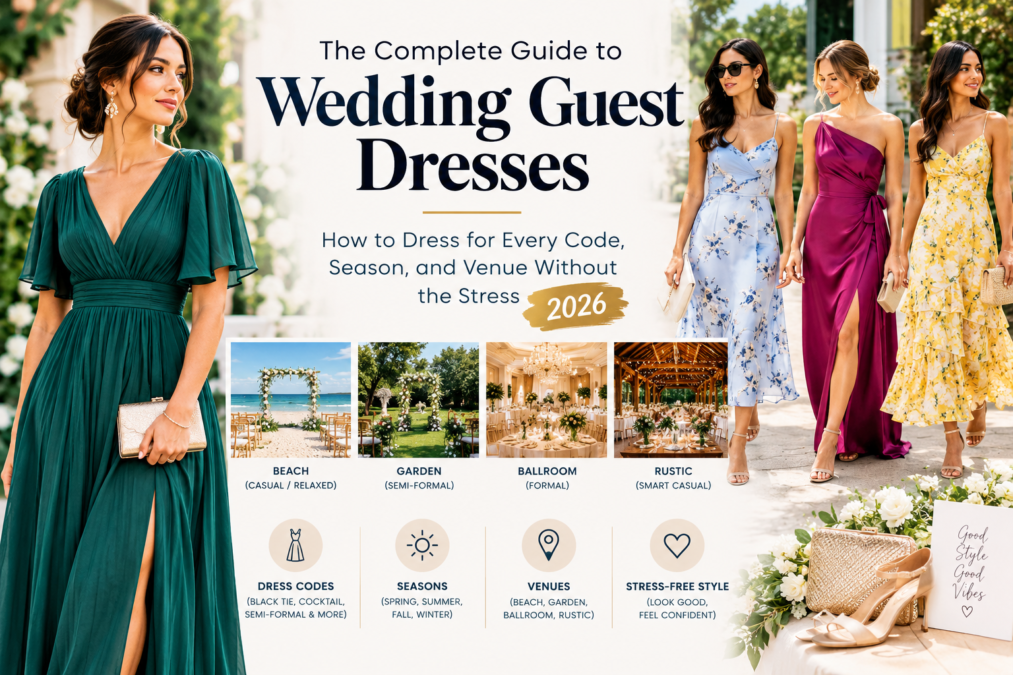
Silhouettes That Solve the Wedding Guest Dress Problem
The wrap dress has earned its reputation as one of the most reliably flattering wedding guest dresses for a reason that goes beyond aesthetics. The defined waist follows an hourglass figure, skims over the hips on a pear shape, and gives a straighter frame a waistline it might not otherwise have, and the adjustable tie accommodates the reality that bodies fluctuate across a long day of eating and dancing . In a quality fabric at knee or midi length, a wrap reads as appropriately dressed for semi-formal and cocktail weddings without tipping into overdressed territory, and a lighter fabric and softer print make it shine at daytime and outdoor ceremonies .
The sheath and column silhouette offers a sleeker, more modern alternative for guests who want a streamlined line. A structured fabric with some stretch skims and flatters a curvier figure, while thin or clingy fabric is less forgiving, and the clean line reads as more current and intentional than a traditional flared shape . The practical caveat is movement. A narrow floor-length sheath without a slit or stretch can limit stride length and make dancing difficult, which is easily solved by choosing a style with a back slit, a kick pleat, or stretch in the fabric . For a guest who wants to look elegant without competing with the bride, the sheath projects refined restraint rather than drama.
The broader principle that connects these silhouettes is proportion over formality. A midi dress in a rich fabric can read as more appropriately dressed than a short dress that is technically more formal, and a relaxed linen suit can be more polished than a tight synthetic one . What signals effort and elegance is not the level of formality but how well the clothes fit and how deliberately they were chosen. Tailoring outperforms price every time.
Matching Fabric and Footwear to the Venue and Season
Fabric determines comfort across a long day, not just how sharp the photographs look. For fall and winter ceremonies, wool and flannel hold their shape and resist wrinkling through a reception that runs from ceremony to dancing . Spring and summer events call for linen, cotton, and linen-wool blends that breathe in heat and direct sun, and twenty minutes standing in a garden during the ceremony will tell you everything about whether that choice was right . Shoulder seasons and unpredictable climates have a middle option in tropical wool, which handles warmth better than standard worsted and recovers from creasing far better than pure linen .
Footwear is where outdoor weddings get practical fast. Heels and soft ground do not get along, and nobody wants to spend cocktail hour pulling a stiletto out of the grass. Block heels, wedges, and dressy flats are the genuine move for garden and outdoor ceremonies, and a thick block heel with a wider base gives height without the sinking . The mistake that catches guests is dressing for the photographs and forgetting about the dancing. Think through the entire day, including the church ceremony followed by an outdoor cocktail hour followed by a dinner dance, and make sure the shoes survive all three .
Seasonal trends offer useful direction without dictating the choice. Butter yellow has held its position as a defining color for summer celebrations, particularly in flowing silhouettes that keep the wearer cool . For fall, the purple palette from smoky lilac to rich plum has taken over, alongside long-sleeved floor-sweeping styles that suit chillier days and more buttoned-up venues . Art Deco details, including geometric prints, beaded embellishment, and velvet finishes, have brought a wearable glamour to guest dressing, provided one Deco element leads and everything else stays clean .
A Practical Reference for Wedding Guest Dress Decisions
The table below consolidates the core decisions into a single view, organized by the factors that most often determine whether an outfit works. It is not a set of rigid rules but a framework for narrowing the field quickly.
| Decision Factor | The Safe Choice | The Risky Choice | Why It Matters |
|---|---|---|---|
| Color | Jewel tones, saturated prints, darker neutrals | White, ivory, cream, pale shades that photograph white | The bride’s territory is non-negotiable |
| Cocktail dress code | Knee-to-midi dress, tailored jumpsuit, dressy two-piece | Floor-length gown or casual sundress | Cocktail means polished, not formal and not casual |
| Black tie dress code | Floor-length gown in silk, chiffon, velvet, or crepe | Midi or cocktail-length dress | Formality is defined by length and fabric |
| Outdoor venue footwear | Block heels, wedges, dressy flats | Stilettos or kitten heels | Soft ground and long standing hours |
| Daytime garden setting | Floral prints, soft midis, wrap dresses, light layers | All-black, heavy fabrics, structured gowns | The setting calls for relaxed elegance |
| Evening formal setting | Rich fabrics, subtle shimmer, refined jewelry | Head-to-toe sequins, excessive skin | Sparkle in moderation celebrates without competing |
The row that saves the most last-minute panic is the first one. Color is the decision guests agonize over most, and the actual risk is concentrated in a very narrow band of shades. Everything outside that band is fair game.
Problem and Solution: The Common Guest Dressing Failures
The most frequent failure is not a fashion error but a timing one. Shopping at the last minute collapses the decision into whatever is available in the right size, which is how guests end up in something that fits the dress code on paper but feels wrong in the mirror. The solution is to treat the dress as a project that begins when the invitation arrives, not the week before. A saved search, a rental reservation, or a secondhand find all require lead time, and the guests who look most effortless are usually the ones who started earliest.
The second failure is dressing for one part of the day and ignoring the rest. A guest who chooses a beautiful gown for a ceremony with an outdoor cocktail hour on grass has solved the photograph and created a problem for the walk. A guest who chooses a lightweight sundress for a garden ceremony and stays for an evening reception under heaters has solved the afternoon and created a problem for the temperature drop. The solution is to read the full schedule, not just the ceremony time, and to add a layer or choose a shoe that works across every transition .
The third failure is the quiet one: matching the bridesmaids by accident. A pastel pink or champagne shade that feels right for summer can place a guest in the same tonal family as the bridal party, which is not a catastrophe but is avoidable with a little reconnaissance . The solution is a discreet inquiry, either to the couple or to someone in the wedding party, about the palette. Most people are happy to answer, and the question reads as considerate rather than nosy .
Frequently Asked Questions About Wedding Guest Dresses
What is the most important rule for choosing wedding guest dresses?
The single most important rule is to avoid white, ivory, cream, and any shade that photographs as bridal. Those colors are reserved for the couple, and wearing them reads as tone-deaf regardless of intent . Everything else follows from there: follow the stated dress code, dress for the full event rather than one portion of it, and choose something that fits well and looks deliberate. The rules have loosened considerably around color and black, but the white prohibition has not budged.
Can you wear black to a wedding as a guest?
Yes. Modern etiquette fully welcomes black at evening, formal, cocktail, and city weddings, and a black tie dress code practically invites it . The old rule connecting black to funerals has expired. The remaining nuance is contextual: at a bright daytime garden or beach wedding, all-black can feel heavy, and lifting it with color or metallics solves the problem. Cultural traditions should be honored where they apply, and at many Indian weddings, black is avoided entirely .
What does cocktail attire mean for wedding guest dresses?
Cocktail attire means polished but not formal. For guests, that translates to a knee-length or midi dress, a tailored jumpsuit, or a dressy two-piece set . A floor-length gown is not required, and heels are optional if flats feel better. The goal is looking intentional and put-together rather than reaching for the most formal thing in the closet. A structured midi dress in a solid color or a subtle print is the most reliable starting point, and it works across a wide range of venues and seasons.
How do you choose wedding guest dresses for an outdoor ceremony?
Start with the ground and the temperature. Block heels, wedges, and dressy flats are the practical choice for grass, gravel, and sand, while stilettos and kitten heels create genuine problems . For fabric, choose something that breathes if the ceremony is in direct sun, and add a layer if the reception continues into cooler evening hours. Floral prints, soft midis, and wrap dresses suit garden settings particularly well, and light layers are smart for outdoor ceremonies that shift between warm and breezy .
Is it better to overdress or underdress as a wedding guest?
Overdressing is the safer error, and it is not close. Visible underdressing reads as indifference toward a day the couple spent months creating, while no guest has ever been offended by someone who looked wonderful . The general principle that experienced guests apply is to choose the dressier option when torn between two, and to treat the dress code as a floor rather than a ceiling. The one exception is a black tie event where a ball gown would compete with the couple, and restraint in that specific context is its own form of good judgment.
Conclusion
The wedding guest dresses decision is easier than the market makes it feel, provided the priorities are in the right order. The dress code on the invitation comes first and deserves to be followed literally. The color rule comes second and is narrower than most guests fear, concentrated almost entirely around white and its photographic cousins. The rest is fit, fabric, footwear, and a genuine reading of the venue and the schedule. None of it requires a personal stylist or an unlimited budget, and most of it requires only a little lead time.
The final insight worth carrying into the next invitation is about what the outfit is actually for. A wedding guest dress is not a statement about the wearer’s taste or a chance to be discovered in the background of a photograph. It is a form of respect, a visible signal that you understood the assignment and showed up for the couple rather than for yourself. The guests who get this right are rarely the most expensively dressed in the room. They are the ones who look comfortable, intentional, and entirely at ease, which is exactly what the day is supposed to feel like.