Most people own a makeup primer they barely understand. It sits in the drawer, gets applied in a rushed swipe before foundation, and never quite delivers the transformation the packaging promised. The product has a reputation problem: it is simultaneously marketed as essential and dismissed as optional, and the confusion is genuinely earned. A primer is not one thing. It is a category of products with wildly different formulations, purposes, and best-use cases, and treating them interchangeably is the fastest route to disappointment.
The truth is more useful than the marketing. A primer can absolutely change how your base wears, how long your blush survives a commute, and whether your foundation settles into pores by noon. It can also do nothing at all if you choose the wrong formula for your skin or apply it like moisturizer. This guide separates the claims from the chemistry and explains what a primer is actually doing on your face, which type belongs in your routine, and the application mistakes that quietly sabotage the results.
What a Makeup Primer Actually Is and What It Does to Your Skin
A makeup primer is a gel, cream, or liquid product applied after skincare and before complexion makeup, designed to create a smoother surface for foundation and extend its wear . The analogy to paint primer is tired but accurate: it fills imperfections and gives the next layer something to grip. Celebrity makeup artist Tyron Machhausen describes the mechanism plainly: a primer “can serve a variety of purposes like controlling shine, evening out skin texture, minimizing the appearance of pores, boosting glow, or color correction” .
What separates a good primer from a basic moisturizer is the specific job it performs. Silicone-based formulas create an optical blurring effect by filling depressions in the skin, which is why pores and fine lines appear softer immediately after application . Water-based gripping primers work more like double-sided tape, creating a tacky surface that locks liquid foundation in place through heat and humidity. Hydrating primers flood the skin with ingredients like hyaluronic acid and glycerin so foundation does not cling to dry patches . The formula dictates the function, and buying a mattifying primer for dry skin is the equivalent of using a degreaser on a hardwood floor.
The feature-snippet answer worth memorizing is this: a makeup primer sits between skincare and foundation to smooth texture, control shine or boost hydration, and improve makeup longevity. It is not skincare, and it is not foundation. It is a bridge product, and its value depends entirely on whether the two sides of that bridge need connecting.
The Different Types of Makeup Primer and How to Match One to Your Skin
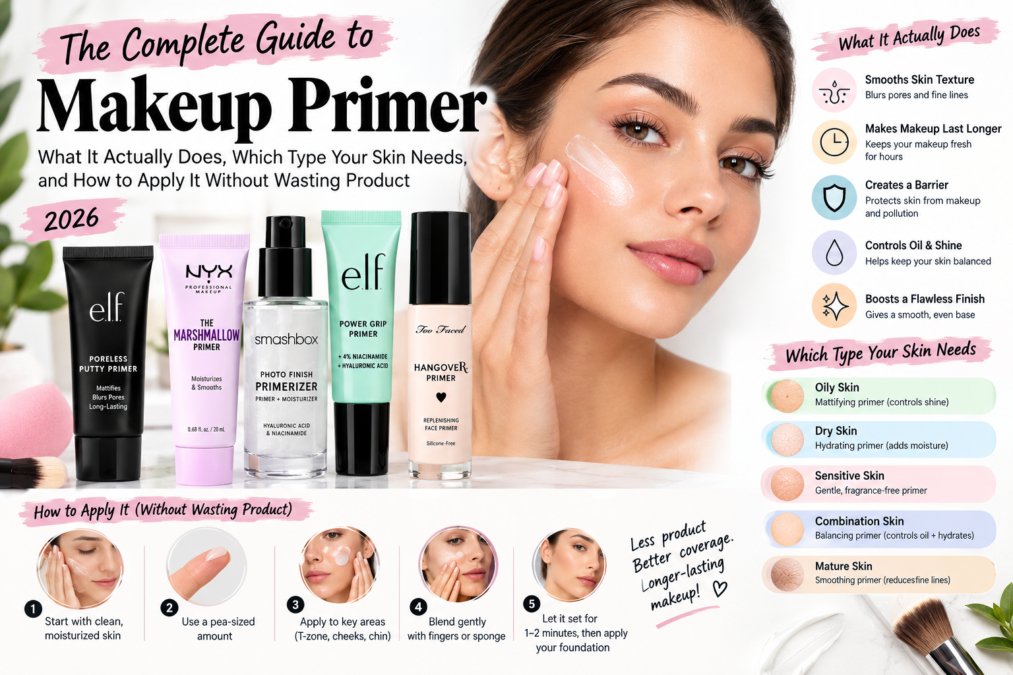
The primer aisle is organized around skin concerns, and understanding the categories is the difference between a product that works and one that fights your foundation. Hydrating primers are built for dry or mature skin, loaded with squalane, glycerin, and hyaluronic acid to plump the surface and prevent foundation from separating over rough patches . Mattifying primers target oil production with ingredients that absorb excess sebum, but pro artist Ranti Adeyemi cautions against expecting a fully matte finish: “it’s designed to help prevent the skin from producing excess oil too quickly. You’ll still develop some natural shine throughout the day, but your makeup should wear much better” .
Illuminating and color-correcting primers occupy the cosmetic end of the spectrum. Light-reflecting particles deliver glow before foundation, while tinted formulas use the color wheel to neutralize specific concerns: green cancels redness, peach brightens sallowness, and lavender counters dullness . Pore-minimizing primers are their own subcategory, relying on silicone polymers to create that airbrushed effect. The critical compatibility rule that rarely appears on packaging is that water-based primers and silicone-based foundations can repel each other, causing pilling or separation, while matching bases layer cleanly .
A useful way to think about primer selection is to diagnose the failure mode of your current makeup. If foundation disappears from your nose by lunch, you need oil control. If it cakes around your mouth and eyes, you need hydration. If it looks patchy and uneven from the first minute, you need smoothing. If your blush and bronzer fade while foundation stays put, a gripping primer is the missing piece. Buying primer without identifying the problem first is how drawers fill with half-used bottles.
How to Apply Makeup Primer Correctly Without Wasting Product
Application is where most primer routines quietly fail. The correct order is cleanser, moisturizer, sunscreen, then primer, then foundation . Skipping moisturizer and going straight from cleanser to primer is a common mistake that leaves the primer with nothing to sit on, and the result is uneven absorption and patchy foundation . Allowing each layer to absorb fully before the next step matters more than most people realize; primer applied over damp moisturizer dilutes and never forms the film that makes it work.
The amount you use is smaller than the average person assumes. A pea-sized amount is sufficient for the entire face, and pressing or patting the product into the skin with fingers generates warmth that helps it melt in better than a brush or sponge would . Placement should be strategic rather than all-over. Adeyemi recommends using an oil-control primer only on oily zones like the T-zone and a hydrating formula only on dry patches, because “tailoring your primer placement will usually give a much better result” . Slathering a single primer across the whole face is the most common route to that heavy, slipping feeling that makes people give up on primer entirely.
The waiting step is non-negotiable. Giving primer three to five minutes to set before foundation prevents the two products from sliding against each other, and finishing with a light setting powder stops the silicones in primer and the moisture in foundation from repelling over the course of the day . A common mistake is over-layering multiple primers across the entire face in an attempt to address every concern at once, which creates a thick film that foundation cannot grip . One targeted formula in the right zones beats three formulas everywhere.
Primer vs. Moisturizer vs. Sunscreen: Where Each Product Belongs
The confusion between primer and moisturizer is persistent because both products create a smoother surface, but their mechanisms and purposes diverge sharply. Moisturizer hydrates the skin itself, improving barrier function and addressing dryness at the cellular level. Primer creates a temporary surface film designed to interact with makeup, not to nourish the skin . You can wear moisturizer without makeup and your skin benefits. You can wear primer without makeup and the benefit is cosmetic: blurring, mattifying, or glow, set with a light powder if you want it to last .
The question of whether primer is necessary at all has a straightforward answer: it depends on the makeup and the skin. For a quick tinted moisturizer on a good skin day, primer adds little. For a full-coverage foundation that needs to survive a long workday, a hot commute, or a formal event, primer is the difference between a base that holds and one that migrates. Joy Adenuga puts it plainly: “For quick, light coverage on a good skin day, you can skip it, but for any serious makeup, I’d always reach for one” .
A Structured Comparison of Primer Types and Their Best Use Cases
The table below consolidates the major primer categories, their key ingredients, and the skin situations where each earns its place. It is a diagnostic tool rather than a shopping list.
| Primer Type | Key Ingredients | Best For | What It Does Not Do |
|---|---|---|---|
| Hydrating | Hyaluronic acid, glycerin, squalane | Dry, dehydrated, or mature skin | Control oil or mattify |
| Mattifying | Oil-absorbing powders, silica | Oily or combination skin, T-zone shine | Add glow or hydrate dry patches |
| Illuminating | Mica, light-reflecting particles | Dull skin, no-makeup makeup looks | Blur pores or control shine |
| Color-correcting | Green, peach, or lavender pigments | Redness, sallowness, dark spots | Replace concealer or foundation |
| Pore-blurring | Silicone polymers, dimethicone | Enlarged pores, textured skin | Hydrate or nourish the skin |
| Gripping | Tacky polymers | Long-wear foundation, humid climates | Smooth texture or correct tone |
The row that causes the most trouble is gripping primer. These formulas are designed to be sticky and are excellent at locking foundation in place, but the tackiness can accentuate dry patches and texture if applied across the entire face . They belong on the areas where makeup migrates most, not everywhere. The same logic applies to pore-blurring silicone primers, which are best pressed into the T-zone and nose rather than spread across cheeks that do not need filling.
Problem-Solution Scenarios That Primer Can Actually Fix
The most common complaint primer addresses is midday shine that turns foundation into a slick, patchy mess. The solution is not more powder; it is an oil-control primer applied specifically to the forehead, nose, and chin before foundation, paired with a lighter moisturizer in those zones. The primer slows sebum production at the surface, and the powder handles what breaks through. The mistake is applying a mattifying primer everywhere, which leaves the cheeks flat and emphasizes any dryness.
Another frequent problem is foundation that separates and clings to dry patches around the nose and mouth. A hydrating primer pressed into those areas creates a smoother surface that foundation can glide over rather than catch on, and the difference is visible within the first hour of wear . For texture and visible pores, a silicone-based blurring primer fills the depressions optically, but only if it is patted into the skin rather than rubbed, because rubbing lifts the product off the exact areas it needs to fill.
The third scenario is color-related: redness across the cheeks and nose that foundation alone cannot neutralize without looking heavy. A green-tinted color-correcting primer cancels the red at the surface, allowing a lighter layer of foundation to finish the job . The same logic applies to sallow or dull skin, where a peach or lavender primer brightens the canvas before complexion products go on. These are not gimmicks; they are the cosmetic equivalent of white-balancing a photograph before editing it.
How Primer Fits Into a Routine for Different Skin Types and Climates
Skin type dictates primer strategy more than any other factor. Oily skin benefits from a mattifying or gripping formula applied to the T-zone and a lightweight, oil-free moisturizer underneath. Dry skin needs a hydrating primer layered over a rich moisturizer, with a focus on the areas where foundation tends to catch. Combination skin is the case that rewards strategic placement most: an oil-control primer on the nose and forehead, a hydrating formula on the cheeks, and nothing on areas that behave. The single-primer-all-over approach serves almost no one well .
Climate adds a second variable that most primer advice ignores. In hot and humid conditions, gripping and mattifying formulas earn their keep because heat and sweat actively work against foundation adhesion. In cold, dry climates, hydrating primers prevent the wind and indoor heating from turning foundation into a cracked surface. The same person may need two different primers across a year, and that is not excess; it is matching the product to the conditions. A gripping primer that performs beautifully in July can feel tight and drying in January, and a hydrating primer that saves a winter complexion can slide off in a heatwave.
The final routine consideration is layering with other products. Mixing a water-based primer with a silicone-based foundation is a reliable way to produce pilling, and the same incompatibility can occur between a silicone-heavy moisturizer and a silicone primer . If a product pills, the problem is usually the combination rather than either product alone. Testing a new primer with the foundation you actually wear, rather than the one in the drawer you never reach for, is the only reliable compatibility check.
Frequently Asked Questions About Makeup Primer
What does a makeup primer actually do for your skin?
A makeup primer creates a temporary surface layer that smooths texture, fills pores and fine lines, controls shine or adds hydration, and gives foundation something to grip so it wears longer . It is not skincare in the nourishing sense, and it does not permanently improve the skin. Its benefits are cosmetic and immediate, which is why the right primer makes foundation look better from the first minute and the wrong one makes it worse.
Do you really need to use a primer every day?
You do not. Primer earns its place when you are wearing a full base that needs to last through a long day, a hot commute, or an event, and when your skin has a specific issue that foundation alone cannot handle, such as visible pores, persistent shine, or dry patches . For light coverage on a good skin day, skipping primer costs you very little. The product is a tool for specific problems, not a non-negotiable step.
What is the correct order for moisturizer, sunscreen, and primer?
Cleanse, apply moisturizer, let it absorb, apply sunscreen, let it absorb, then apply primer, then foundation . Each layer needs a moment to settle before the next, or the products mix and lose their individual benefits. Primer always goes closest to the makeup, and sunscreen always goes underneath it if you are using a dedicated SPF rather than relying on a primer with SPF, which is not sufficient as primary sun protection.
Can you wear a makeup primer without foundation?
Yes, and some primers are designed for exactly that. A blurring or mattifying primer can be worn alone to smooth texture and control shine, set with a light dusting of translucent powder if you want it to last . Illuminating primers work well as a final skincare step for a glow without coverage. The caveat is that gripping primers are specifically designed to hold foundation and can feel uncomfortably tacky when worn alone, so they are the wrong choice for a bare-face day.
Why does my foundation pill or slide off after I apply primer?
Pilling almost always signals a base mismatch, usually a water-based primer layered with a silicone-based foundation or a silicone-heavy moisturizer . Sliding foundation can mean the primer was applied too thickly, not given time to set, or that the primer and foundation have incompatible textures. A pea-sized amount, a three-to-five-minute wait, and matching water with water or silicone with silicone solve the majority of these problems.
Conclusion
The makeup primer is neither the miracle product the marketing promises nor the unnecessary step the skeptics dismiss. It is a targeted tool with a specific job, and its value depends entirely on whether that job matches what your skin and your makeup are actually doing. A hydrating primer on dry cheeks, a mattifying formula on an oily T-zone, a gripping layer under long-wear foundation in a humid climate: these are the applications where primer earns its place in the routine. The same product applied indiscriminately across the whole face, over unabsorbed moisturizer, in a thick layer, is the reason so many people conclude primer does nothing.
The final takeaway worth carrying into your next routine is diagnostic rather than prescriptive. Before buying another primer, identify the exact failure your current makeup has: the shine by noon, the patchy nose, the fading blush, the pores that foundation seems to magnify. Match the formula to that failure, apply it only where it is needed, and give it time to set. A primer is not supposed to transform your face. It is supposed to make the makeup you already wear behave the way you expected it to, and when it is chosen and applied correctly, that is exactly what it does.