Long skirts have a quiet power that few other garments possess. They sweep, they drape, and they carry a sense of movement that transforms the simple act of walking into something graceful. Yet for all their elegance, they also raise practical questions. Will the hem drag on wet pavements. Does the volume overwhelm a shorter frame. Can a long skirt work for the office without looking like costume. These are the concerns that stop people from embracing a style that has, across centuries and cultures, proven itself endlessly adaptable.
The appeal of a floor-skimming or ankle-grazing skirt lies in its versatility, but that versatility depends on understanding fabric, cut, and proportion. A bias-cut satin slip behaves nothing like a tiered cotton maxi, even though both technically fall into the same category. A structured wool column creates a completely different line than a flowing chiffon peasant skirt. This guide unpacks all of it, from textile behaviour and historical context to the styling formulas that make these skirts work for real bodies, real budgets, and real weather.
What Counts as a Long Skirt and Where the Boundaries Sit
A long skirt is any skirt that extends below the knee, with the most common lengths falling between midi, which ends around the mid-calf, and maxi, which reaches the ankle or floor. The distinction matters more than semantics suggest, because the point at which a hem lands dramatically changes the visual proportions of the wearer and the practical demands of the garment. An ankle-length skirt requires more fabric, more careful hemming, and more attention to footwear than a midi that stops at the calf.
Terminology in this category is genuinely messy, and it helps to untangle it. Midaxi is a marketing term that has crept into retail over the past decade, describing a length that sits between midi and maxi, usually landing just above the ankle. Tea length traditionally refers to a hem that falls between the knee and the ankle and is most often associated with formal or vintage-inspired dressing. Floor-length describes exactly what it says, though in practice most floor-length skirts hover a centimetre or two above the ground to avoid constant contact with the pavement. Understanding these labels helps when shopping online, where photographs can distort proportion and a model’s height can make a maxi look like a midi.
The cultural history of the long skirt is also worth acknowledging, because it shapes how we read the garment today. Floor-length skirts have been worn across virtually every civilisation for practical reasons, from protection against the elements to modesty conventions, and the short skirt is, historically speaking, the recent innovation. What changed in the twentieth century was not the existence of long skirts but their meaning. They shifted from default to deliberate, from requirement to choice, and that shift is precisely what gives them their current expressive power.
The Psychology and Cultural Meaning Behind Long Skirts
Clothing communicates before we speak, and the long skirt carries a particular set of signals that shift depending on context. In some settings it reads as modesty, in others as bohemian freedom, and in others again as formal elegance. This semiotic flexibility is unusual. Few garments can move so fluidly between a festival field, a boardroom, and a wedding without alteration, and that range explains why the style persists across trend cycles while more prescriptive garments fade.
There is also a sensory dimension that people who wear these skirts describe consistently. The weight of the fabric against the legs, the way air moves underneath a loose hem, the sound of certain fabrics as they move, all contribute to a physical experience that differs markedly from wearing trousers or a short skirt. For many wearers, this sensory quality is the primary reason they return to the style. It is not simply about appearance. It is about how the garment feels to inhabit, and that is a consideration that rarely appears in trend reporting but matters enormously in daily wear.
The long skirt also carries associations with specific subcultures and moments that add resonance. The flowing prairie skirts of the seventies, the gothic floor-length layers of the eighties, the minimalist column skirts of nineties designer collections, and the cottagecore revival of recent years all contributed distinct visual vocabularies. Wearing the style today means drawing on that accumulated meaning, whether consciously or not, and choosing which associations to lean into through fabric, print, and styling.
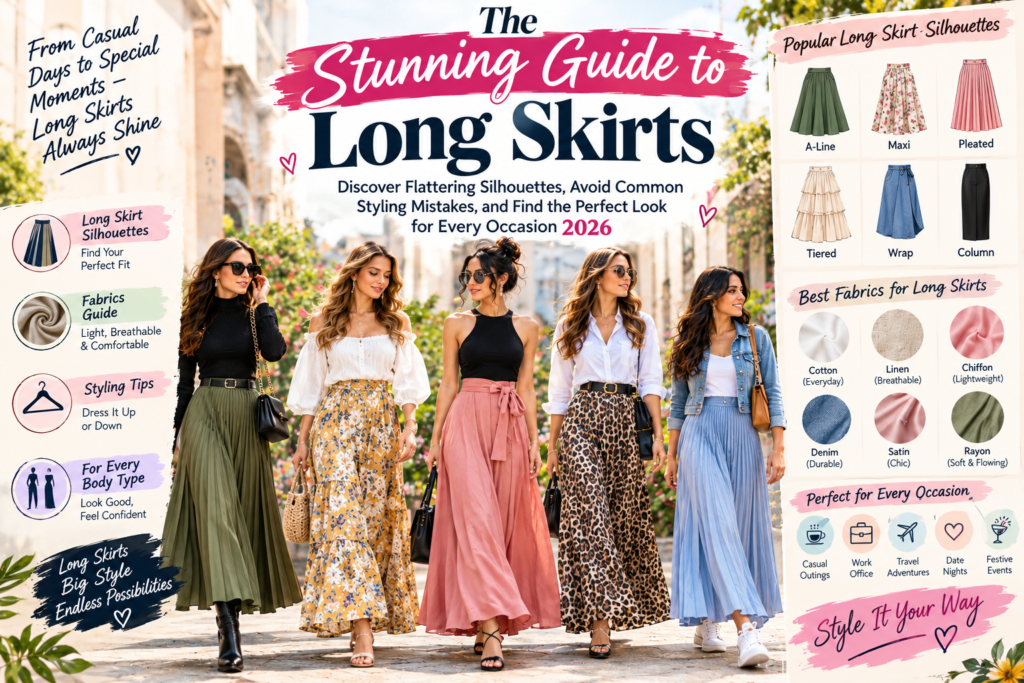
Understanding Silhouettes: From Column to Tiered and Beyond
The silhouette of a long skirt determines almost everything about how it looks and how it behaves. A column or pencil skirt falls in a narrow, straight line from hip to hem, creating a sleek, vertical effect that reads as polished and often professional. This cut works best in structured fabrics that hold their shape, such as wool suiting, heavy crepe, or lined cotton, because soft fabrics will cling rather than fall cleanly. The column is the most space-efficient long skirt and the easiest to wear in crowded environments or office settings.
A-line skirts widen gradually from the waist to the hem, creating the shape of the letter A. This is the most universally flattering of the long silhouettes, because the flare balances the hip and thigh while the fitted waist defines the narrowest point of the torso. A-line long skirts work in virtually every fabric, from stiff denim to fluid silk, and they tolerate a wider range of hem lengths. Tiered skirts, by contrast, are constructed from horizontal panels of fabric that increase in width as they descend, producing a ruffled, romantic effect. This construction adds volume, so it suits wearers who want to create the illusion of curves or who simply enjoy a more dramatic line.
Fabrics That Make or Break a Long Skirt
Fabric choice matters more for long skirts than for almost any other garment, because the hemline amplifies whatever the material does. A fabric with good drape produces elegant movement and a clean line. A fabric with poor drape produces stiffness, awkward folds, and a hem that refuses to hang straight. Understanding a few basic textile properties removes most of the guesswork from shopping.
Weight is the first consideration. Lightweight fabrics such as chiffon, voile, and fine cotton lawn create airy, flowing skirts that are ideal for warm weather but can be difficult to control in wind and prone to transparency. Midweight fabrics including cotton poplin, linen, Tencel, and crepe offer the best balance for most situations, holding a shape while still moving naturally. Heavyweight fabrics such as wool, denim, corduroy, and velvet create structured, sculptural skirts that hang cleanly and provide warmth, though they can feel restrictive and require more careful tailoring.
Drape is the second consideration and is closely tied to fibre content and weave. Satin, silk, viscose, and rayon have natural fluidity, which is why they dominate bias-cut and slip-style skirts. Linen and cotton tend to have more body, which suits A-line and tiered constructions. Synthetics vary enormously. Polyester can be engineered to mimic silk’s drape or to behave like a stiff taffeta, so the fibre name alone tells you very little about how the finished skirt will behave. The specific weave, finish, and weight matter far more than the generic category, which is why handling a garment or reading detailed fabric descriptions is more useful than scanning the composition label alone.
A table helps clarify the practical trade-offs across the most common options.
Long Skirt Fabric Reference
| Fabric | Weight and Drape | Best Silhouette | Seasonal Suitability | Care Considerations |
|---|---|---|---|---|
| Cotton poplin | Midweight, moderate body | A-line, tiered, wrap | Spring and summer | Machine washable, wrinkles easily |
| Linen | Midweight, crisp with softening over time | A-line, column, wrap | Warm weather | Wrinkles significantly, dry clean or gentle wash |
| Silk and satin | Lightweight, fluid, high sheen | Bias-cut, slip, column | All seasons, occasion wear | Dry clean recommended, prone to water marks |
| Chiffon | Very light, sheer, highly fluid | Layered, tiered, maxi | Summer, occasion wear | Hand wash, requires lining, fragile |
| Viscose and rayon | Light to midweight, soft drape | Bias-cut, wrap, A-line | All seasons | Can shrink, hand wash or gentle cycle |
| Wool suiting | Heavy, structured, minimal drape | Column, pencil, A-line | Autumn and winter | Dry clean, susceptible to moths |
| Denim | Heavy, structured, holds shape | A-line, column, wrap | All seasons | Machine washable, may fade |
| Velvet | Heavy, plush, moderate drape | Column, A-line, bias | Autumn and winter | Dry clean, crushes easily, directional nap |
| Tencel and lyocell | Midweight, excellent drape | A-line, wrap, bias-cut | All seasons | Machine washable, resists wrinkling |
Choosing the Right Length for Your Height and Frame
Hem length is the single most consequential decision when buying a long skirt, and it is also the one most often made by accident. The difference between a hem that lands at the widest part of the calf and one that lands just below it can be the difference between a flattering line and a visually shortening one. The general principle is that hems should land at a narrowing point of the leg rather than at the widest point, which is why mid-calf can be tricky and just-above-the-ankle tends to work well.
For petite frames, the concern about being overwhelmed by fabric is legitimate but manageable. The most effective approaches are to choose a higher waistline, which lengthens the apparent leg, and to keep the skirt’s volume moderate rather than dramatic. A high-waisted A-line midaxi in a midweight fabric will generally flatter a shorter frame more than a low-rise tiered maxi. Vertical elements also help, including centre-front seams, narrow pleating, and long unbroken lines of colour. Pairing the skirt with a fitted or tucked top maintains a visible waist, which is essential for preserving proportion.
Styling Long Skirts for Everyday Wear
The everyday long skirt outfit is built on a simple principle: balance the volume below with definition above. When a skirt is full or tiered, the top should be relatively fitted, tucked, or cropped so that the waist remains visible. When the skirt is narrow or column-cut, the top can be looser without creating shapelessness, because the vertical line of the skirt provides structure. This single rule resolves most styling questions before they arise.
Layering adds practicality and interest. A cropped jacket, a fitted blazer, a tucked-in knit, or a structured denim jacket all provide definition at the waist and warmth for transitional weather. Belts are a particularly useful tool with long skirts, since they visually establish the waist and can rescue a skirt whose waistband sits slightly too low. A wide belt over a midi skirt and a tucked blouse is a classic formula that works across seasons. Bags should be chosen with proportion in mind. A very small bag against a very full skirt can look lost, while an oversized tote can compete with the volume of the garment.
Styling Long Skirts for Work and Formal Occasions
The long skirt is one of the most underrated professional garments available, largely because it is assumed to be casual. In reality, a column or A-line skirt in a structured neutral fabric is entirely appropriate for most office environments and often more comfortable than a pencil skirt, particularly for anyone who spends the day moving between sitting and standing. A wool or crepe midi in navy, charcoal, black, or camel paired with a tucked blouse and a tailored blazer reads as polished and intentional, not bohemian.
For formal occasions, the long skirt becomes genuinely glamorous, and this is where fabric earns its keep. A bias-cut silk or satin skirt in a deep tone, paired with a fitted top and statement jewellery, holds its own against a cocktail dress while offering a more distinctive silhouette. A sequinned or metallic long skirt can serve as the focal point of an evening outfit, with the rest of the look kept deliberately simple. The main pitfall in formal settings is length. A skirt that is too long will catch underfoot on stairs and dance floors, so a floor-length hem should be checked while wearing the shoes you intend to wear and adjusted if necessary.
The long skirt also performs well in transitional and unpredictable weather, which is part of why it has such a devoted following in temperate climates. A heavier midi with boots and a knit can handle a cold morning, and the same skirt with a lighter top works in the afternoon. Layering tights underneath extends the seasonal range of lighter fabrics, and a slip beneath a sheer or clinging fabric solves both opacity and static issues. This adaptability makes the style a practical investment rather than a single-season novelty.
Solving Common Long Skirt Problems
Even a well-chosen long skirt can present difficulties, and most of them have straightforward solutions. Hem dragging is the most frequent complaint, particularly with maxi lengths worn with flat shoes. The simplest fix is to have the skirt hemmed to a length that clears the ground by roughly a centimetre while wearing the shoes you wear most often with it. Temporary solutions include hem tape, which can be adjusted and removed, and a hidden internal loop that lifts the hem slightly when walking on stairs.
Static cling is another persistent issue, especially with synthetic and lightweight fabrics. An anti-static spray applied to the inside of the skirt is effective, as is a slip worn underneath, which also improves opacity. Rubbing a small amount of moisturiser or a dryer sheet lightly along the inside of the hem can reduce static in a pinch. For skirts that cling to tights, a lined skirt or a slip resolves the problem more reliably than any spray.
Care, Storage, and Longevity
How a long skirt is cared for determines whether it retains its drape and shape over years or degrades within a season. Washing is the first area of risk. Structured fabrics such as wool, velvet, and lined silks should generally be dry cleaned, both to preserve the fabric and to maintain the shape of the garment. Midweight cottons, linens, and Tencel can usually be machine washed on a gentle cycle, though linen wrinkles heavily unless removed promptly and hung to dry. Delicate fabrics such as chiffon and fine viscose are best hand washed or placed in a mesh bag on a delicate cycle, and they should never be wrung out, since twisting distorts the weave and the hem.
Drying and pressing are equally consequential. Hanging a long skirt by the waistband while damp allows gravity to do most of the work, smoothing the fabric naturally. This is especially effective for bias-cut garments, which can distort if hung by the hem or dried flat in an awkward position. Irons should be used with care, particularly on velvet, which requires a needle board or a suspended steam method, and on synthetics, which can melt under high heat. Storing the skirt on a hanger with clips, folded at the waistband or hung by the waistband itself, prevents creases from forming across the middle of the garment.
Storage also affects longevity. Long skirts occupy more vertical space than shorter garments, so they are best hung full length in a wardrobe rather than folded on a shelf, where creases form along the fold line. Moths are a particular threat to wool, silk, and cashmere blends, so storing these in breathable garment bags with cedar or lavender is a sensible precaution. Rotating skirts between wears gives the fabric time to recover from the stress of sitting and moving, and this simple habit meaningfully extends the life of natural-fibre garments. Keeping a small sewing kit with matching thread and spare hem tape also means minor repairs can be handled immediately, before they become visible problems.
Frequently Asked Questions About Long Skirts
What is the difference between a midi and a maxi skirt?
A midi skirt typically ends between the mid-calf and just above the ankle, while a maxi skirt extends to the ankle or the floor. The exact boundary is not standardised across retailers, and the term midaxi has emerged to describe lengths that fall between the two, usually landing just above the ankle. When shopping online, the most reliable approach is to check the garment length in centimetres or inches rather than relying on the label, since the same term can describe noticeably different lengths across brands. Choosing between them comes down to footwear, occasion, and how much fabric you want to manage through the day.
How can I wear a long skirt without looking shorter?
The key is to preserve a visible waistline and a long vertical line. Choose a higher rise, which lengthens the apparent leg, and pair the skirt with a fitted or tucked-in top so the waist remains clearly defined. Moderate volume rather than dramatic volume is generally more flattering on a shorter frame, and vertical details such as a centre seam or narrow pleating help elongate the body. Footwear with a slight heel or platform lifts the hem clear of the ground and improves the line of the leg. Avoiding hems that land at the widest part of the calf is also important, since that point visually cuts the leg and shortens the silhouette.
What shoes work best with a long skirt?
The best footwear depends on the length and volume of the skirt. With a floor-length maxi, a heel, platform, or wedge keeps the hem clear of the ground and prevents dragging. With a midi or midaxi, flats, loafers, and ankle boots all work well. Boots partner particularly effectively with narrow and column silhouettes in cooler months. Sneakers suit casual fabrics such as denim, jersey, and cotton but tend to look less resolved with silk and satin. The underlying principle is proportion. A heavier, more voluminous skirt benefits from a shoe with some visual weight, while a sleek bias-cut skirt pairs well with something finer.
Are long skirts appropriate for the office?
Yes, provided the fabric and silhouette are chosen with the setting in mind. A column or A-line midi in a structured neutral fabric such as wool suiting, heavy crepe, or lined cotton reads as polished and professional when paired with a tucked blouse and a tailored jacket. What tends to look out of place in an office is not length but casualness, so tiered cottons, sheer fabrics, and beachy prints are better reserved for weekends. Checking the dress code and observing what colleagues wear remains the most reliable guide, but a well-tailored long skirt is generally as appropriate as a midi dress or tailored trousers.
How do I stop a long skirt from dragging on the ground?
The most durable solution is to have the skirt hemmed to a length that clears the ground by about a centimetre while wearing the shoes you wear most often with it. Because heel height changes the effective length, hemming to your most-worn pair is more practical than trying to accommodate every option. For a temporary fix, hem tape can raise a hem without cutting the fabric and can be removed when needed. A hidden internal loop that lifts the hem slightly is another useful trick, particularly for stairs and wet pavements. Wearing the skirt with a slight heel also lifts the hem naturally and often solves the problem without alteration.
Conclusion
The long skirt is one of the most quietly capable garments in any wardrobe, and its reputation for being difficult to wear says more about how it is usually styled than about the garment itself. Once you understand how hem length interacts with height, how fabric weight determines drape, and how balancing volume above and below creates a flattering line, the long skirt stops being a risk and becomes a reliable default. It works in offices, at weddings, on weekends, and through transitional weather, and it does so with a grace that few other garments can match.
The deeper takeaway is that length is not the enemy of flattery. Poor proportion is. A long skirt cut well in the right fabric for the right occasion will flatter a petite frame, a curvy frame, and a tall frame alike, provided the waist is defined, the hem lands at a narrowing point of the leg, and the footwear lifts the line of the body. Get those three things right, and a long skirt becomes what it has always been at its best: not a statement about trends, but a piece of clothing that moves with you and makes the ordinary business of getting dressed feel considerably more considered.