

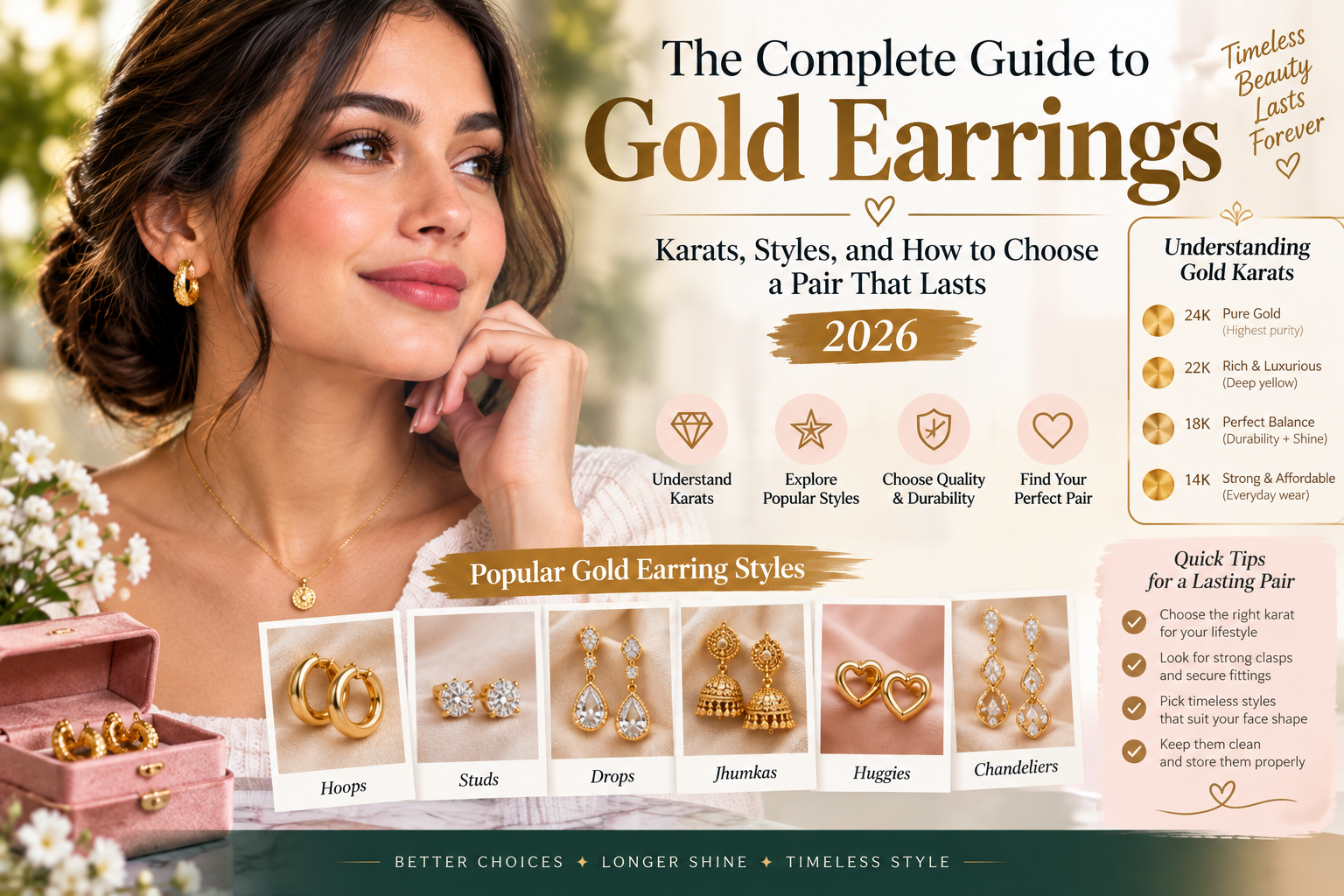
Gold earrings occupy a unique place in the world of jewelry. They are often the first piece of fine jewelry a person owns, the pair that gets worn through job interviews and first dates, the gift that marks a milestone birthday or anniversary. Yet for all their familiarity, the world of gold earrings is layered with technical distinctions, pricing structures, and quality markers that many buyers never fully understand. This guide breaks down everything worth knowing, from how gold purity actually works to the specific features that separate a pair that lasts decades from one that fades within months.
Understanding Gold Karats and What They Mean for Earrings
The term “karat” is the single most important concept to grasp when shopping for gold earrings, and it is also one of the most commonly misunderstood. Karat measures gold purity on a scale of 24 parts, so 24K gold represents 99.9% pure gold with virtually no other metals mixed in. The catch is that pure gold is far too soft for wearable jewelry. It bends, scratches, and loses its shape with minimal handling, which is why 24K gold is reserved almost exclusively for bullion and investment pieces rather than earrings or rings.
The practical options for gold earrings are 18K, 14K, and 10K. An 18K piece contains 75% gold alloyed with 25% other metals like copper, silver, or zinc. This higher gold content gives 18K a rich, saturated yellow color that many people associate with “real gold,” and it retains a substantial amount of that soft, luxurious feel. However, that softness cuts both ways. 18K gold earrings are more susceptible to scratching and bending, particularly in delicate designs like thin hoops or prong-set stones. For earrings that are worn occasionally and handled gently, 18K is a fine choice. For daily wear, it demands more care.
A useful point of reference for buyers comparing options: 18K gold is equal to 750 fineness on the millesimal system, 14K equals 583 or 585, and 10K equals 416 or 417. These numbers sometimes appear as stamps on the jewelry itself and can be useful for verifying authenticity when shopping secondhand or at estate sales.
The Difference Between Solid Gold, Gold-Filled, and Gold-Plated Earrings
Not everything sold as “gold earrings” contains the same amount of gold, and understanding these categories is essential for making an informed purchase. Solid gold earrings are exactly what the name suggests: the entire piece, inside and out, is made from a gold alloy of a specific karat. These are the most valuable and the most durable, and they can be repaired, resized, and polished repeatedly without losing their gold content.
Gold vermeil is a step up from standard plating, characterized by a sterling silver base rather than brass or copper, and a gold layer of at least 2.5 microns thick—considerably thicker than the sub-0.5-micron layer found in typical gold-plated jewelry. The sterling silver foundation makes vermeil a better choice for people with sensitive skin or nickel allergies, and the thicker gold layer means it holds its color longer than cheap plating. However, vermeil still belongs in the plated family, and with enough wear, the gold layer can eventually wear through to reveal the silver underneath. For someone who wants the look of gold earrings without the solid gold price, vermeil is a reasonable compromise for occasional wear.
Gold-plated earrings, the most affordable category, consist of a base metal coated with a microscopic layer of gold, often through electroplating. This layer is thin enough that it can wear off within weeks or months of regular wear, particularly in areas that contact skin oils or hair products. Gold-plated earrings are best understood as fashion accessories rather than investments. They can be fun for trying out a trend, but they should not be expected to maintain their appearance over the long term.
For a quick visual reference, the key distinctions break down as follows:
| Category | Base Metal | Gold Content | Durability | Best For |
|---|---|---|---|---|
| Solid Gold | None (all gold alloy) | 100% of piece | Highest; repairable and refinishable | Heirloom pieces, daily signature wear |
| Gold-Filled | Brass or similar | At least 5% by weight | High; years of daily wear | Everyday earrings on a budget |
| Gold Vermeil | Sterling Silver | 2.5+ microns gold layer | Moderate; lasts longer than plating | Sensitive skin, occasional elegant wear |
| Gold-Plated | Brass, copper, steel | Under 0.5 microns | Low; fades within months | Trend pieces, short-term wear |
Why Earring Style Matters More Than You Might Think
The style of a gold earring is not just an aesthetic decision. It determines comfort, wearability, and how often you will actually reach for that pair. Studs, which sit flush against the earlobe with no drop, are the most versatile and sleep-friendly option. They work with every outfit, can be layered with other piercings, and are the only style most people can comfortably wear while sleeping or exercising. A simple pair of gold ball studs or bezel-set stones forms the foundation of a functional earring wardrobe. Diamond solitaire studs in a gold setting offer a classic that works for both everyday and formal occasions.
Huggie earrings have become one of the most popular styles in recent years, and for good reason. These small hoops, typically between 8 and 14 millimeters in diameter, sit snugly against the earlobe without dangling or catching on clothing. They bridge the gap between the subtlety of a stud and the visibility of a hoop, and many people find them comfortable enough to wear continuously. For second or third piercings, huggies are often the ideal choice because they do not compete with a larger primary earring.
Hoops offer the widest range of expression within a single style category. A 15-millimeter hoop reads as subtle and professional, while a 50-millimeter hoop makes a bold statement. The thickness of the hoop—whether it is a thin, delicate wire or a chunky tube—changes the entire personality of the piece. Thin hoops feel more formal and refined; thicker hoops feel modern and casual. Medium hoops in the 25 to 30 millimeter range tend to strike the best balance for most people, offering enough presence to be noticed without overwhelming the face.
Drop and dangle earrings add movement and length. Drop earrings feature a fixed pendant that hangs below the lobe, while dangle or chandelier styles incorporate multiple elements that swing with movement. These are the earrings for evenings and events, and they work best when the rest of the outfit is relatively simple. Pairing a dramatic dangle earring with a statement necklace usually creates visual confusion rather than harmony. For someone with a round face, long drops can create an elongating effect; for a square or angular face, rounded hoops soften strong jawlines.
Hallmarks and Quality Stamps: What to Look For
A hallmark is an official stamp applied to precious metal items by an independent assay office, and it serves as a guarantee of the metal’s purity. The system dates back to 1300 in the United Kingdom and remains one of the oldest forms of consumer protection in existence. In the UK, the Hallmarking Act of 1973 requires that any item described as gold, silver, platinum, or palladium must carry an approved hallmark unless it falls below specific weight exemptions. For gold, the exemption weight is one gram, meaning many small earrings technically do not require a hallmark, though reputable makers often include them anyway.
A complete UK hallmark includes three compulsory marks: the sponsor’s mark, which identifies who submitted the item for testing; the assay office mark, which shows where it was tested; and the fineness mark, which confirms the metal content. Optional marks include a pictorial symbol and a date letter. The presence of a hallmark is not just a legal technicality—it is a practical tool for verifying that what you are buying is what it claims to be. The London Assay Office describes the hallmark as a “tardis of information” that tells who made an item, what it is made of, where it was tested, and often when.
How to Evaluate Gold Earring Quality Beyond the Karat
Karat is the headline number, but several other factors determine whether a pair of gold earrings will serve you well over time. The closure mechanism is one of the most overlooked yet consequential details. A butterfly or friction back is the most common and works fine for studs, but it can loosen over time and is not ideal for valuable pieces. Screw backs offer more security for studs, particularly for people who are active or prone to losing earrings. For hoops and dangles, the closure design affects both security and comfort. An omega back, for example, provides a secure fit that resists slipping, while a simple wire hook is easier to put on but offers less security.
The thickness of the metal in a hoop or dangle earring matters for both durability and comfort. Extremely thin hoops may look elegant but can bend out of shape with minimal pressure. Hollow hoops are lighter and more affordable but dent more easily than solid ones. For everyday wear, a solid or well-constructed hollow hoop in 14K gold represents a good balance of durability, weight, and price.
The quality of any gemstone settings also deserves attention. Prong settings, while common and often beautiful, can snag on clothing and hair, and prongs can loosen over time. Bezel settings, in which the gemstone is encircled by a rim of metal, are more secure and less likely to catch on things, making them a better choice for earrings that will be worn frequently. For diamond or gemstone earrings, checking that the stones are secure before each wear is a simple habit that prevents loss.
Real-World Scenarios: Matching Gold Earrings to Lifestyle
The “best” gold earrings are the ones that fit the actual life of the person wearing them. Consider a nurse who works twelve-hour shifts and cannot remove earrings during the workday. Studs or small huggies in 14K gold make the most sense here—they are comfortable enough to sleep in, secure enough to stay put during physical activity, and durable enough to withstand the occasional bump against equipment or bedding. A large dangle or an 18K hoop would be impractical and potentially unsafe in that environment.
Now consider someone who works in a professional office and wants a single pair that transitions from meetings to dinner. Medium-sized 14K hoops in a classic round or slightly oval shape offer the versatility to work in both contexts. They are substantial enough to feel polished but not so large that they read as evening-only. Adding a pair of simple gold studs for days when even a medium hoop feels like too much creates a two-pair rotation that covers nearly every situation.
For someone building a jewelry collection from scratch, the advice from jewelry professionals is consistent: start with a small number of high-quality pieces rather than many inexpensive ones. A 14K gold stud, a pair of huggies, and a medium hoop form a foundation that can be worn in dozens of combinations. Adding a drop or dangle earring for special occasions completes a wardrobe that handles everything from a Tuesday morning meeting to a wedding. The temptation to buy multiple trendy gold-plated pieces is understandable, but those pieces will fade and tarnish, leaving the wearer with a drawer full of discolored jewelry and nothing reliable to put on.
Caring for Gold Earrings to Preserve Their Appearance
Gold is a relatively soft metal, even in its alloyed forms, and earrings are particularly vulnerable because they are handled frequently and exposed to skin oils, hair products, and environmental pollutants. The simplest care habit is to put earrings on last when getting dressed and take them off first when undressing. Perfume, hairspray, and lotion can leave residue that dulls the gold’s shine and, over time, can contribute to wear on plated or vermeil pieces.
Cleaning gold earrings at home requires little more than warm water, a mild dish soap, and a soft-bristled brush. A baby toothbrush works well for reaching into the crevices of intricate designs. After cleaning, drying the earrings with a soft cloth rather than letting them air dry prevents water spots. For gold-filled and vermeil pieces, avoiding abrasive cleaners and rough cloths is especially important because these can accelerate the wear of the gold layer.
Storage matters more than most people realize. Earrings tossed loosely into a jewelry box will scratch each other and tangle with necklaces. A jewelry organizer with individual compartments or a simple divided tray prevents this. For gold-filled or vermeil earrings, keeping them in a dry environment and away from direct sunlight helps preserve the finish. Solid gold earrings are more forgiving, but even they benefit from careful storage that prevents unnecessary scratching.
Common Problems and Practical Solutions
One of the most common frustrations with gold earrings is the green or black discoloration that sometimes appears on the earlobe after wearing. This is not a sign that the gold is fake or low quality. It is a reaction between the metals in the alloy—particularly copper—and the natural acids in a person’s skin or in products applied to the skin. The reaction is more common with lower-karat gold and with plated jewelry where the base metal is exposed. The solution is straightforward: clean the earrings regularly, avoid applying lotions or perfumes directly to the earlobe area, and consider moving to a higher karat or a nickel-free alloy if the reaction is persistent.
Another frequent issue is earring backs that loosen and fall off, leading to lost earrings. This is particularly common with butterfly backs on studs. Replacing them with silicone backs or screw backs provides a more secure hold. For valuable earrings, some jewelers offer locking backs that require deliberate action to remove, which virtually eliminates the risk of loss during daily wear.
Tarnishing is a concern primarily for gold-plated and, to a lesser extent, gold-filled jewelry. The base metals in these pieces can oxidize when exposed to air and moisture, and the tarnish can eventually show through the gold layer. Storing such pieces in airtight bags or containers with anti-tarnish strips slows this process significantly. For vermeil, the sterling silver base can tarnish, which may create a darkening effect under the gold layer. Regular gentle cleaning and dry storage are the best defenses.
The Cultural and Emotional Significance of Gold Earrings
Gold earrings carry meanings that extend far beyond their material value. In many South Asian cultures, gold jewelry is an integral part of bridal adornment and family tradition, with specific styles and weights carrying symbolic significance. A research paper on traditional Pakistani jewelry notes that working women often move away from heavy ensembles toward simpler pieces like a “bali” in the ear and a locket around the neck, reflecting a balance between cultural heritage and practical daily life. This observation captures something universal about gold earrings: they can be both deeply traditional and entirely modern, adapting to the wearer’s circumstances without losing their essential character.
Gold has also historically served as a store of value in cultures where other forms of savings were less secure. In Pakistan, for example, gold prices are tracked daily, and the value of 10 grams of gold is reported in newspapers alongside currency exchange rates. This dual role of gold as both adornment and asset gives gold earrings a weight—literal and figurative—that other jewelry does not carry. A pair of gold earrings purchased today may be worn for decades and eventually passed down, its value measured not just in the current gold price but in the memories and occasions it has witnessed.
Understanding Gold Pricing and Making Smart Purchases
The price of a gold earring is determined by three primary factors: the weight of the gold, the current market price of gold, and the craftsmanship or design premium. Gold prices fluctuate daily based on international markets, and this volatility is reflected in retail prices. In late September 2026, for instance, the price of 10 grams of gold in Pakistan rose by over 4,000 rupees in a single day, reaching approximately 388,000 rupees. This kind of daily movement means that the same earring can cost noticeably more or less depending on when it is purchased, and it explains why jewelry prices are sometimes quoted in terms of weight plus making charges rather than a flat retail price.
When comparing gold earrings across different retailers, it helps to break the price down into its components. The metal value is straightforward: the weight of the earring multiplied by the current price per gram for that karat. The making charge, or labor cost, varies widely based on the complexity of the design and the reputation of the maker. A simple pair of gold ball studs may have a modest making charge, while an intricate filigree or gemstone-set design commands a higher premium. Understanding this breakdown allows buyers to evaluate whether a particular pair represents good value or whether they are paying primarily for a brand name or design trend.
For buyers who want the durability of solid gold without the full price, gold-filled earrings offer a legitimate middle path. As noted, gold-filled pieces contain at least 5% gold by weight and can last for years with proper care. The key is to verify that the item is genuinely gold-filled rather than merely gold-plated, which requires checking for the appropriate stamp or asking the retailer directly. The terminology can be confusing—”rolled gold plate” and “gold overlay” are older terms for gold-filled, while “gold wash” and “gold tone” indicate plating. When in doubt, the presence of a karat stamp such as “14K GF” or “12K RGP” indicates a gold-filled construction, while “14K GP” indicates plating.
Building a Versatile Gold Earring Collection
A functional gold earring collection does not require dozens of pairs. Most jewelry professionals recommend building around a core of four or five pieces that cover the full range of occasions and moods. The foundation is a pair of simple studs—either plain gold balls or a bezel-set stone in a 3 to 5 millimeter size. These are the earrings for early mornings, travel days, and situations where you want to look put-together without thinking about your jewelry. A second pair of slightly larger studs or a pair of small huggies adds variety for everyday wear and second piercings.
Medium-sized hoops in the 25 to 35 millimeter range serve as the “step out” pair for dinners, meetings, or any occasion that calls for a bit more presence. These can be worn alone or layered with a stud or huggie in a second piercing. Finally, a drop or dangle earring in a classic design provides the option for formal events, weddings, or evenings when a little extra glamour is appropriate. The specific designs within each category matter less than having the categories covered. A person who owns one excellent pair of each type will find themselves reaching for their jewelry far more often than someone who owns fifteen pairs of trendy but poorly made earrings.
For those who enjoy layering, the ear stack has become a recognized styling approach. The idea is to build a graduated arrangement of earrings across multiple piercings, typically moving from a small stud or huggie in the upper piercing to a larger hoop or drop in the main lobe piercing. The key to a successful ear stack is visual balance: mixing sizes, textures, and occasionally metals creates interest, but too many large or busy pieces in close proximity creates clutter. Starting with a foundation of two or three well-chosen pieces and adding gradually is the most reliable way to build a stack that looks intentional rather than accidental.
Frequently Asked Questions About Gold Earrings
What is the best karat of gold for everyday earrings
The best karat for everyday wear is generally 14K gold. It offers a practical balance between durability and appearance, containing 58.3% pure gold alloyed with metals that give it enough hardness to withstand daily handling, accidental bumps, and exposure to the elements without deforming. Eighteen-karat gold is purer and has a richer color, but its softness makes it more prone to scratching and bending, particularly in thin or delicate designs. Ten-karat gold is the most durable option but has a paler color that some people find less appealing. For a pair of gold earrings that will be worn frequently, 14K represents the most reliable choice for most people.
How can I tell if gold earrings are real
The most reliable way to determine if gold earrings are real is to look for a hallmark or purity stamp. In the United Kingdom, a hallmark from an assay office is a legal guarantee of the metal content and should include a sponsor’s mark, the assay office mark, and a fineness mark such as 375, 585, or 750. In the United States, purity marks are recommended but not mandatory, so the presence of a “14K” or “18K” stamp is a good sign but not an absolute guarantee. Beyond stamps, though some people experience a green reaction from the alloyed metals in lower-karat gold, which is not a sign of fakeness.
Why do some gold earrings turn my ears green
The green discoloration that some people experience from gold earrings is a reaction between the metals in the gold alloy—specifically copper—and the acids in sweat, skin oils, or cosmetic products. It is more common with 10K gold and with gold-plated or gold-filled earrings where the base metal may be exposed over time. The reaction is harmless and does not mean the earrings are fake. To reduce it, clean the earrings regularly, avoid applying lotions or perfumes directly to the earlobe area, and consider switching to a higher karat or to a nickel-free alloy. Solid 18K and 24K gold are least likely to cause this reaction because they contain a higher proportion of pure gold.
Are gold-filled earrings worth buying
Gold-filled earrings are worth buying for people who want the look and durability of gold at a fraction of the cost of solid gold. Gold-filled pieces contain at least 5% gold by weight, and the gold layer is mechanically bonded to the base metal rather than simply plated onto it, making it significantly more resistant to wear and tarnishing than gold-plated jewelry. A well-made gold-filled earring can be worn daily for years before showing signs of wear. The main limitations are that gold-filled pieces cannot be repaired or resized the way solid gold can, and they will eventually show wear if subjected to particularly harsh conditions. For everyday earrings that are not heirlooms, they offer excellent value.
What earring styles work best for sensitive ears
For sensitive ears, the best options are solid gold in 14K or higher, or gold vermeil, which uses a sterling silver base rather than brass or copper. Sterling silver is less likely to cause allergic reactions than the base metals commonly used in gold-plated jewelry, and the thicker gold layer in vermeil provides a barrier between the silver and the skin. Solid gold is the safest choice because it contains no base metals that can leach onto the skin.
Conclusion
Gold earrings are more than an accessory. They are a practical investment, a daily source of pleasure, and often a piece of personal history that travels with you through different phases of life. Understanding the distinctions between karats, the differences between solid, filled, and plated constructions, and the features that separate comfortable earrings from ones that sit unworn in a jewelry box makes the difference between a purchase that satisfies for years and one that disappoints within months.
The most valuable insight is this: gold earrings reward thoughtful selection far more than quantity. A small collection of well-chosen 14K pieces—a stud, a huggie, a medium hoop, and a drop—will be worn more often and serve more situations than a drawer full of trend-driven plated earrings that lose their finish before the season ends. Gold rewards patience and knowledge, and the buyer who takes the time to understand what they are purchasing will find that their gold earrings become more than jewelry. They become the pieces they reach for without thinking, the ones that feel like part of them, the ones that quietly do their job through every ordinary and extraordinary day.