


A kids watch is so much more than a miniature timepiece strapped to a small wrist. It is a milestone gift, a learning tool, a safety device, and sometimes a source of genuine parental anxiety. Walk into any store or scroll through any online marketplace and you will find an overwhelming spectrum: cheerful analog faces with cartoon characters, rugged digital displays built for playground punishment, and smartwatches that promise to keep your child connected and tracked at all times.
That variety is both a blessing and a curse. The right kids watch can help a child grasp the abstract concept of time, develop independence, and even stay safer during the walk home from school. The wrong one can become a distraction in class, a target for hackers, or simply an expensive piece of plastic that sits in a drawer after two weeks. This guide is designed to cut through the noise. Drawing on manufacturer guidance, security research, and real-world parenting experience, it walks through everything that actually matters when you are choosing a timepiece for a child.
You will learn which watch types suit which ages, how to evaluate durability and safety, what security researchers have discovered about smartwatch vulnerabilities, and how to teach a child to actually read an analog clock. By the end, you will have a clear framework for making a decision that fits your child, your budget, and your peace of mind.
Understanding the Three Main Types of Kids Watches
The world of children’s timepieces splits into three broad categories, and each serves a fundamentally different purpose. Analog quartz watches use traditional hour and minute hands driven by a battery-powered quartz movement. They are simple, durable, and widely recommended as a first watch because they visually represent the passage of time in a way digital displays cannot match . A child watching a minute hand sweep around the dial develops an intuitive sense of duration, fractions, and the relationship between “now” and “later.”
Digital watches display time as numbers, often with additional functions like alarms, stopwatches, calendars, and sometimes calculators. They are easier to read at a glance, which makes them appealing for younger children or those who struggle with analog comprehension. However, because they show only the current moment without visual context, they do not build the same spatial-temporal understanding . Smartwatches for children represent the third category: internet-connected devices with GPS tracking, calling, messaging, and sometimes cameras, games, and social features. They solve a real problem for parents who want to stay in contact with a child who is beginning to move through the world independently, but they introduce a host of new considerations around security, distraction, and healthy screen habits .
The choice between these categories is not about which is objectively best. It is about matching the tool to the developmental stage and the family’s needs.
When Is a Child Ready for Their First Watch
The question of readiness has two dimensions: chronological age and developmental maturity. Most children begin to understand the basic concept of time around age five, when kindergarten introduces calendars and daily schedules . They may grasp that “snack time” comes after “story time” and that a long hand pointing at the twelve means something significant. Full mastery of reading an analog clock, however, typically arrives between ages seven and eight . Before that, a watch functions more as a toy and a symbol of growing up than as a practical timekeeping tool.
Age alone should not be the deciding factor. A responsible six-year-old who walks to a neighbor’s house alone might benefit enormously from a simple watch that helps them return home on time. A distracted nine-year-old who loses everything might need a cheaper, more durable option before graduating to something nicer. The real question is whether the child can take care of the object and whether they have situations where knowing the time independently would genuinely help them .
There is also a powerful symbolic value in the first watch. Many parents describe the moment as a rite of passage, similar to getting a first bicycle or a first library card. The child feels trusted and grown-up, and that feeling can motivate them to take the responsibility seriously .
Analog vs. Digital: Why the Classic Face Still Matters
The analog-versus-digital debate is more consequential for children than for adults. Digital clocks tell you what time it is right now. Analog clocks show you where you are in the flow of time, how much has passed, and how much remains . That distinction may sound philosophical, but it has practical educational value. A child looking at an analog watch sees that the minute hand has traveled a quarter of the way around the dial, which means fifteen minutes have passed since they started their homework. That visual representation builds number sense and spatial reasoning in ways that a changing digit display cannot replicate .
Educational researchers have found that children taught to read analog clocks often develop stronger spatial perception and mathematical intuition. The clock face becomes a circular number line, and reading it requires integrating position, proportion, and direction. These are foundational skills that support later learning in geometry, fractions, and even music .
This does not mean digital watches are useless for children. Once a child has mastered analog time-telling, a digital watch becomes a legitimate upgrade, especially for sports, outdoor activities, or situations where quick readability matters. But for the first watch, most manufacturers and educators recommend starting with analog . Brands like Flik Flak and Lorus have built entire product lines around this principle, designing colorful, durable analog watches specifically for the learning stage .
Smartwatches for Kids: Benefits and the Hidden Risks
Kids smartwatches occupy a strange middle ground between toy, tool, and surveillance device. For parents, the appeal is obvious. A GPS-enabled watch with calling capability means you can reach your child after school, see where they are on a map, and set safe zones that trigger alerts if they wander too far . For children, the appeal is equally clear: a gadget on their wrist that looks like what the older kids have, often with games, step counters, and the ability to send emoji to friends.
The benefits are real for families who use them thoughtfully. A child walking to school for the first time, a family with two working parents who need to coordinate pickup, or a child with a long bus commute can all benefit from the communication and location features . But the risks are equally real, and they fall into two categories: security and behavioral.
Security researchers have demonstrated that many low-cost children’s smartwatches contain serious vulnerabilities. In a comprehensive analysis presented at the ACM Asia Conference on Computer and Communications Security, researchers found attack vectors including command injection, passive message decryption, and unauthorized device enrollment across multiple market-dominant platforms . In practical terms, this means a hacker could potentially track a child’s location, intercept messages, or even activate the microphone and camera without any indication to the user . The supply chain problem is structural: manufacturers operate on thin margins, resellers profit most, and no single party has both the incentive and the ability to fix security flaws .
The behavioral concerns are just as significant. Many children’s smartwatches have evolved into miniature smartphones, with social features, games, payment systems, and content that can distract from school and family life. Teachers report students secretly playing with watches during class. Some platforms use social pressure, like friend counts and step rankings, to drive engagement in ways that mirror the addictive patterns of adult social media . The result is a device that was marketed as a safety tool becoming a source of conflict and distraction.
Key Features to Evaluate Before You Buy
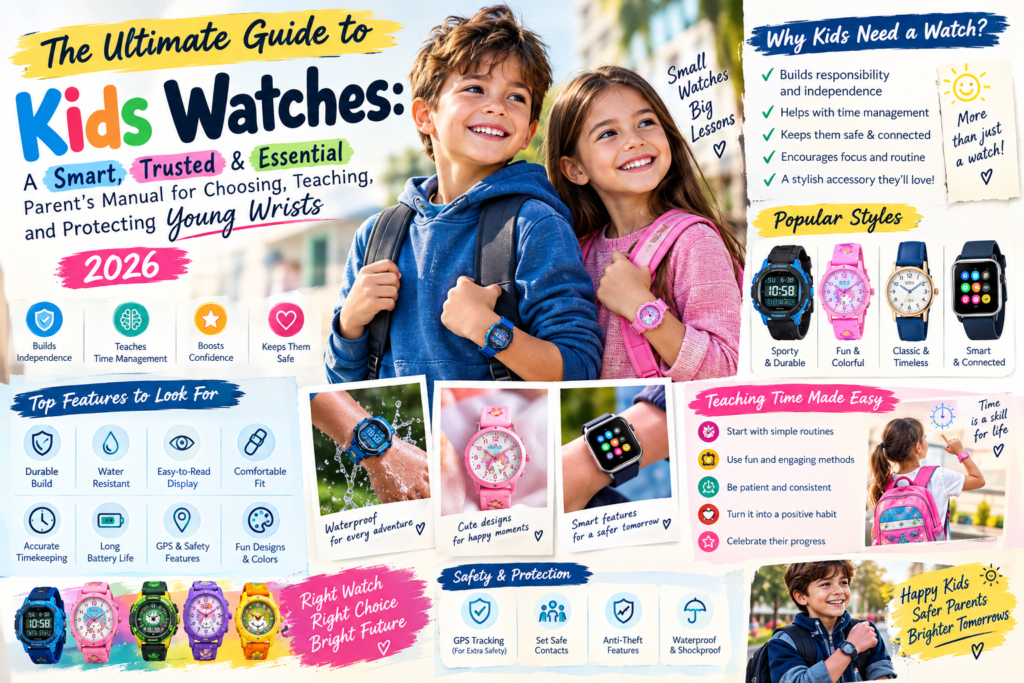
When you are standing in a store aisle or comparing listings online, the feature list can feel endless. Focusing on a few critical dimensions cuts through the clutter. Durability is non-negotiable for children. Kids drop things, bang their wrists against doorframes, and submerge their hands in water without thinking. Look for shockproof resin cases, scratch-resistant acrylic crystals, and water resistance ratings of at least 30 meters, which covers splashes, rain, and hand-washing but not swimming . Silicone or resin straps are preferable to leather or metal because they are comfortable, hypoallergenic, and easy to clean.
Size and fit matter more than you might expect. A watch that is too large will flop around on a small wrist, catch on clothing, and become uncomfortable within minutes. A case diameter of around 30 to 34 millimeters is generally appropriate for children, compared to 40 to 44 millimeters for adult men’s watches . Strap adjustment is equally important. Look for bands with at least eight or nine holes, and check the minimum wrist circumference the strap can accommodate. A watch that slips and slides will end up in a drawer. Many product descriptions include specific wrist measurements from real users, which are far more useful than generic age recommendations .
For smartwatches, the feature set requires more scrutiny. GPS accuracy, battery life, call quality, and parental control options are baseline requirements. But the most important feature is the least visible: the security architecture. Devices from established companies with public security track records are safer than no-name watches sold through third-party marketplaces. The New York Times Wirecutter recommends buying from trusted brands and specifically names the Verizon Gizmo and Apple Watch SE as safer choices for younger and older children respectively .
| Feature | Analog | Digital | Smartwatch |
|---|---|---|---|
| Primary Purpose | Learning time, style | Quick readability, functions | Communication, tracking, safety |
| Best Age Range | 5–10 | 8–12 | 6–14 (supervised) |
| Durability Focus | Case, crystal, strap | Case, battery door | Screen, software, security |
| Water Resistance | 30m minimum | 30m minimum | Varies widely, check rating |
| Parental Control | None needed | None needed | Essential, verify security |
| Distraction Risk | Low | Low to moderate | High, requires boundaries |
| Price Range | Low to moderate | Low | Moderate to high |
Teaching Time-Telling with a Watch
A watch is only useful if the child can read it, and learning to read an analog clock is a genuine cognitive skill that develops over months, not days. The process starts with understanding the parts: the hour hand, the minute hand, the numbers around the dial, and the direction the hands move. Many parents begin by pointing out the clock in their home and relating it to daily routines. “When the big hand reaches the twelve and the little hand is on the seven, it is time to leave for school.”
The next step is connecting the watch to the child’s own experience. A watch that belongs to the child changes the dynamic. They are not just watching a clock on the wall; they are wearing time on their wrist and can check it whenever they want. This ownership motivates practice. Games help: asking the child to announce when five minutes have passed, or challenging them to guess the time before looking. Some watch brands include learning resources, such as printable exercises or interactive apps that reinforce time-telling skills .
Patience is essential. A child who is struggling to distinguish the hour hand from the minute hand is not being difficult. The skill involves integrating spatial position, number recognition, and the conceptual understanding of duration, which is genuinely abstract. Most children need repeated exposure over months before it clicks. The watch becomes a companion in that process, a tangible object that makes the abstract concrete .
Water Resistance, Durability, and Everyday Wear
Children are hard on watches in ways that adults often underestimate. A watch worn by an active seven-year-old will experience sweat, rain, hand-washing, accidental drops, and collisions with playground equipment. Understanding water resistance ratings is the first step in choosing something that will survive. A rating of 3 ATM or 30 meters means the watch can handle splashes and brief immersion, but it is not designed for swimming or showering . If your child swims regularly, you need a higher rating, typically 10 ATM or 100 meters.
Case and crystal materials matter just as much. Resin or plastic cases absorb impact better than metal, which can dent or scratch. Acrylic crystals scratch more easily than mineral glass or sapphire, but they are also more shatter-resistant and cheaper to replace. For young children, a slightly scratched acrylic crystal that has survived a fall is preferable to a shattered sapphire crystal that cracked on impact . Silicone straps are comfortable, easy to clean, and unlikely to cause skin irritation, which is why they dominate the children’s watch market .
Fit deserves attention too. A watch that is too tight will leave marks and feel uncomfortable. One that is too loose will twist around the wrist, making it hard to read and increasing the chance of it catching on something. The strap should sit snugly but allow you to slide a finger underneath. Check the adjustment range before buying, and if your child is between sizes, err on the side of a strap with more holes rather than fewer.
Sizing, Comfort, and Finding the Right Fit
A watch that fits well disappears on the wrist. The child forgets they are wearing it until they need to check the time. A watch that fits poorly becomes a constant source of irritation, and it will spend more time on a dresser than on a wrist. Getting the size right starts with measuring your child’s wrist circumference. A soft measuring tape or a piece of string and a ruler will do. Most children between ages five and twelve have wrists ranging from about 12 to 16 centimeters, though this varies widely.
Case diameter is the next consideration. A watch with a 30-millimeter case will look proportionate on a small wrist, while a 40-millimeter case will look oversized and feel heavy . The strap length must accommodate the wrist with room for adjustment as the child grows. Some watches are designed with this in mind, featuring long straps with many adjustment holes so they can be tightened for a small wrist and loosened as the child grows .
Weight is an often-overlooked factor. A heavy watch on a small wrist becomes tiring to wear, especially for younger children who are not used to the sensation. Lightweight materials like resin, plastic, and silicone keep the overall weight down. A watch that weighs 20 grams or less is unlikely to bother even a sensitive child . If you are choosing between two similar models, the lighter one is almost always the better choice for a first watch.
Safety, Privacy, and Security for Smartwatch Buyers
If you are considering a smartwatch for your child, security cannot be an afterthought. The devices are designed to collect and transmit sensitive data: location, voice, images, and contact information. When that data is not properly protected, the results can be serious. Researchers have shown that some children’s smartwatches can be remotely compromised by attackers who do not need any prior knowledge of the child or the device . The microphone and camera can be activated silently, messages can be intercepted, and emergency contact lists can be modified.
The root of the problem is a supply chain that prioritizes cost over security. Many cheap smartwatches are built on common platforms like SETracker or SinoTrack, which are white-labeled and sold under dozens of brand names. When vulnerabilities are discovered, the companies with the ability to fix them often lack the incentive, and the companies selling the watches lack the technical capability .
The practical takeaway for parents is to buy from established brands with a track record of responding to security issues. Apple, Verizon (Gizmo), and a handful of other reputable manufacturers have demonstrated that they take security seriously. Before purchasing any smartwatch, search for security reviews and check whether the manufacturer has published information about how they handle data and respond to vulnerabilities. The cheapest option is rarely the safest one when a child’s privacy is at stake.
Building Healthy Habits Around Timepieces
A watch can support independence and responsibility, but only if it is introduced with clear expectations. For young children, the watch is a learning tool and a fun accessory. There is no need for strict rules about when to wear it or how often to check it. The goal is familiarity and comfort. As children get older, the watch becomes a practical tool for managing their own schedule. They can check the time before leaving for school, keep track of how long they have been playing outside, and learn to estimate how long tasks take.
Smartwatches require more deliberate boundaries. Many parents find it helpful to establish screen-free times and places: no watches at the dinner table, no messaging during homework hours, no games after a certain time. The watch should serve the child’s needs, not the other way around. If a smartwatch is causing more conflict than convenience, it may be time to reconsider whether the features are genuinely useful or simply adding noise .
There is also value in the simplicity of a non-connected watch. A child who wears a basic analog watch learns to rely on their own judgment about time rather than checking a screen for notifications. They experience the satisfaction of arriving home on time without being tracked. That kind of small independence builds confidence in ways that a GPS ping cannot.
Gift-Worthy Options and Real-World Scenarios
The best kids watches are the ones that match the child’s personality and daily life. A five-year-old who is just learning to read a clock might thrive with a colorful analog watch featuring large, clear numbers and a character they love. A seven-year-old who walks to a friend’s house after school might benefit from a simple digital watch with a reliable alarm. A ten-year-old who takes the bus to extracurricular activities might be ready for a smartwatch with calling and location sharing, provided the security checks out.
Real-world scenarios help illustrate the decision. Consider a family whose eight-year-old daughter has just started walking to school with a neighbor. She does not have a phone, and the parents want to know she has arrived safely. A basic smartwatch with GPS tracking and one-touch calling would serve this purpose without overwhelming her with features. Now consider a six-year-old son who is fascinated by how things work and asks constant questions about time. An analog watch with a visible movement, perhaps even a clear case back, would turn his curiosity into a learning opportunity.
For a child who plays sports, a durable digital watch with a stopwatch and water resistance is practical. For a child who is easily distracted, a simple analog watch removes the temptation of games and notifications. The right choice depends on the child, not on a universal recommendation.
Maintenance, Battery Life, and Long-Term Care
A kids watch takes more abuse than an adult watch, which means it needs more attention. Battery life varies by type. Analog quartz watches typically last one to three years on a battery, and replacements are inexpensive. Digital watches often last two to five years. Smartwatches need charging every few days, sometimes daily, depending on usage. A dead smartwatch is useless for safety purposes, so battery life should be a major consideration if the watch is intended for communication.
Cleaning is straightforward for most children’s watches. A wipe with a damp cloth removes sweat and dirt from the case and strap. Silicone straps can be washed with mild soap and water. Avoid submerging the watch unless the water resistance rating specifically allows it. Check the strap regularly for cracks or stretching, especially where it connects to the case. A strap that fails suddenly can send the watch flying off a wrist at an inconvenient moment.
For analog watches, the crystal will eventually accumulate scratches. Minor scratches can sometimes be polished out with a plastic polish, but deep scratches may require replacement. For digital and smartwatches, screen protectors are available and worth considering, especially for active children. A cracked screen on a smartwatch often means the device is no longer usable, while a scratched acrylic crystal on an analog watch is a cosmetic issue at worst.
Frequently Asked Questions
What age is appropriate for a child’s first watch?
Most children are ready for a first watch between ages five and seven, when they begin learning to tell time and develop enough responsibility to keep track of a personal item . Children as young as three can wear a watch as a toy to become familiar with the concept, but it will not serve a practical timekeeping function until they can read the dial or display. The ideal moment is when the child shows interest and has situations where knowing the time independently would be helpful, such as getting ready for school or coming home before dark.
Should I choose an analog or digital watch for a beginner?
For a first watch, analog is generally recommended because it teaches the fundamental concept of time as a continuous flow rather than a series of discrete numbers . Analog clocks help children understand fractions, spatial relationships, and the passage of time in ways that digital displays do not. Once the child has mastered reading an analog clock, usually around age eight or later, a digital watch becomes a practical upgrade for sports, travel, or everyday convenience.
Are kids smartwatches safe for children?
Safety depends entirely on the specific device and manufacturer. Many low-cost smartwatches have demonstrated serious security vulnerabilities that allow unauthorized access to location data, microphone, and camera . Reputable brands with established security practices are significantly safer. Before buying, research the manufacturer’s security track record, check for recent vulnerability reports, and consider whether the benefits of connectivity outweigh the risks for your child’s age and maturity level.
How do I know what size watch will fit my child?
Measure your child’s wrist circumference with a soft tape or a piece of string. Most children’s watches accommodate wrists from about 12 to 16 centimeters. Check the product specifications for the strap’s minimum and maximum circumference, and read user reviews for real-world fit feedback. A case diameter of 30 to 34 millimeters is generally appropriate for children, and straps with at least eight adjustment holes provide room to grow. When in doubt, a slightly smaller and lighter watch is more comfortable for a child than an oversized one.
What features should I look for in a durable kids watch?
Prioritize shock resistance, water resistance of at least 30 meters, and a comfortable, adjustable strap made from silicone or resin . Acrylic crystals are more shatter-resistant than glass, even if they scratch more easily. For analog watches, look for clear, readable dials with distinct hour and minute hands. For digital and smartwatches, check battery life, ease of use, and whether the interface is appropriate for the child’s age. Avoid unnecessary features that add complexity without adding value.
Conclusion
The final insight is this: a kids watch is not a miniature adult watch, and it should not be treated as one. It is a developmental tool, a safety consideration, and a statement of trust all at once. Choose it with the same care you would give to a first bicycle or a first library card, and it will earn its place on that small wrist.
A kids watch is so much more than a miniature timepiece strapped to a small wrist. It is a milestone gift, a learning tool, a safety device, and sometimes a source of genuine parental anxiety. Walk into any store or scroll through any online marketplace and you will find an overwhelming spectrum: cheerful analog faces with cartoon characters, rugged digital displays built for playground punishment, and smartwatches that promise to keep your child connected and tracked at all times.
That variety is both a blessing and a curse. The right kids watch can help a child grasp the abstract concept of time, develop independence, and even stay safer during the walk home from school. The wrong one can become a distraction in class, a target for hackers, or simply an expensive piece of plastic that sits in a drawer after two weeks. This guide is designed to cut through the noise. Drawing on manufacturer guidance, security research, and real-world parenting experience, it walks through everything that actually matters when you are choosing a timepiece for a child.
You will learn which watch types suit which ages, how to evaluate durability and safety, what security researchers have discovered about smartwatch vulnerabilities, and how to teach a child to actually read an analog clock. By the end, you will have a clear framework for making a decision that fits your child, your budget, and your peace of mind.
Understanding the Three Main Types of Kids Watches
The world of children’s timepieces splits into three broad categories, and each serves a fundamentally different purpose. Analog quartz watches use traditional hour and minute hands driven by a battery-powered quartz movement. They are simple, durable, and widely recommended as a first watch because they visually represent the passage of time in a way digital displays cannot match . A child watching a minute hand sweep around the dial develops an intuitive sense of duration, fractions, and the relationship between “now” and “later.”
Digital watches display time as numbers, often with additional functions like alarms, stopwatches, calendars, and sometimes calculators. They are easier to read at a glance, which makes them appealing for younger children or those who struggle with analog comprehension. However, because they show only the current moment without visual context, they do not build the same spatial-temporal understanding . Smartwatches for children represent the third category: internet-connected devices with GPS tracking, calling, messaging, and sometimes cameras, games, and social features. They solve a real problem for parents who want to stay in contact with a child who is beginning to move through the world independently, but they introduce a host of new considerations around security, distraction, and healthy screen habits .
The choice between these categories is not about which is objectively best. It is about matching the tool to the developmental stage and the family’s needs.
When Is a Child Ready for Their First Watch
The question of readiness has two dimensions: chronological age and developmental maturity. Most children begin to understand the basic concept of time around age five, when kindergarten introduces calendars and daily schedules . They may grasp that “snack time” comes after “story time” and that a long hand pointing at the twelve means something significant. Full mastery of reading an analog clock, however, typically arrives between ages seven and eight . Before that, a watch functions more as a toy and a symbol of growing up than as a practical timekeeping tool.
Age alone should not be the deciding factor. A responsible six-year-old who walks to a neighbor’s house alone might benefit enormously from a simple watch that helps them return home on time. A distracted nine-year-old who loses everything might need a cheaper, more durable option before graduating to something nicer. The real question is whether the child can take care of the object and whether they have situations where knowing the time independently would genuinely help them .
There is also a powerful symbolic value in the first watch. Many parents describe the moment as a rite of passage, similar to getting a first bicycle or a first library card. The child feels trusted and grown-up, and that feeling can motivate them to take the responsibility seriously .
Analog vs. Digital: Why the Classic Face Still Matters
The analog-versus-digital debate is more consequential for children than for adults. Digital clocks tell you what time it is right now. Analog clocks show you where you are in the flow of time, how much has passed, and how much remains . That distinction may sound philosophical, but it has practical educational value. A child looking at an analog watch sees that the minute hand has traveled a quarter of the way around the dial, which means fifteen minutes have passed since they started their homework. That visual representation builds number sense and spatial reasoning in ways that a changing digit display cannot replicate .
Educational researchers have found that children taught to read analog clocks often develop stronger spatial perception and mathematical intuition. The clock face becomes a circular number line, and reading it requires integrating position, proportion, and direction. These are foundational skills that support later learning in geometry, fractions, and even music .
This does not mean digital watches are useless for children. Once a child has mastered analog time-telling, a digital watch becomes a legitimate upgrade, especially for sports, outdoor activities, or situations where quick readability matters. But for the first watch, most manufacturers and educators recommend starting with analog . Brands like Flik Flak and Lorus have built entire product lines around this principle, designing colorful, durable analog watches specifically for the learning stage .
Smartwatches for Kids: Benefits and the Hidden Risks
Kids smartwatches occupy a strange middle ground between toy, tool, and surveillance device. For parents, the appeal is obvious. A GPS-enabled watch with calling capability means you can reach your child after school, see where they are on a map, and set safe zones that trigger alerts if they wander too far . For children, the appeal is equally clear: a gadget on their wrist that looks like what the older kids have, often with games, step counters, and the ability to send emoji to friends.
The benefits are real for families who use them thoughtfully. A child walking to school for the first time, a family with two working parents who need to coordinate pickup, or a child with a long bus commute can all benefit from the communication and location features . But the risks are equally real, and they fall into two categories: security and behavioral.
Security researchers have demonstrated that many low-cost children’s smartwatches contain serious vulnerabilities. In a comprehensive analysis presented at the ACM Asia Conference on Computer and Communications Security, researchers found attack vectors including command injection, passive message decryption, and unauthorized device enrollment across multiple market-dominant platforms . In practical terms, this means a hacker could potentially track a child’s location, intercept messages, or even activate the microphone and camera without any indication to the user . The supply chain problem is structural: manufacturers operate on thin margins, resellers profit most, and no single party has both the incentive and the ability to fix security flaws .
The behavioral concerns are just as significant. Many children’s smartwatches have evolved into miniature smartphones, with social features, games, payment systems, and content that can distract from school and family life. Teachers report students secretly playing with watches during class. Some platforms use social pressure, like friend counts and step rankings, to drive engagement in ways that mirror the addictive patterns of adult social media . The result is a device that was marketed as a safety tool becoming a source of conflict and distraction.
Key Features to Evaluate Before You Buy
When you are standing in a store aisle or comparing listings online, the feature list can feel endless. Focusing on a few critical dimensions cuts through the clutter. Durability is non-negotiable for children. Kids drop things, bang their wrists against doorframes, and submerge their hands in water without thinking. Look for shockproof resin cases, scratch-resistant acrylic crystals, and water resistance ratings of at least 30 meters, which covers splashes, rain, and hand-washing but not swimming . Silicone or resin straps are preferable to leather or metal because they are comfortable, hypoallergenic, and easy to clean.
Size and fit matter more than you might expect. A watch that is too large will flop around on a small wrist, catch on clothing, and become uncomfortable within minutes. A case diameter of around 30 to 34 millimeters is generally appropriate for children, compared to 40 to 44 millimeters for adult men’s watches . Strap adjustment is equally important. Look for bands with at least eight or nine holes, and check the minimum wrist circumference the strap can accommodate. A watch that slips and slides will end up in a drawer. Many product descriptions include specific wrist measurements from real users, which are far more useful than generic age recommendations .
For smartwatches, the feature set requires more scrutiny. GPS accuracy, battery life, call quality, and parental control options are baseline requirements. But the most important feature is the least visible: the security architecture. Devices from established companies with public security track records are safer than no-name watches sold through third-party marketplaces. The New York Times Wirecutter recommends buying from trusted brands and specifically names the Verizon Gizmo and Apple Watch SE as safer choices for younger and older children respectively .
| Feature | Analog | Digital | Smartwatch |
|---|---|---|---|
| Primary Purpose | Learning time, style | Quick readability, functions | Communication, tracking, safety |
| Best Age Range | 5–10 | 8–12 | 6–14 (supervised) |
| Durability Focus | Case, crystal, strap | Case, battery door | Screen, software, security |
| Water Resistance | 30m minimum | 30m minimum | Varies widely, check rating |
| Parental Control | None needed | None needed | Essential, verify security |
| Distraction Risk | Low | Low to moderate | High, requires boundaries |
| Price Range | Low to moderate | Low | Moderate to high |
Teaching Time-Telling with a Watch
A watch is only useful if the child can read it, and learning to read an analog clock is a genuine cognitive skill that develops over months, not days. The process starts with understanding the parts: the hour hand, the minute hand, the numbers around the dial, and the direction the hands move. Many parents begin by pointing out the clock in their home and relating it to daily routines. “When the big hand reaches the twelve and the little hand is on the seven, it is time to leave for school.”
The next step is connecting the watch to the child’s own experience. A watch that belongs to the child changes the dynamic. They are not just watching a clock on the wall; they are wearing time on their wrist and can check it whenever they want. This ownership motivates practice. Games help: asking the child to announce when five minutes have passed, or challenging them to guess the time before looking. Some watch brands include learning resources, such as printable exercises or interactive apps that reinforce time-telling skills .
Patience is essential. A child who is struggling to distinguish the hour hand from the minute hand is not being difficult. The skill involves integrating spatial position, number recognition, and the conceptual understanding of duration, which is genuinely abstract. Most children need repeated exposure over months before it clicks. The watch becomes a companion in that process, a tangible object that makes the abstract concrete .
Water Resistance, Durability, and Everyday Wear
Children are hard on watches in ways that adults often underestimate. A watch worn by an active seven-year-old will experience sweat, rain, hand-washing, accidental drops, and collisions with playground equipment. Understanding water resistance ratings is the first step in choosing something that will survive. A rating of 3 ATM or 30 meters means the watch can handle splashes and brief immersion, but it is not designed for swimming or showering . If your child swims regularly, you need a higher rating, typically 10 ATM or 100 meters.
Case and crystal materials matter just as much. Resin or plastic cases absorb impact better than metal, which can dent or scratch. Acrylic crystals scratch more easily than mineral glass or sapphire, but they are also more shatter-resistant and cheaper to replace. For young children, a slightly scratched acrylic crystal that has survived a fall is preferable to a shattered sapphire crystal that cracked on impact . Silicone straps are comfortable, easy to clean, and unlikely to cause skin irritation, which is why they dominate the children’s watch market .
Fit deserves attention too. A watch that is too tight will leave marks and feel uncomfortable. One that is too loose will twist around the wrist, making it hard to read and increasing the chance of it catching on something. The strap should sit snugly but allow you to slide a finger underneath. Check the adjustment range before buying, and if your child is between sizes, err on the side of a strap with more holes rather than fewer.
Sizing, Comfort, and Finding the Right Fit
A watch that fits well disappears on the wrist. The child forgets they are wearing it until they need to check the time. A watch that fits poorly becomes a constant source of irritation, and it will spend more time on a dresser than on a wrist. Getting the size right starts with measuring your child’s wrist circumference. A soft measuring tape or a piece of string and a ruler will do. Most children between ages five and twelve have wrists ranging from about 12 to 16 centimeters, though this varies widely.
Case diameter is the next consideration. A watch with a 30-millimeter case will look proportionate on a small wrist, while a 40-millimeter case will look oversized and feel heavy . The strap length must accommodate the wrist with room for adjustment as the child grows. Some watches are designed with this in mind, featuring long straps with many adjustment holes so they can be tightened for a small wrist and loosened as the child grows .
Weight is an often-overlooked factor. A heavy watch on a small wrist becomes tiring to wear, especially for younger children who are not used to the sensation. Lightweight materials like resin, plastic, and silicone keep the overall weight down. A watch that weighs 20 grams or less is unlikely to bother even a sensitive child . If you are choosing between two similar models, the lighter one is almost always the better choice for a first watch.
Safety, Privacy, and Security for Smartwatch Buyers
If you are considering a smartwatch for your child, security cannot be an afterthought. The devices are designed to collect and transmit sensitive data: location, voice, images, and contact information. When that data is not properly protected, the results can be serious. Researchers have shown that some children’s smartwatches can be remotely compromised by attackers who do not need any prior knowledge of the child or the device . The microphone and camera can be activated silently, messages can be intercepted, and emergency contact lists can be modified.
The root of the problem is a supply chain that prioritizes cost over security. Many cheap smartwatches are built on common platforms like SETracker or SinoTrack, which are white-labeled and sold under dozens of brand names. When vulnerabilities are discovered, the companies with the ability to fix them often lack the incentive, and the companies selling the watches lack the technical capability .
The practical takeaway for parents is to buy from established brands with a track record of responding to security issues. Apple, Verizon (Gizmo), and a handful of other reputable manufacturers have demonstrated that they take security seriously. Before purchasing any smartwatch, search for security reviews and check whether the manufacturer has published information about how they handle data and respond to vulnerabilities. The cheapest option is rarely the safest one when a child’s privacy is at stake.
Building Healthy Habits Around Timepieces
A watch can support independence and responsibility, but only if it is introduced with clear expectations. For young children, the watch is a learning tool and a fun accessory. There is no need for strict rules about when to wear it or how often to check it. The goal is familiarity and comfort. As children get older, the watch becomes a practical tool for managing their own schedule. They can check the time before leaving for school, keep track of how long they have been playing outside, and learn to estimate how long tasks take.
Smartwatches require more deliberate boundaries. Many parents find it helpful to establish screen-free times and places: no watches at the dinner table, no messaging during homework hours, no games after a certain time. The watch should serve the child’s needs, not the other way around. If a smartwatch is causing more conflict than convenience, it may be time to reconsider whether the features are genuinely useful or simply adding noise .
There is also value in the simplicity of a non-connected watch. A child who wears a basic analog watch learns to rely on their own judgment about time rather than checking a screen for notifications. They experience the satisfaction of arriving home on time without being tracked. That kind of small independence builds confidence in ways that a GPS ping cannot.
Gift-Worthy Options and Real-World Scenarios
The best kids watches are the ones that match the child’s personality and daily life. A five-year-old who is just learning to read a clock might thrive with a colorful analog watch featuring large, clear numbers and a character they love. A seven-year-old who walks to a friend’s house after school might benefit from a simple digital watch with a reliable alarm. A ten-year-old who takes the bus to extracurricular activities might be ready for a smartwatch with calling and location sharing, provided the security checks out.
Real-world scenarios help illustrate the decision. Consider a family whose eight-year-old daughter has just started walking to school with a neighbor. She does not have a phone, and the parents want to know she has arrived safely. A basic smartwatch with GPS tracking and one-touch calling would serve this purpose without overwhelming her with features. Now consider a six-year-old son who is fascinated by how things work and asks constant questions about time. An analog watch with a visible movement, perhaps even a clear case back, would turn his curiosity into a learning opportunity.
For a child who plays sports, a durable digital watch with a stopwatch and water resistance is practical. For a child who is easily distracted, a simple analog watch removes the temptation of games and notifications. The right choice depends on the child, not on a universal recommendation.
Maintenance, Battery Life, and Long-Term Care
A kids watch takes more abuse than an adult watch, which means it needs more attention. Battery life varies by type. Analog quartz watches typically last one to three years on a battery, and replacements are inexpensive. Digital watches often last two to five years. Smartwatches need charging every few days, sometimes daily, depending on usage. A dead smartwatch is useless for safety purposes, so battery life should be a major consideration if the watch is intended for communication.
Cleaning is straightforward for most children’s watches. A wipe with a damp cloth removes sweat and dirt from the case and strap. Silicone straps can be washed with mild soap and water. Avoid submerging the watch unless the water resistance rating specifically allows it. Check the strap regularly for cracks or stretching, especially where it connects to the case. A strap that fails suddenly can send the watch flying off a wrist at an inconvenient moment.
For analog watches, the crystal will eventually accumulate scratches. Minor scratches can sometimes be polished out with a plastic polish, but deep scratches may require replacement. For digital and smartwatches, screen protectors are available and worth considering, especially for active children. A cracked screen on a smartwatch often means the device is no longer usable, while a scratched acrylic crystal on an analog watch is a cosmetic issue at worst.
Frequently Asked Questions
What age is appropriate for a child’s first watch?
Most children are ready for a first watch between ages five and seven, when they begin learning to tell time and develop enough responsibility to keep track of a personal item . Children as young as three can wear a watch as a toy to become familiar with the concept, but it will not serve a practical timekeeping function until they can read the dial or display. The ideal moment is when the child shows interest and has situations where knowing the time independently would be helpful, such as getting ready for school or coming home before dark.
Should I choose an analog or digital watch for a beginner?
For a first watch, analog is generally recommended because it teaches the fundamental concept of time as a continuous flow rather than a series of discrete numbers . Analog clocks help children understand fractions, spatial relationships, and the passage of time in ways that digital displays do not. Once the child has mastered reading an analog clock, usually around age eight or later, a digital watch becomes a practical upgrade for sports, travel, or everyday convenience.
Are kids smartwatches safe for children?
Safety depends entirely on the specific device and manufacturer. Many low-cost smartwatches have demonstrated serious security vulnerabilities that allow unauthorized access to location data, microphone, and camera . Reputable brands with established security practices are significantly safer. Before buying, research the manufacturer’s security track record, check for recent vulnerability reports, and consider whether the benefits of connectivity outweigh the risks for your child’s age and maturity level.
How do I know what size watch will fit my child?
Measure your child’s wrist circumference with a soft tape or a piece of string. Most children’s watches accommodate wrists from about 12 to 16 centimeters. Check the product specifications for the strap’s minimum and maximum circumference, and read user reviews for real-world fit feedback. A case diameter of 30 to 34 millimeters is generally appropriate for children, and straps with at least eight adjustment holes provide room to grow. When in doubt, a slightly smaller and lighter watch is more comfortable for a child than an oversized one.
What features should I look for in a durable kids watch?
Prioritize shock resistance, water resistance of at least 30 meters, and a comfortable, adjustable strap made from silicone or resin . Acrylic crystals are more shatter-resistant than glass, even if they scratch more easily. For analog watches, look for clear, readable dials with distinct hour and minute hands. For digital and smartwatches, check battery life, ease of use, and whether the interface is appropriate for the child’s age. Avoid unnecessary features that add complexity without adding value.
Conclusion
The final insight is this: a kids watch is not a miniature adult watch, and it should not be treated as one. It is a developmental tool, a safety consideration, and a statement of trust all at once. Choose it with the same care you would give to a first bicycle or a first library card, and it will earn its place on that small wrist.


