

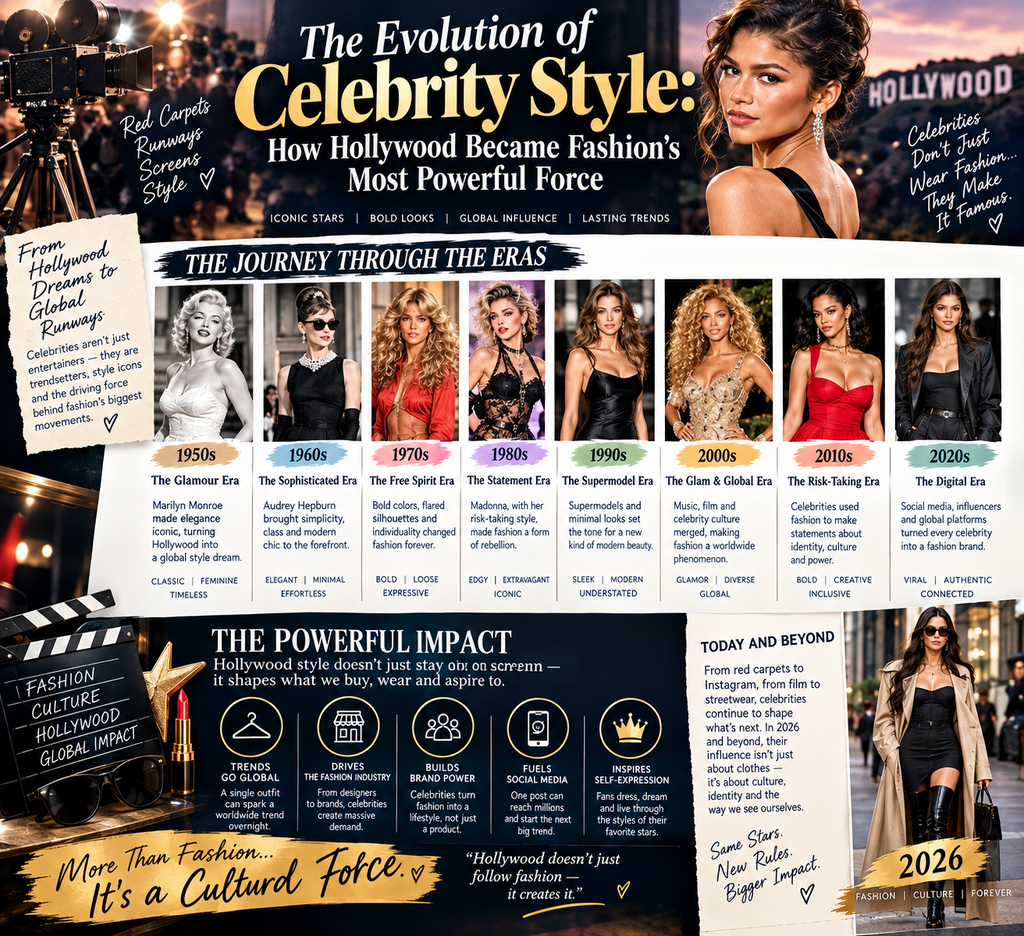
Celebrity style has always held a mirror to our cultural obsessions, but in 2026, the reflection has never been sharper or more immediate. The days when a star’s wardrobe was confined to red-carpet premieres and award shows are long gone. Today, the most talked-about fashion moments happen in airports, on coffee runs, and during press tours that stretch across continents. Paparazzi images circulate within seconds, fan accounts dissect every stitch, and stylists have become as famous as the clients they dress. The line between off-duty and on-duty has essentially dissolved, creating a continuous feed of outfit inspiration that shapes how millions of people dress every single day.
What makes this moment so fascinating is that celebrity style is no longer just about aspiration. It’s about storytelling, self-expression, and in many cases, a calculated form of visual marketing. When Zendaya steps out in an archival gown that subtly references the film she’s promoting, she’s not just wearing clothes—she’s building a narrative . When Kendall Jenner tucks a paperback into her designer bag, she’s transforming literature into a status symbol . And when male celebrities like Bad Bunny or Jacob Elordi wear pieces from luxury womenswear houses, they’re actively reshaping what gendered fashion even means . Understanding celebrity style in 2026 requires looking beyond the surface and recognizing the machinery beneath.
The Stylist as Creative Director and Cultural Architect
The most significant shift in celebrity style over the past decade is the elevated role of the stylist. These professionals are no longer simply pulling dresses for premieres. They are brand architects, image consultants, and in many cases, the creative force behind a celebrity’s entire public identity. Karla Welch, who has worked with everyone from Justin Bieber to Tracee Ellis Ross, describes her approach as tapping into her clients’ individual styles rather than imposing a singular aesthetic. “I think I’m known for really tapping into my clients’ individual styles,”
Method Dressing and the Rise of Meta Narratives
Method dressing—the practice of wearing clothes that thematically echo a film or character—has become the dominant red-carpet strategy of 2026. Zendaya and her longtime stylist Law Roach have elevated this to an art form, building entire visual worlds across press tours that give fans a new reference to decode with every appearance . During the Spider-Man: Brand New Day promotional run, Zendaya wore a vintage John Galliano dress from Spring/Summer 1997 featuring a silver spider web motif, followed by an archival Versace outfit that reimagined the superhero’s red-and-blue suit in sparkling two-piece form . For The Odyssey, she shifted gears entirely, wearing a fluid Trussardi maxi dress with studded patchwork that evoked ancient Greek aesthetics without resorting to costume .
Archival Fashion and the Quest for Cultural Literacy
The most covetable celebrity style moments of 2026 share a common thread: they’ve made history before. Archival fashion has become the ultimate symbol of taste, exclusivity, and cultural knowledge. Vintage creations from legendary houses like Versace, John Galliano, and Alexander McQueen are now the go-to choices for stylists seeking to make a statement that transcends fleeting trends . When Kylie Jenner opted for an archival halter dress that debuted on a Gucci by Tom Ford runway over 25 years ago for a 2026 launch event, she sent a clear message: this is fashion that matters .
The Blurring Lines of Gender and the Rise of Male Muses
One of the most compelling developments in celebrity style is the increasing visibility of male celebrities as muses for luxury womenswear brands. Jacob Elordi, Bad Bunny, A$AP Rocky, Pedro Pascal, and Kendrick Lamar have all been dressed by houses that traditionally focus on women’s collections, and the results have been commercially and culturally significant .
Designer Shweta Kapur of label 431-88 sees this as a natural evolution rather than a gimmick. “When Chanel or Schiaparelli dress someone like Pedro Pascal or Kendrick Lamar or Bad Bunny, it’s not about pushing menswear,” she says. “It’s about reframing their house codes through a different lens. Tweed, couture embroidery, sharp tailoring—on a male celebrity, it suddenly feels less archival and more current” . There’s also a commercial logic at play. Male celebrities often have enormous followings that span both male and female fans, making them efficient vehicles for brand exposure. And as Kapur notes.
The Press Tour as the New Red Carpet
The red carpet used to be the ultimate arbiter of celebrity style. Now, the press tour has stolen that crown. With off-duty wardrobes under constant paparazzi scrutiny and social media demanding a rolling supply of outfit inspiration, the looks celebrities wear between premieres—to interviews, airport departures, and coffee runs—often generate more engagement than the gowns they wear to the events themselves . This shift has fundamentally changed how stylists approach their work. They’re no longer just planning for a handful of red-carpet moments; they’re building a continuous narrative that unfolds over weeks or months of promotion.
The Book as Accessory and the Intellectual Turn
This literary turn isn’t just about aesthetics. It reflects a broader desire for substance in an era of surface-level engagement. Brands have noticed. Saint Laurent operates a brutalist bookstore in Paris called Babylone, and its holiday campaign featured short films inspired by Proust . Miu Miu hosts literary salons, and Chanel created a Literary Rendezvous at its Paris headquarters in collaboration with Charlotte Casiraghi . When a celebrity is photographed with a book, they’re signaling curiosity, depth, and a life beyond the red carpet. In a culture saturated with images, the book offers a different kind of currency: the suggestion that there’s more to this person than what meets the eye.
The New Style Tribes and the Rejection of Algorithmic Sameness
What unites these tribes is a shared rejection of the old top-down model where a single runway trend trickled down to the masses. Today, influence flows in multiple directions, and celebrity style is just one current among many. But it remains an exceptionally powerful one. When a celebrity wears something, it enters the cultural conversation in a way that a runway look rarely does. The personal connection—the sense that this is a real person making a choice—gives celebrity fashion an emotional resonance that advertising can’t replicate. That’s why the most successful brands in 2026 aren’t just dressing celebrities; they’re building long-term relationships with them, treating them as creative partners rather than walking billboards.
A Table of Defining Celebrity Style Moments in 2026
| Celebrity | Key Style Moment | Cultural Impact |
|---|---|---|
| Zendaya | Archival Galliano and Versace for Spider-Man press tour | Elevated method dressing into a narrative art form |
| Bad Bunny | Custom Schiaparelli tuxedo at the Grammys | Generated $9.2M in MIV; first menswear look for the house |
| Kendall Jenner | Chanel ensembles paired with literary titles | Normalized the book as a fashion accessory |
| Blake Lively | Minimalist black jeans and trench coat | Signaled the end of maximalist denim and a turn toward restraint |
| Lady Gaga | Alexander McQueen archival pieces at the Grammys | Reinforced the cultural value of fashion history |
| Milly Alcock | Mixed neutrals with flip-flops and oversized sunnies | Demonstrated how to combine multiple trends effortlessly |
The Problem of Overexposure and the Solution of Substance
For all its influence, celebrity style faces a growing problem: overexposure. When every airport look, every gym run, and every coffee outing is documented and dissected, the mystique that once made celebrities compelling begins to erode. Audiences become desensitized. The solution, increasingly, is substance. The most resonant celebrity style moments of 2026 are those that come with a story, a reference, or a point of view. It’s not enough to wear a beautiful dress; you need to have a reason for wearing it. This is why method dressing works when it’s executed with nuance. It gives the audience something to decode, a puzzle to solve, a narrative to follow. It transforms a photo into a story.
The same principle applies to the literary accessory trend. A book isn’t just a book; it’s a window into a celebrity’s inner life, real or curated. It signals that there’s more happening beneath the surface than the paparazzi can capture. For stylists and publicists, the challenge is to create moments that feel authentic rather than manufactured. The audience has become remarkably adept at detecting performative behavior, and the penalty for inauthenticity is swift. The celebrities who succeed in this environment are those who treat fashion as an extension of their genuine interests and personality, not as a costume they put on for public consumption.
The Global Reach of Celebrity Style and Its Local Interpretations
This globalization has implications for how brands approach celebrity partnerships. A single global ambassador may no longer be sufficient to reach diverse audiences. Instead, brands are building rosters of regional ambassadors who can speak authentically to local consumers while maintaining a consistent brand identity. The most successful campaigns of 2026 recognize that celebrity style is context-dependent. A look that generates millions of impressions in one market might generate indifference in another. Understanding these nuances is essential for anyone hoping to leverage celebrity influence effectively.
FAQ
What Defines Celebrity Style in 2026
Celebrity style in 2026 is defined by a blend of accessibility, narrative, and cultural literacy. The press tour has eclipsed the red carpet as the primary stage for fashion moments, and stylists have become central creative figures. Archival fashion, method dressing, and the rise of male muses for womenswear are all hallmarks of the current landscape. Perhaps most importantly, celebrity style now functions as a form of continuous storytelling, with every outfit contributing to a larger narrative about who the celebrity is and what they represent.
Why Are Celebrities Wearing Archival Fashion
Archival fashion offers a combination of exclusivity, cultural credibility, and narrative richness that contemporary pieces often lack. When a celebrity wears a vintage design from a legendary house, they’re connecting themselves to a specific moment in fashion history and demonstrating a level of taste and knowledge that resonates with discerning audiences. Archival pieces also create social media engagement opportunities, as fans research the original collection and share their findings. This trend reflects a broader cultural appreciation for craftsmanship and sustainability, positioning archival fashion as both an aesthetic choice and a values statement.
How Has the Role of Celebrity Stylists Changed
Celebrity stylists have evolved from behind-the-scenes service providers to prominent creative directors who shape public personas and brand narratives. They now oversee not just red-carpet looks but complete press tour wardrobes, street style moments, and commercial partnerships. The most successful stylists, like Karla Welch and Law Roach, have become brands in their own right, with influence that extends across the fashion industry. This elevation reflects the increased importance of visual identity in an era where social media engagement is a primary measure of success.
What Is Method Dressing and Is It Effective
Method dressing is the practice of wearing clothing that thematically references a film, character, or project being promoted. When executed well, it creates a cohesive visual narrative that engages audiences and generates media coverage. Zendaya’s press tours are the gold standard, with each look contributing to a larger story. However, method dressing can fail when it becomes too literal or costume-like. The most effective approach, often called meta dressing, uses subtle references and sophisticated interpretations rather than direct replication of character costumes.
How Do Male Celebrities Influence Womenswear Brands
Male celebrities have become increasingly important muses for luxury womenswear houses, driving significant media value and expanding brand narratives. When Bad Bunny wore custom Schiaparelli or Jacob Elordi carried a Chanel bag, they generated millions in earned media and introduced these brands to new audiences. This trend reflects a broader cultural shift toward fluidity in fashion, where garments are increasingly marketed and worn without strict gender boundaries. For brands, partnering with male celebrities offers access to massive, engaged followings and positions them as culturally progressive.
Conclusion
Celebrity style has never been more influential or more complex. What was once a straightforward system of red-carpet gowns and awards-season glamour has evolved into a continuous, multi-platform narrative that shapes how millions of people think about clothing, identity, and self-expression. The most powerful celebrity style moments of 2026 are those that combine visual impact with narrative depth—a Zendaya archival look that references her film’s themes, a Bad Bunny Schiaparelli suit that challenges gendered fashion norms, a Kendall Jenner book that transforms a paperback into a status symbol. These moments work because they’re not just about clothes. They’re about culture, history, and the ongoing conversation between celebrity and audience.
The final takeaway is this: celebrity style matters because it offers a window into how we collectively negotiate questions of identity, aspiration, and belonging. When we follow what celebrities wear, we’re not just admiring beautiful garments. We’re participating in a shared cultural language, one that evolves with every press tour, every paparazzi photo, and every viral outfit. The celebrities who understand this—and the stylists who guide them—are the ones who will continue to shape what we wear and how we see ourselves. Celebrity style is not frivolous. It’s a mirror, and in 2026, it’s reflecting a world that’s more fluid, more narrative-driven, and more interconnected than ever before.