
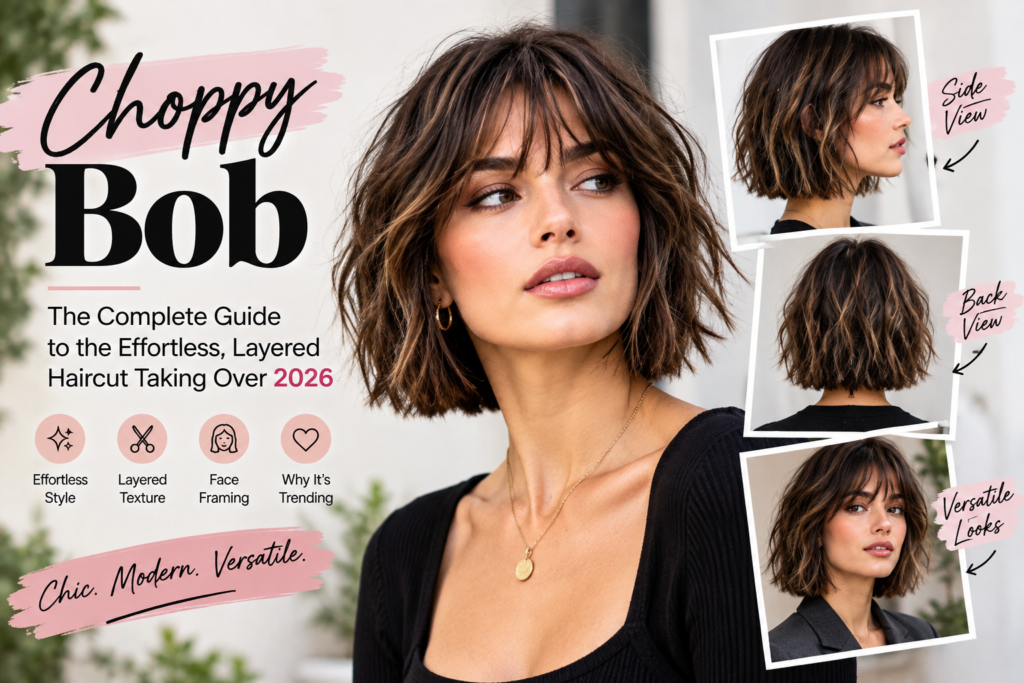

The choppy bob has become the defining haircut of 2026, and for good reason. It represents a deliberate departure from the polished, structured bobs that dominated previous seasons, embracing instead a lived-in, textural quality that feels both modern and refreshingly attainable. Characterized by irregular layers and softened, uneven ends, this cut creates movement and volume in ways that sleeker styles simply cannot match. It is the haircut equivalent of a perfectly rumpled linen shirt—intentional in its construction, yet entirely relaxed in its presentation .
What sets the choppy bob apart from its blunt counterpart is philosophical as much as technical. Where a blunt bob demands precision and maintenance, the choppy bob thrives on a certain amount of controlled chaos. The layers are cut to look deliberately uneven, creating a tousled effect that reads as effortless rather than unkempt. This quality has made it particularly appealing to busy professionals who want a stylish cut without the daily styling commitment. As hairstylist Mehria Aziz told InStyle, it is “a great short haircut if you’re looking for something playful, sexy, and fresh-looking that adds movement, definition, and volume to your hair” .
What Exactly Is a Choppy Bob and How Does It Differ from Other Bob Styles
A choppy bob is a layered, chin-to-shoulder-length haircut featuring intentionally irregular, textured ends that create volume and movement. Unlike a classic blunt bob, which is defined by a clean, straight edge and uniform length, the choppy bob embraces graduated layers and point-cut or razor-cut ends to achieve a softer, more relaxed silhouette . The technique involves cutting into the ends rather than straight across, which removes weight and allows the hair to fall in a more organic, less rigid manner.
| Feature | Choppy Bob | Blunt Bob |
|---|---|---|
| Cutting Technique | Point cutting, razor work, graduated layers | Straight across, one-length |
| End Texture | Irregular, piecey, softened | Clean, sharp, uniform |
| Primary Benefit | Volume, movement, texture | Density, shine, precision |
| Styling Time | Minimal; air-dry friendly | Requires smooth blow-dry |
| Grow-Out Period | Forgiving; layers blend naturally | Demands frequent trims |
| Best For | Fine to medium hair; those wanting volume | Thick, straight hair; sleek aesthetic |
The Enduring Appeal and Cultural History of the Choppy Bob
The choppy bob is not a new invention. Its roots stretch back to the late 1970s and early 1980s, when Debbie Harry of Blondie wore a peroxide, texturized cut that became a defining image of the era’s new wave aesthetic . Her version featured undone movement, statement layers, and a chopped fringe that felt rebellious and refreshingly unpolished. This was a bob that rejected the salon-perfect finish in favor of something more raw and expressive.
The style experienced a significant resurgence in the early 1990s, championed by figures like Winona Ryder, whose chin-length, snipped cut became a touchstone for the grunge-adjacent fashion of the time . The choppy bob has continued to evolve through subsequent decades, appearing in various forms on celebrities ranging from Natalie Portman to Jenna Ortega, each bringing their own interpretation to the cut . What makes its current iteration distinctive is the emphasis on personalization and wearability. As Mark Hayes, International Creative Director at VIDAL SASSOON, noted, the modern choppy bob is continuously evolving, with variations like the shaggy bob and French bob gaining popularity, and a shift toward “even more personalized versions, incorporating curtain bangs, asymmetrical cuts and playful colour trends” .
Why the Choppy Bob Works for Nearly Every Hair Type and Face Shape
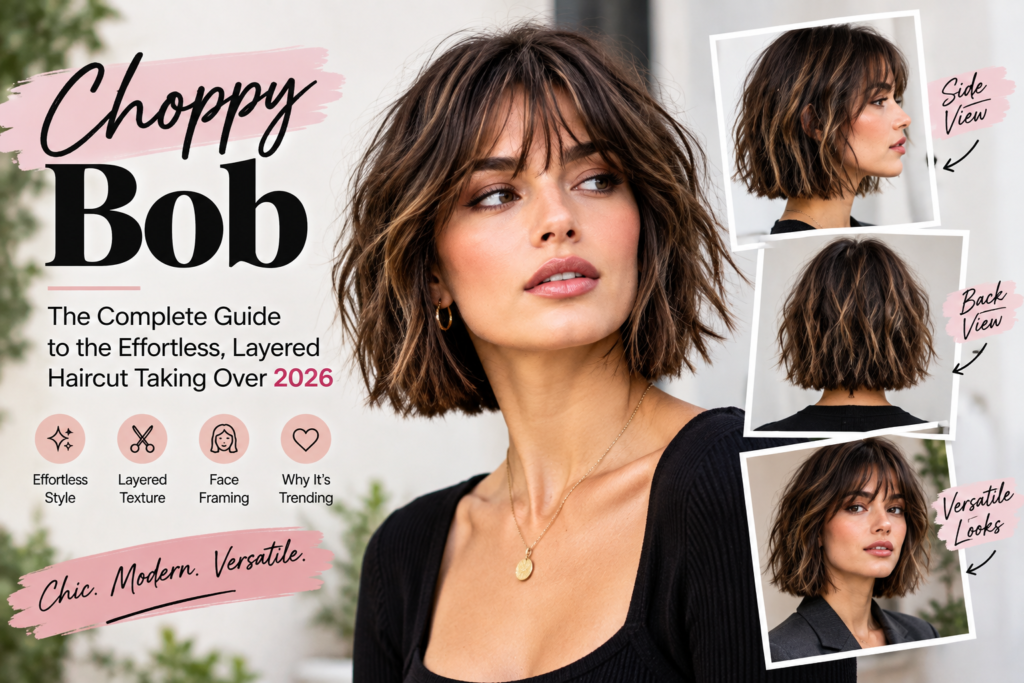
One of the most compelling arguments for the choppy bob is its remarkable adaptability. Hairstylist Fabian Lliguin, co-founder of Rahua haircare, told Harper’s Bazaar that “the beauty of the cut is in its movement; the ends are intentionally varied, creating softness, volume, and a slightly undone quality” . This variability is precisely what makes it suitable for such a wide range of hair types. For fine or thin hair, strategic layering can create the illusion of fullness and density by allowing hair to occupy more visual space. For thicker hair, the same layering removes weight and prevents the cut from becoming a heavy, helmet-like shape .
Face shape considerations are equally flexible with this cut. The choppy bob can be adapted to flatter oval, round, square, and heart-shaped faces through adjustments in length and layering placement . A slightly longer front section can elongate a round face, while shorter, choppier layers around the cheekbones can add width to a narrower face. Schwarzkopf’s styling guide notes that choppy haircuts “add expression to narrow faces and emphasise the contours of round faces” . The key is working with a stylist who understands how to position the layers for your specific features rather than applying a one-size-fits-all approach.
The Critical Role of Cutting Technique in Achieving the Perfect Choppy Bob
The success of a choppy bob lives or dies by the cutting technique employed. This is not a cut that can be executed with a single straight snip. Stylists use a combination of point cutting, razor cutting, and graduated layering to achieve the characteristic texture . Point cutting involves holding the scissors vertically and snipping into the ends of the hair, which creates soft, irregular tips rather than a solid line. Razor cutting, when done correctly, can produce an even more organic, feathered effect by slicing through the hair at an angle.
How to Communicate Your Choppy Bob Vision to Your Stylist
The consultation process is where a choppy bob either comes together or falls apart. Because “choppy” can mean wildly different things to different people, clear communication is essential. Hairstylist Mehria Aziz recommends asking your stylist about “a razor, thinning shears, or point-cutting techniques before the chop,” noting that this ensures “your stylist is familiar with this trend and knows exactly what you are looking for” . Bringing reference photos is strongly advised, as visual examples eliminate ambiguity far more effectively than verbal descriptions alone.
When describing your desired outcome, focus on the qualities you want to achieve rather than just the name of the cut. Phrases like “piecey, undone layers rather than a blunt finish” and “an effortless, lived-in look that can work both straight and wavy” communicate the essence of a choppy bob more precisely . Jennifer Korab, a celebrity hairstylist, recommends asking for “a collarbone-length cut with a lot of texture and movement” and specifically requesting that cutting techniques like point cutting or razor work be used to break up and shatter the ends . This specificity helps your stylist understand not just what you want, but how to achieve it technically.
Styling Your Choppy Bob for Effortless, Undone Texture
The styling philosophy for a choppy bob is fundamentally different from that of a blunt bob. Where a blunt bob rewards precision and smoothness, the choppy bob thrives on imperfection and texture. The goal is to enhance the natural movement of the layers, not to force them into a rigid shape. Lliguin advises starting with towel-dried hair and using your fingers to encourage natural movement as it dries, either air-drying for a softer finish or using a diffuser to enhance texture . Once dry, twisting or pinching small sections between your fingers defines the choppy layers without making them look overly styled.
Texturizing products are essential tools for maximizing the choppy bob’s potential. Mark Hayes identifies texturizing spray as “invaluable for enhancing the cut’s natural movement,” while also suggesting that a root lift spray can create volume for added dimension . For those who prefer a more polished finish, a round brush can be used during blow-drying, but the goal should always be to maintain some element of softness and separation. Sea salt spray is another excellent option, particularly for creating that beachy, lived-in quality that suits this cut perfectly . The cardinal rule, as Lliguin emphasizes, is that “the finished look should have movement and softness—you want the hair to feel touchable rather than stiff” .
Addressing Common Challenges and Problem-Solution Scenarios
Even the most forgiving haircuts come with their own set of challenges, and the choppy bob is no exception. One of the most common complaints from those with fine hair is that too much layering can actually make hair look thinner and more limp rather than fuller . The solution lies in strategic layering—using fewer, more considered layers rather than aggressive chopping throughout. Lliguin explains: “For finer hair, a more strategic approach to layering can create the illusion of fullness and movement” . This might mean adding layers primarily around the face and crown rather than throughout the entire head.
Another frequent issue is the dreaded “triangle head” effect, where the bob widens at the bottom rather than maintaining a balanced silhouette. This typically occurs when layers are cut too short at the crown or when the hair is too thick at the ends. The solution involves removing weight from the interior of the cut rather than just the ends, and ensuring that the stylist understands the importance of maintaining that weighted base at the perimeter . For those with naturally straight hair who want more texture, a curling wand or flat iron can be used to add soft bends through the mid-lengths and ends, creating the illusion of natural choppiness without requiring a texture-enhancing cut .
Choppy Bob Variations and Modern Interpretations
The choppy bob has spawned numerous variations, each offering a distinct take on the core concept. The choppy lob extends the cut to collarbone length, providing more styling flexibility while maintaining the textured, layered quality that defines the style . This version is particularly well-suited to those who want the movement of a choppy bob but aren’t ready to commit to a shorter length. The French bob, meanwhile, pairs choppy layers with a shorter, chin-grazing length and often incorporates a fringe, creating a look that feels both sophisticated and slightly rebellious .
For those seeking an even edgier interpretation, the choppy bixie combines elements of the bob and pixie cut, featuring intense layers and a piecey, grown-out texture that nods to 1990s grunge aesthetics . Celebrity stylist Howard McLaren notes that a softly layered look can be perfected with mousse and shine cream, describing it as “a true carefree style that lasts” . These variations demonstrate the remarkable versatility of the choppy bob concept and its ability to adapt to different lengths, textures, and personal styles while maintaining its core identity as a relaxed, movement-focused cut.
Maintenance and Grow-Out: The Practical Advantages of Choosing Choppy
One of the most underrated benefits of the choppy bob is its maintenance profile. Unlike blunt cuts, which demand precise trims every four to six weeks to maintain their sharp line, the choppy bob has a far more forgiving grow-out period. The layers blend naturally as they lengthen, meaning that even when you’re overdue for a trim, the cut still looks intentional rather than overgrown . This makes it an excellent choice for those who want a stylish cut without the commitment of frequent salon visits.
Raven Hurtado, a hairstylist at Maxine Salon, notes that the choppy lob is particularly good for “someone who is looking for a more playful look with volume and body with minimal styling” . The grow-out process for a choppy bob is similarly low-stress. Because the layers are already irregular, the transition to a longer length feels gradual and natural rather than awkward. Many people find that they can extend their salon visits to eight or even ten weeks without the cut losing its shape. For those considering a first-time chop or looking to transition from a longer style, the choppy bob offers a gentle entry point into shorter hair that doesn’t require the same level of upkeep as more structured alternatives.
Frequently Asked Questions About the Choppy Bob
What is a choppy bob and how is it different from a regular bob?
A choppy bob is a layered haircut with intentionally uneven, textured ends that create movement and volume, whereas a regular or blunt bob features a clean, straight edge with uniform length. The choppy bob uses techniques like point cutting and graduated layering to achieve a softer, more relaxed finish that looks slightly undone by design. This distinction means the choppy bob typically requires less daily styling and has a more forgiving grow-out period than its blunt counterpart.
Can a choppy bob work for fine or thin hair?
Yes, a choppy bob can be an excellent choice for fine hair when the layering is approached strategically. The key is to use layers to create the illusion of fullness and movement rather than thinning the hair further. Fabian Lliguin, hairstylist and co-founder of Rahua, explains that “for finer hair, a more strategic approach to layering can create the illusion of fullness and movement” . Working with a stylist experienced in fine hair is essential to avoid over-layering, which can make thin hair look even more limp.
How should I style a choppy bob on a daily basis?
Daily styling for a choppy bob should prioritize texture and movement over smoothness and precision. Start with towel-dried hair and use your fingers to encourage natural movement, then apply a texturizing spray or sea salt spray to enhance the piecey quality of the layers. Air-drying is often sufficient, but a diffuser can add volume if desired. The goal is to avoid making the hair look too perfect or stiff; the choppy bob is designed to embrace a certain amount of natural, undone texture.
What should I tell my stylist when asking for a choppy bob?
When requesting a choppy bob, be specific about the texture and finish you want. Ask for “piecey, undone layers rather than a blunt finish” and request that cutting techniques like point cutting or razor work be used to break up the ends . Bringing reference photos is strongly recommended, as visual examples communicate your vision more clearly than words alone. It also helps to discuss your hair type and daily styling routine so your stylist can adapt the cut to work with your natural texture and lifestyle.
How often do I need to get a choppy bob trimmed to maintain its shape?
The choppy bob is relatively low-maintenance compared to other short haircuts, typically requiring trims every six to eight weeks to maintain its shape. However, because the layers blend naturally as they grow, the cut remains wearable even when you’re slightly overdue for a trim. Many people find they can extend their appointments to eight or ten weeks without the style losing its essential character. This forgiving grow-out period is one of the practical advantages that makes the choppy bob appealing for those with busy schedules.
Conclusion
The choppy bob represents a refreshing shift in hair aesthetics, moving away from the rigid precision of blunt cuts toward something more organic, textured, and genuinely wearable. Its appeal lies not just in its visual qualities—the movement, the volume, the effortless cool—but in its practical adaptability. Whether you have fine hair that needs a boost of volume, thick hair that benefits from weight removal, or simply want a cut that looks stylish without demanding hours of styling, the choppy bob delivers. The expert consensus is clear: this is a cut that works with your natural texture rather than against it, creating a finish that feels authentic and lived-in .
The final insight worth carrying forward is that the choppy bob, despite its relaxed appearance, is a technically demanding cut that rewards careful communication and skilled execution. The difference between a beautifully textured bob and a shapeless, over-layered mess often comes down to the stylist’s understanding of your specific hair type and face shape. Investing time in the consultation process, bringing reference images, and being clear about the texture you want will pay dividends in the final result. When executed well, the choppy bob becomes more than just a haircut—it becomes a signature, a style that feels uniquely yours and effortlessly modern.